Georges Braque
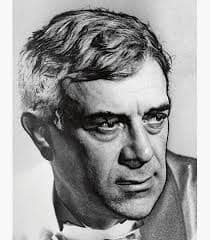
Georges Braque, born in Argenteuil (Seine-et-Oise, now Val-d'Oise) on May 13, 1882, and died in Paris on August 31, 1963, was a French painter, sculptor, and printmaker.
Initially working in the wake of the Fauves, influenced by Henri Matisse, Andre Derain, and Othon Friesz, he arrived, in the summer of 1906, at the landscapes of l'Estaque with cube-shaped houses that Matisse called "cubist," particularly marked in the painting Maisons a l'Estaque. According to Olivier Cena, this simplification is supposed to be at the origin of Cubism, though that remains debated.
By methodically studying Paul Cezanne's contour lines from 1906 onward, Braque gradually developed compositions using slight interruptions in lines, as in Nature morte aux pichets. Then, with a series of nudes such as Nu debout and Le Grand Nu, after 1908 he moved toward a break with classical vision, the fragmentation of volumes, a period commonly called Cubist, lasting from 1911 to 1914. He then used geometric forms mainly for still lifes, introduced stenciled letters into his paintings, and invented pasted-paper works. As a true "thinker" of Cubism, he elaborated laws of perspective and color. In 1912 he also invented paper sculptures, now all lost, of which only one photograph of a counter-relief remains.
Mobilized during the First World War, where he was seriously wounded, the painter abandoned geometric forms for still lifes in which objects are set in recomposed planes. During the following period, up to the 1930s, he produced landscapes and human figures and, despite the variety of subjects, his work shows remarkable coherence. Braque, both precursor and heir to the classical tradition, is the French painter par excellence. Le Cahier de Georges Braque, 1917-1947, published in 1948, sums up his position.
The Second World War inspired his most somber works: Le Chaudron and La Table de cuisine. After peace returned and with the end of his illness, he created deeper works, such as the Ateliers, often developed over several years, pursuing six sketches at once, as Jean Paulhan testifies. His best-known paintings are also his most poetic: the Oiseaux series, two examples of which have adorned the ceiling of the Henri-II room at the Louvre Museum since 1953. He also created sculptures, stained glass windows, and jewelry drawings, but from 1959, affected by cancer, he slowed his pace of work. His last major painting is La Sarcleuse.
Two years before his death, in 1961, a retrospective of his works entitled L'Atelier de Braque was held at the Louvre Museum, making Braque the first painter to be exhibited there during his lifetime.
A discreet man, little inclined toward public relations, Braque was an intellectual passionate about music and poetry, notably a friend of Erik Satie, Rene Char, and Alberto Giacometti. He died on August 31, 1963, in Paris. National funeral honors were organized for him, during which Andre Malraux delivered a speech.
Resources
Dominique Aury on Georges Braque - INA
Georges Braque: Interview with Georges Charbonnier, France Culture
A life, a body of work - Georges Braque
Georges Braque as illustrator, 1962 - INA
Georges Braque composes a greeting card, 1952 - INA
Brassai on Georges Braque, 1960 - INA
Malraux's tribute to Georges Braque, 1963 - INA
Georges Braque - FranceArchives
Exhibitions :
News :
- Nadja, a surrealist itinerary – 2022-04-25
See also, by Jean Paulhan :
- Letters to Marcel Jouhandeau about Braque
- Nine letters to Georges Braque with two responses from the painter
- Painting in God
- Braque le Patron
Bibliography of texts published in the NRF
The texts below, published in La Nouvelle Revue Française, are grouped into four main sets: texts by Georges Braque, notes and columns by the author, texts about the author, and, when available, translations by the author.
Notes by Georges Braque
These texts by Georges Braque may include reading notes, mood notes, performance reviews, miscellaneous pieces, or previously unpublished texts. They appeared in NRF sections such as Chronique des romans, L'air du mois, Le temps comme il passe, etc., or in tribute issues.
- Heureux de témoigner ma vive sympathie à Francis Ponge..., 1956-09-01, Hommage à Francis Ponge
Texts about Georges Braque
These texts may include thematic studies about the author, correspondence, reading notes on works by or about the author, interviews conducted by the author, or works edited by the author.
- Exposition Braque - Picasso (Galerie Paul Rosenberg), by André Lhote, 1930-06-01, Notes : les arts
- Le symbolisme plastique de Georges Braque, by André Lhote, 1937-05-01, Notes : les arts
- Cinq Poésies en hommage à Georges Braque, by René Char, 1959-05-01, Les revues, les journaux
- Braque à n'en pas finir, by Collectifs, Jean Guérin, 1964-01-01, Les revues, les journaux
- Deux expositions Braque, by Renée Boullier, 1967-10-01, Notes : les arts
Chronological distribution of texts published in the NRF (1908-1968)
This chart shows the chronological distribution of texts across the four categories defined above: Texts, Notes, Translations, and Texts about the author.
Textes parus dans les Cahiers de la Pléiade
Les textes qui suivent, publiés dans les Cahiers de la Pléiade, sont regroupés en trois ensembles, les textes de Georges Braque, les textes traduits par l'auteur et les textes dont il est le sujet.
Textes sur Georges Braque
Ces textes peuvent être des études thématiques sur l'auteur, des correspondances, des notes de lecture d'ouvrages de l'auteur ou sur l'auteur, ou d'ouvrages traduits par lui.
- Braque, Auberjonois, Giacometti, par René de Solier, printemps-été 1951 [206 p.]