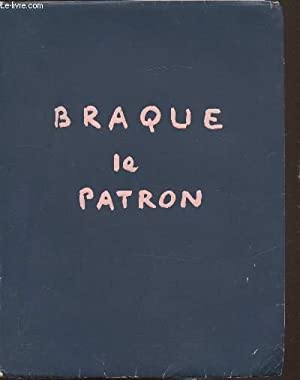
Braque le Patron
Jean PaulhanGeorges Braque“The painter lights his big fires with scrap wood”. (Lie Tseu)
Dedication of Jean Paulhan
_Tisserand wanted to make an encyclopedia so complete that every object in the world would find a place there. “Your encyclopedia is ready-made,” he was told. It is the world itself.
(anon. xviii. s.) Dedication of Jean Paulhan
Tisserand wanted to make an encyclopedia so complete that every object in the world would find a place there. He is told “Your encyclopedia is already made: it is the world itself.”
(Singular facts, 1844)
For Robert, his old Jean Paulhan
“Braque is patient. His face, so humble that he seems to have seen peace. But
the shoulder is of a lumberjack; and the size of a giant. "You have to have time,
he says, to think about it." Indeed, he sits down. Then: "When I was young, I
I never imagined that we could paint without a model. It came to me little by little. Do
a portrait! And a woman in an evening dress, for example. No, I don't have
quite dominating spirit."
He explains: “Portraiture is dangerous. You have to pretend to think about your model. You hurry. You answer before the question is even asked. You have ideas.”
Ideas, for Braque, are not a compliment. When people say of a
painter that he is intelligent, distrust.
Extract :
“I hardly believe in ghosts or specters. But I see clearly that I'm wrong. Because deep down we all believe in it, and it would be more loyal to admit it. A normal man has never completely recognized himself in his portraits. The day we are shown our profile in a set of mirrors, hearing our voice on a record, reading our old love letters, is a bad day for us: and at the moment we rather want to to yell. It is so obvious that we are nonsense, but not that. Accurate photos, faithful portraits can be powerful, subtle, beautiful or ugly. They have one trait that goes far beyond these: it is that they are not not similar. Montaigne was pretty much the opposite of the sadistic rat what the images show us. Leonardo da Vinci didn't really look of a chrysanthemum, nor Goethe of a melon. We must warn now our grandsons that we have nothing in common with the sad images that they will keep from us.
But it is more difficult to know what we are, and the idea physical form that we form. Maybe we see each other secretly skinned? No, it's less bloody. Into skeletons? No, it's less decisive. It’s both elusive and devilishly clear. It's enough precisely what we call a spectrum, and all in all this is familiar, since we have it in mind at all times. This is also okay practical than a snail or a lemon.
A lemon. That's where I was going with this. Because it seems to us, well understood, that the snail or the lemon must be happy with its appearance, if man is not; that's all he deserves, that he just had to not be a snail. But this may not be the case. It is even likely (as soon as we think about it) that the snail, too, never stops protesting (silently) against the shell, stilt eyes and even skin pearly that we see in him. And perhaps one day there will be painters subtle enough – or, who knows, sufficiently informed – to take the away from this inner snail; to treat the horns and shell as they want to be treated.”
Editeur : Gallimard
Notice du catalogue général de la BNF