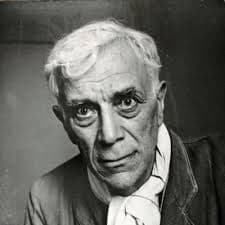
Nine letters to Georges Braque with two responses from the painter
Jean PaulhanGeorges BraqueThe following extracts from letters were published in the exhibition catalog Jean Paulhan through his painters organized by André Berne-Joffroy
*
* *
dated: Thursday 25
This is the beginning of the study, the end will take approximately eight pages.
I would like to call him: Shoot the boss (in the Christian sense of the word. What the Orientals call the guru.)
I try to take things from the lowest, the simplest. The conclusion would be roughly "...if the greatest painter is the one who gives the most accurate but most insistent idea of painting, the most precise, but the most radiant, well, it is Braque that we take as our boss, as our teacher and as our secret law."
...
I would also like to prepare the reader to hear exactly your thoughts.
*
* *
dated: Monday
I don't know who the mystic was (Suso perhaps) who said: the scholar strives to make everything clear, and everything becomes obscure. The mystic agrees to leave a point in the shadows, and everything else immediately lights up and abounds with clarity.
Am I wrong if I think that few painters have, with as full an adhesion as you, accepted, embraced this obscure point - that from there comes the abundance which strikes me and (if I may say so) strange to me to such an extent in your notebooks.
It annoys me to always speak of you as a metaphysician. But what if it were the opposite? If it was the fault of the critics for never having dared to first see in Cézanne or in Van Gogh the metaphysician (or the religious, it's all one)?
*
* *
dated: Wednesday
The fish makes me think for a long time about this mixture of extreme violence and serenity that is yours. I have it close to me, I hardly part with it.
Do you remember these words of Vasari: "Attentive to the principal of art, this painter left to others the pleasure of fantasy, the caprices, the new ideas. In his canvases we find neither houses, nor trees, nor factories. It is in vain that one would look there for certain kindnesses of art, to which he feared to concede his genius."
Naturally, we always want, when we talk about a painter, to start again a bit with Vasari...
*
* *
dated: Friday
Who did I see arriving at La Fortelle the day before yesterday? Pope Serafin. (It was the great priest with the head of Christ who officiated the day Marcelle Braque led us to the Russian church.) He is very friendly, but (in my opinion) too liberal: he kindly explained to me that to convert to Orthodoxy it was enough to prefer God to oneself - the rest being, far from it, fantasy. He is a Russian painter who converted fifteen years ago...
*
* *
dated: Tuesday
The whole theme lies in the title of the last chapter: modern beauty is metaphysical. What do your thoughts on painting lead to, on the one hand; on the other hand, the analysis of these necessary accidents which were cubism, fauvism, papier-collé; finally the observation of the first shock which comes from your paintings. That's five chapters.
...
It was difficult (and indeed absurd) to talk about Van Gogh and Cézanne without alluding to their metaphysics. But I believe that with you the thing has become strictly impossible. (Hence the weakness, it seems to me, of most studies of your work. But I will talk to you about it again.)
*
* *
dated: Friday
Clearly, I'm putting my foot down. Why not say outright, finally, what everyone knows: that we live in a (pictorial) era of giants. And the rest.
*
* *
dated: Tuesday
And if Francis Ponge accompanied us on Saturday, would you be bothered? He would like to write a study or a book about you, and I encourage him to do so. (He is truly a great writer.)
*
* *
dated: 15-VIII-49
The kitchen table has just returned... She seems very happy to be home.
...
I'm sending you a little story
Story of the hermit and the king's daughter
To tempt the hermit, the king's pretty daughter showed him her body, and spoke to him of her jewels and her feasts. But the hermit for his part revealed to him the love of God and the vanity of passions.
Every day the king's daughter found new adventures, but the hermit had more hidden reasons. So that they ended up converting each other, and the hermit left for Memphis, where he died quite quickly of excess. But the princess, of fasts and deprivations.
Who gives his secret, loses it.
*
* *
dated: Sunday May 24, 1953
Here is roughly the theme of the article that I proposed (at his invitation) to Nouveau Femina:
Modern painting is driven by Cubism. It is from him that it derives its reason for being; it is on him that she finds support again if she happens to doubt herself.
Cubism consists of the substitution of an immediate and raw space for the concerted space of the Renaissance and the classics.
This substitution was made possible by the use of a device similar to Brunelleschi's perspective machine, to Dürer's gridded window: glued paper.
Pasted paper, anticipated in 1905 by several young painters, was created on September 13, 1912 by Braque and immediately used by Picasso.
Over the past fifty years, pasted paper has tended to replace drawing in the presentation of the painting. With a sensual and sacred appearance for Braque and his disciples, it is spiritual and playful for Picasso and the Picassoians.
The title would be, I think, “Braque or Cubism”. This is all fair, isn't it? What embarrasses me a little is the role, in the pasted paper, of printing letters. While the role of the tapestry braid, for example, seems very explainable to me: it is about submitting the classical perspective to the new space. But the letter does not carry within it, it seems to me, any combined perspective...
*
* *
First response from Braque, undated
Here are brief answers to your questions. Our conversations will help you, I think, to complete them.
1° In fact, my first so-called cubist concerns were to find a new mode of representation. Classical space was something previously determined.
perspective - for the painter it was a question of bringing everything back to its laws.
For me it is subjecting the object to a mode or a need for representation which created its space.
2° Cubism began with the search for space.
Pasted papers. Integration of color.
Evidence that color and shape do not merge. These are two sensations that act simultaneously.
3° Space towards us until touch...
*
* *
Second response from Braque, dated: June 8, 1953
I have read and reread your letter. What you wrote about perspective seems very relevant to me and will help a lot to put some on the path. However, when it comes to checking, there is confusion. For the designer, this is a very defined thing: it is the means used to enlarge or reduce a drawing. Perspective does not come into play.