Painting in God
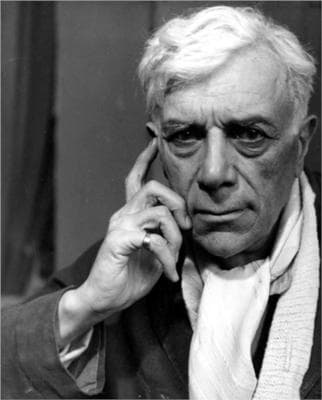
Jean PaulhanGeorges BraqueBraque was not only the inflexible and good friend, the great painter among the great painters, who we now miss. His paintings did not block his view, he had painting before his eyes, and something other than painting.
The Cubists were not painters who drew cubes – or spheres or cylinders. They were the first painters since the Renaissance to neglect cubes, spheres and cylinders in their composition.
Open any perspective treatise, whether Renaissance, classical, romantic. You will first read that the artist who wants to put the woman, the tree or the horse in the right perspective must begin by enclosing them in cubes, the lines of which will serve as guides and models for his drawing. Then will come the colors. Thus the world that you propose to render and interpret is made up of pieces and pieces. But the Cubists overturned the accepted order.
It was on September 15, 1912 that Braque invented the seeing machine, which he had been looking for with Picasso for five years: glued paper, analogous to the perspective machines of Brunelleschi or Dürer. Now all of modern painting comes out of this childish, miserable invention. It is from it that all the art of Juan Gris and Léger comes. It is from her again that Matisse, Klee, Max Ernst or Jean Dubuffet will come to ask for the new impetus, and the justification that they seek.
Childish. So what did the Cubists discover? This is because all it took to make space was a piece of colored paper that was stuck onto another paper. Note that the discovery could have been made at lower cost: the simplest spot of color placed on a white canvas immediately gives the feeling that it is moving forward, while the canvas is moving backwards. But the tapestry braid, which Braque had used that day, bore another proof.
For this braid represented a chain of roses, painted, as is customary, following all the rules of old perspective. Now it was obvious that this old perspective, as soon as it was confronted with the new, did not hold up, collapsed, gave way to a raw space, however strange, however abnormal it was.
Here I will be told that the experience was hazardous. Of course! That she could very well have failed. Certainly! And we see it fail every day, in some distant disciple of Braque. But the fact is that she did not fail that day. Nor in the years that followed, when Braque and Picasso completed the substitution of the rigorous space, the “certainly” space of the Renaissance, with a new hazardous, imprudent expanse that no one would have expected. Painting ran its adventure with them. Such are the rights, such is the approach of genius.
(The best parties are also the most unexpected – and what would it be painting, if it were not a party?)
What were the features, what was the nature of the new space? This is because it happened to be, rather than mathematical, purely sensitive. Instead of drawing preceding color, colors and drawing, material and form went hand in hand, forming only one element without seam or gap. In short, a strictly pictorial space, which we would not even have thought of saying was used for painting. This risky, hazardous space, coming from before reason, was painting itself. And who would not have the feeling, looking at Braque's paintings, that the painter was only content with the essential.
Because Braque is not only the great painter that everyone recognizes. It represents quite exactly a state of our thinking and our life.
Langevin said: “Tensor calculus knows physics better than the physicist himself.” And Braque was able to say: “painting knows paintings better than the painter.” What is this and what do they want us to hear? This, undoubtedly:
The masters of art have always taught us that there is only one way to introduce light into a canvas: it is to start by putting shadows. Thus there is no clear thought that does not have its obscure and mysterious side.
It is to this mystery that believers allude who speak of loving in God, of wanting in God, of acting in God. Braque does not scatter the mystery, he confronts it first and leaves ample room for the dark side. This is where the dazzling, pure clarity of his work comes from, and the simplest thing that can be said about him is that he knows how to paint in God.
It may be useful, to understand the context of the time, to read this response from Jean Paulhan to an article by the critic Guermantes in Le Figaro, about the death of Braque:
Guermantes complains in Le Figaro (23-IX), under this title, that the honors paid to Braque have exceeded due measure. (...)
I fear that Guermantes, a charming society columnist, knows little about the work and life of Braque. Matisse never said "these little cubes...". Braque never painted cubes. He never "imprisoned a large bird in his still lifes" either: he painted birds, and he also painted still lifes, that's all. No, “living creatures” are not absent from his paintings; Does Guermantes therefore ignore the Canéphores, the Goddesses, the “Young Girls on Bicycles”? Paper-collated paper has nothing in common with trompe-l'oeil; trompe l'oeil seeks to give the illusion of reality, paper-paste proves that the painter does not have to worry about reality. Neither Picasso nor Braque ever saw “entertainment” in this papier-collé, but (said Braque) “justification”. It's quite the opposite. So for the rest.