Letter to Joë Bousquet
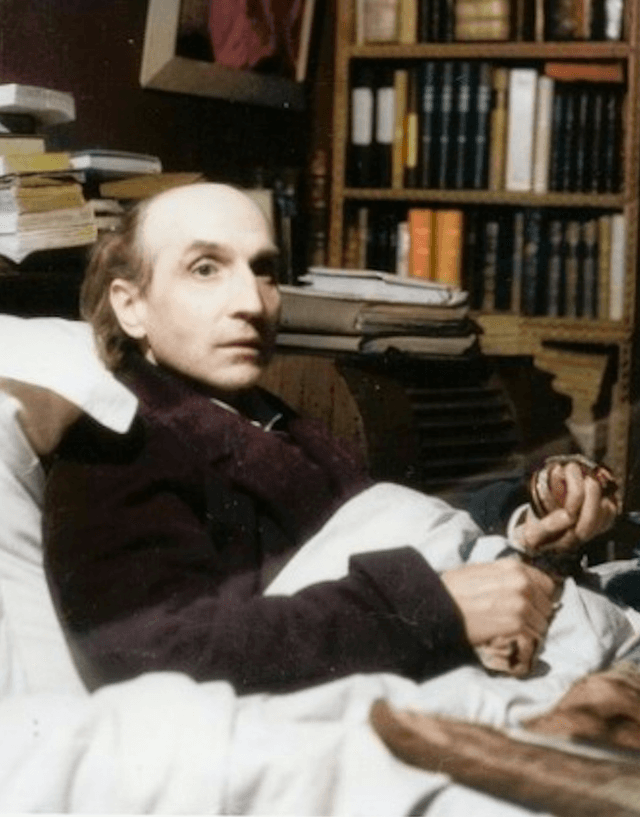
Jean PaulhanAlainJoë BousquetJulien BendaPaul ValéryThe following letter is reproduced in facsimile in the October 1984 issue of the magazine Terriers dedicated to Jean Paulhan. Christian Liger made the following presentation.
This unpublished letter from Jean Paulhan to Joë Bousquet was communicated to us by Claire Paulhan, granddaughter of the writer who is preparing the publication of this correspondence.
_Undated, these three pages are at the crossroads of two moments in Paulhan's linguistic reflection. During the 1930s and 1940s, his reflection led him to a definitive version of Les Fleurs de Tarbes, a work published in 1941 by Gallimard.
_Despite the struggles, the commitments and the dangers of war, Paulhan still pursues the mysteries of language, along other paths, from 40 to 45, to arrive at this article from _ Temps Modernes to which reference is made here: Rhetoric had its password (March 1946).
The studies on Valéry, Benda and Alain will appear respectively in August 46 in La Nef, in June 48 in Critique, and in winter 50 in Les Cahiers de la Pléiade. But they are already under construction in 1946.
The letter published here therefore has the merit of being doubly unifying:
First, because it explains the link between “Terror” and “Rhetoric”.
Secondly, because it treats the four articles on Valéry, Benda, Alain and Rhetoric — which were rightly published consecutively in the complete works — as chapters of the same reflection, and perhaps of the same book never brought to fruition.
The themes of The Gift of Languages then imposed themselves, leading Paulhan to what is, undoubtedly and despite everything, his last word.
Christian Ligier
*
* *
Letter
dated: Sunday
I have so much proof that I am not mistaken that I keep all my courage. But it's a pretty tough pass.
You understand, I attack rhetoric from two sides at once:
a./ by the band. I take the three rhetorical writers of our day, who by chance (as if they had understood each other) seem to have shared the Rhetoric: one (P.V.) taking the side of the false, the other (Benda) of the abstract, the last (Alain) of the banal, and I wonder what their proofs are worth.
Now I find in all three, at a given point, the same (obvious) error, the same essential obscurity - which I must therefore admit plays a role in their demonstrations. Now it is an error whose effect is regular: it makes me doubt the nature of the fact of language considered, whether it is a concerted assembly of words or given crudely - and thereby, depriving me in some way of all certain language, sends me back to a pure thought, without words (since it has just lacked words.)
(Here, perhaps you remember that I arrived with the Terror, on completely different elements, at an analogous discovery: and that the theories of Gourmont, Schwob or Albalat, in themselves indefensible, at least had this common effect of making the commonplace what they thought they were observing that it was: a pure word, which lacked ideas.
But I also attack Rhetoric head-on:)
b./ I observe that rhetoricians have always behaved as if they formed a secret society — as if they had a secret. What secret? I decide to treat Rhéto as a ciphered language — to decipher it.
(This is where I am. To tell the truth, to write further, I would need a good treatise on decryption and a few more rhetorics. I have only brought five or six here. But I have done enough to already know what I am going to find: it is that the effect of the Rhetorics is in some way, on each point studied, to disperse the language - thereby allowing a thought, pure of words—by forcing us to think of any apparently raw, spontaneous sentence, of a block that it must on the contrary be an artificial assemblage, but contrary to any apparent assemblage that it must have been raw, simple, one.
But you can still see where my two investigations come together, and what follows.
Didn't I bore you? I kiss you
Jean