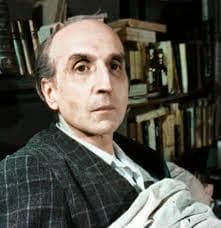
Joë Bousquet
A careful but urgent reflection, but full of impatience and warmth, which has been going on for thirty years, has just come to an end. On what discovery? I will say it as best I can. “Winter bee” seems to have been the name given to it by Joe Bousquet. The two words often recur in his Notebooks, sometimes followed by an image: “At the inn of the moment”; or simply brief, obscure thoughts. He said again: major maxims.
Major; because of this at least Bousquet had no doubt: he had to focus on the essential at all times. He didn't have time to make a mistake. And we didn't think of him as a poet or a writer either - but as the man who, deprived of a body, so to speak, and every day threatened in his thoughts, had to reinvent against all odds a reflection that looked down on this body, and this very thought.
It wasn't about him alone.
Your thought was only yours
Joe Bousquet had not gone long without discovering that his illness was common. Common to all men, certainly, but first of all to writers, who bear the most singular curse these days. Because we can clearly see that they are only read by those who love to read, not by those who love to live - themselves strangely separated, by literature, from the totality of beings, from the world as it is. Now who would suffer from this retrenchment more than an author, whose justification is precisely to say what is, but dishonored from the moment he writes (even if he also highlights the most brilliant qualities) haphazardly, for pleasure, for interest. Here he is deprived, rightly, of this sacred character, which the peoples of old did not refuse him. We must simply hope that the very excess of suffering and shame can force him to make the necessary adjustments - to the discoveries. The man in the street can forget twenty-three hours a day that he is not in the world. For the writer, every moment reminds him and every effort: every new experience. Joe Bousquet proposed nothing less - himself crippled and lying since the bullet of 1918 had broken his spine, the most confined, the least heard of men - than to free all those of his generation.
The evil came from the lowest. Bousquet detected it, almost, in all thought. It was enough for him to recall the days of his injury: on the eve of a battle (he said), a man fears death - and strangely ceases to fear it in the very moment he exposes himself to it, during the fight. Then enters agony, confusedly searches for his fear without finding it and finally realizes that he leaves nothing behind. A curious, frivolous thought which multiplies by a hundred thousand the slightest experience it is given to have, makes of one wounded man all the wounded, of one woman all women, confuses the future and the past and sees the events of the day before in reverse, as if it had foreseen them, finally discovers only the strange resource of balancing one's uncertainty at any moment with an assurance that is all the more flaunted - all the more insolent - as the uncertainty is greater.
This is what we see too much in use. There is no affirmation – the more sharp and firm it is – which does not call for the opposite affirmation. The arguments are worth little: like the bird which has only one wing, they fly in pairs. Every judgment is appealed at the very moment we pronounce it: it could just as easily have been the opposite judgment. In short, the essential trait of each idea is arbitrariness. Perhaps we suspected it. But we must better see that this is an irreducible arbitrariness which deprives us of any ability to judge further. So again, the more science expands, the more it multiplies our points of contact with the uncertain. We only need to learn one thing to stop understanding a hundred. "But you! (Bousquet said to himself), don't you see that we find in your writings neither what you prefer, nor what you forget. Which of your ideas has the same influence over you as love - which is the one which brings together all the forces of your mind -, which is the one which has transformed you? What is stable about all this buzzing of bees? No, they They were all just to enable you to continue. They were only yours.”
Thus the man about to die, who recalls his life in a flash, discovers a monstrous void between what he did and what he thought he was doing. It then seems to him that he deserves, in the name of every man - even more so, every writer - decline and disdain. But he questions himself impatiently, and tries to redeem himself.
You steal the hearts you thought you held
The least that must be said of language is that it clearly presents at first glance the same defects which seemed to us on reflection to be those of thought. It is enough to point out the common people of the reproaches which are commonly addressed to them.
For if it is true that an opinion is only sustained by obscurely supporting itself on the opposite opinion - so that both amount to the same thing, and that the choice we make rather of this one or that one is purely arbitrary - much more so is it the same arbitrariness which from the first contact shocks and revolts us in every aspect of language; or whether it is a question of combinations and rules, of the very construction of a work: why the tragedy in five acts (rather than three)? why the speech in three points (rather than four or twelve)? Or pure and simple grammar: why do we need the subjunctive here, elsewhere the passive or the imperfect? Above all, why impose a subject, a verb, a complement – this frozen mechanism, this whole sad winter – to the thought that I formed so well in a single flash, without all these differences? Push into the vocabulary: why is it the word star which designates the star, the words earth or house which indicate, rather than all others, the house or the earth? Why is the word but which marks the reservation or restriction? Everything happens as if the same arbitrariness of thought was seen, through the effect of language, highlighted, imposed on critical attention.
I say: critical attention. Perhaps it would be more accurate to say that the arbitrariness of language at least, once detected, can hardly be denied (rather than that of the mind by the advantageous appearance it gives itself, by its thousand justifications, by its constant reference to reality, open to a thousand controversies).
It's not that language doesn't also carry its justifications, its real aspect - its advantages. And they are even more striking with him. Certainly, there is hardly a thought that does not expand, barely formed, gives itself as law, and finally covers the entire field of consciousness. Thus words in their own way throw us into who knows what intoxication, take us where we did not want to go, seem at every moment to reveal to us what our thought would have been incapable of reaching on its own. As if simply speaking was a sufficient remedy for our insufficiency. “However (added Bousquet) be careful | In the enchantment that seizes you, you are no longer you. You steal the hearts of those you thought you were holding back.” But a third fault seems, if not more serious, at least more characteristic.
It is due to the very nature of the word. To the fact that it is neither an event nor a thing, but - as soon as we look at it closely (either through some disappointment, or for the sake of analysis) - a simple sign. I mean that it is not sufficient in itself, is only valid as a representative of another object and finally only receives existence (whatever its origins) from the decision by which we assign this or that meaning to it: from the awareness that we take of it. Thus rejecting only ourselves, when we wished to know what is.
From this awareness, should we finally better mark the defect? It is because it wears out, and the word which in its novelty strikes us, quickly becomes banal, and deprived, if not of meaning, of spice, and as if an invitation to this meaning. Thus the reality of an object is only maintained (said Bousquet) through its metamorphoses. The sun must show itself to us like the mirror of roses to remain the sun; columbine, like a curtain of sand...
Yes, such are the vices of language. Besides, they are eye-popping. And no one can deny that they show a terrible gravity: well calculated to disgust any writer from writing - to reject him to himself: to his deep thought, or even (it's all one) to his (one supposes) most raw and spontaneous pre-language thought. Unless...
Approach to puzzles
So what did Bousquet say was strange or difficult? Ah! he warns us:
I am looking for a clarity that changes all words...
and again:
... a poetic ordeal to spoil all the evidence.
But what proof? We first see that it interests — perhaps through poetry — the whole world, spaces and times, days and nights.
During the day, a little shadow flies
Nothing becomes real except to see me love it
This may seem simply “poetic”; worse still, literary. Elsewhere :
I am the dream of my dreams
However, the darkness becomes clearer and takes the form of an oracle:
I saw the ray which does not see the eyes
Fall, to become the hand that holds you
We have to see things the way they look at us.
So do the other major maxims. They are certainly not clear, no. But obscure at least with the same darkness, so equal to itself that it does not seem too difficult to define it, to understand it perhaps. Moreover, more pressing, and as if better assured when it comes to poetry:
That what is sung becomes what sings
The poem does not know the poet
Poetry passes over me like the wind through the leaves of an oak tree.
and this admirable golden verse:
Poetry is the natural language of what we are without knowing it.
I'm not exposing a system, I'm telling a story, I'm trying to provide insight. Here is what I discern:
First of all, if we believe Bousquet, there is perhaps no event in the world that is not capable of seeing the order of its elements and even their nature reversed. Everything becomes its opposite. It is no longer the eye that sees the ray. These are the rays that see (or do not see) the eye. Nor love which chooses its object; but the object that chooses his love. Neither the soul which forms its dreams, but the dreams which form the soul. This is what language is the closest example to us, and which sums up the others quite well; because the raw word can be transformed into spirit; the spirit in word.
Thus literature offers this metamorphosis its chosen terrain, and as its place of evidence. We have just seen it at length. If language is characterized by the same traits and the same illusions as thought, the fact remains that these illusions are seen in it to be magnified and as obvious. So that the writer – man in short – if he wants to escape the errors of his mind and see clearly in the world, must at all times confront his ideas with the words which translate them. Thus he sees himself protected by these against those: this is because he is warned of having to discover in his reflection the same defects that language offers him, in the open if I may say. Having reached this point, must he still say that language expresses thought? If we want. Observe, however, that it would be no less accurate - in any case it is even more effective - to hold that thought expresses language.
However, here is one last point. (Have anyone noticed? Each time I take a step towards pure and banal verisimilitude.) If there is a common feature of expression, it is that the word is not distinct from the thought. But both are one. When I say: “It's nice weather - Hello! - Pierre has broken the ice”, these are not words that I say: they are the very things that I quote, or rather the thing and the word are one. However, this simplicity is broken upon analysis. I cannot observe the most naive sentence without seeing myself forced to separate the words from the ideas. However, unity was desirable: it was the only one capable of putting me on an equal footing with the world. Everything happens as if, in his efforts to find it, Bousquet sometimes saw himself led to go beyond it, sometimes still seeing in the word the sign of the idea, sometimes in the idea the expression of the word.
But Winter Bee says (it seems to me) everything that is difficult to specify. It was because Bousquet had been given the opportunity to be familiar with this state where man knows by sure science, sees by obvious clairvoyance that heat and ice, the joyful hum of thoughts and fixed and frozen words, profusion and mechanism make only one bee.
Now “Winter Bee” was also the name given to Joe Bousquet by one of the young women who came to visit him.
The one who kept her morning face under herd's hair? The one that was smooth and fine like a boarding school bird? The one who seemed to have grown up in the light of the candles? I don't know anything about it. There was also:
The one who didn't know how to cry; the one who taught silence to those who had awakened her; the one that looked like everything we expected, but not like waiting. No. But undoubtedly the December girl, whose dresses make the noise of the sun.
A tale would say it better than me, who clumsily betrays a double secret.
Jean Paulhan, 1950, in Les Cahiers du Sud, July 1, 1950
Bousquet was one of those minds who know how to detect, beyond lessons, habits, the generality of reflection, a secondary evidence, obscure and most often indescribable - but whose very opacity gives the rest its clarity. The ray of sunlight that crosses our room only reveals itself in the grain of dust on which it hits without crossing it. Bousquet was this great shadow which gave meaning and clarity to modern poetry - and first of all to his own.
He said: “Poetry is the natural language of what we are without knowing it.” He also said: “I am looking for a clarity that changes all words. I am looking for a poetic test that spoils all the evidence.”
You only need to open one of his books to know that he had found this test and this kind of clarity. He was ahead of all of us. What am I saying? He is ahead of all of us. Already during his lifetime he had surpassed death. He said: “I enter into my existence as into the memory of another.”
But we are deprived of him. We are, if I may say so, dead to him. We will never again see, between the ten lights of his room, the young face of a radiant alchemist.
Jean Paulhan, 1950, in Complete Works, Tchou
Resources
Joë Bousquet – The witness of the poetic condition (Chaîne Nationale, 1955)
Joë Bousquet or the paradoxical movement
Joë Bousquet at the heart of his century, by Maurice Nadeau
Joë Bousquet resources - André Breton site
News :
See also, by Jean Paulhan :
Mention of Joë Bousquet in a text by Jean Paulhan :
- Jean Paulhan à travers ses peintres (texte) de André Berne-Joffroy
Bibliography of texts published in the NRF
The texts below, published in La Nouvelle Revue Française, are grouped into four main sets: texts by Joë Bousquet, notes and columns by the author, texts about the author, and, when available, translations by the author.
Texts by Joë Bousquet
- Mon frère l'ombre, 1940-03-01
- Traduit du Silence, 1942-01-01
- Lettres à Poisson d'Or, 1966-09-01
- Lettres à Poisson d'Or (Fin), 1967-02-01
Notes by Joë Bousquet
These texts by Joë Bousquet may include reading notes, mood notes, performance reviews, miscellaneous pieces, or previously unpublished texts. They appeared in NRF sections such as Chronique des romans, L'air du mois, Le temps comme il passe, etc., or in tribute issues.
- Simples histoires du Nord, par Hildur Dixelius (Je sers), 1939-04-01, Notes : lettres étrangères
Texts about Joë Bousquet
These texts may include thematic studies about the author, correspondence, reading notes on works by or about the author, interviews conducted by the author, or works edited by the author.
- La Tisane de Sarments, par Joë Bousquet (Denoël et Steele), by Gabriel Bounoure, 1936-10-01, Notes : la poésie
Chronological distribution of texts published in the NRF (1908-1968)
This chart shows the chronological distribution of texts across the four categories defined above: Texts, Notes, Translations, and Texts about the author.
Bibliography of texts published in the journal Commerce
The texts below, published in the journal Commerce, are grouped into two sets: texts by Joë Bousquet and texts translated by the author.
Texts by Joë Bousquet
Bibliography of texts published in the journal Mesures
The texts below, published in the journal Mesures, are grouped into two sets: texts by Joë Bousquet and texts translated by the author.
Texts by Joë Bousquet
Translated texts by Joë Bousquet
- Raymond Lulle, Fragments, 15 octobre 1939 [180 p.]
Bibliography of texts published in Les Cahiers de la Pleiade
The texts below, published in Les Cahiers de la Pleiade, are grouped into three sets: texts by Joë Bousquet, texts translated by the author, and texts about the author.
Texts by Joë Bousquet
Texts about
These texts may include thematic studies about the author, correspondence, reading notes on works by or about the author, or works translated by the author.
- Mort de Joë Bousquet by Marcel Lecomte, hiver 1950-1951 [214 p.]