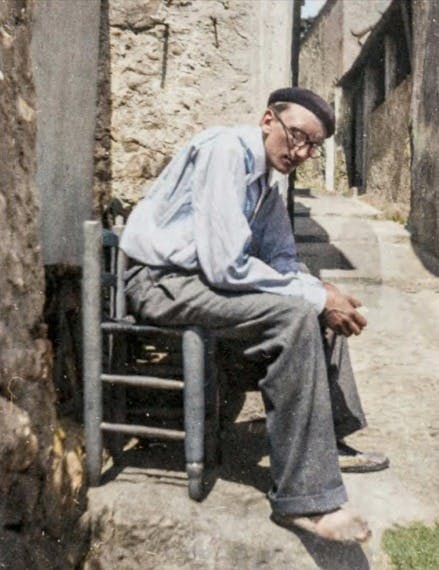
Maurice Blanchot at La NRF: secretary, critic, writer
Christophe BidentPierre Drieu la RochelleJean PaulhanMaurice BlanchotGaston Gallimard
Secretary of the NRF, Blanchot almost became one in 1942, alongside Drieu, in circumstances that are less confusing today. Critical, it was so from the resumption in 1953, at the rate of one column per month, which found decisive readers in almost all fields of literature, art and knowledge. A writer, he regularly contributed a few good pages of the stories which would appear in full in the white collection.
This variation invites a reading that is both formal and chronological. It is nonetheless necessary to look at (this is, it seems to me, decisive) two other periods: the one where Blanchot did not collaborate with The NRF and the one where the NRF did not appear. These reports in absentia shed light on the reports in praesentia and make it possible to draw up a more complete portrait of the relations between Blanchot and the journal.
I will therefore follow five phases:
-
- In the thirties, Blanchot followed the magazine more or less far and sent his first book to Paulhan: Thomas l'obscur was published in the white collection in 1941
-
- The following year, Blanchot accepted, not without reservations, then abandoned the proposal to take charge of the secretariat of the review.
-
- From 1944 to 1953, the review did not appear; but we could say, paradoxically, that Blanchot remains in the presence of a review in absence, in particular because the relations with Paulhan augur the place he will occupy when the NNRF takes over.
-
- From 1953 to 1969, Blanchot's presence in the magazine was strong; However, he moves away from it over time: there are literary reasons and political reasons for this.
-
- From 1969 to 2003, Blanchot only rarely appears in the magazine's summary, for reasons partly linked to the death of Paulhan and the relationship he maintained with the Gallimard house, a mixture of love and disenchantment.
What interests me here is how Blanchot was a secretary, critic and writer at the same time, maintaining essential links between literature, the bosses (Gallimard, Paulhan) and their “house”.
Towards the NRF
Blanchot began publishing in the 1930s. No text from him, however, in
the NRF of that time, and little more from those close to him: we barely note a text from Thierry Maulnier in 1932 and a few notes from Claude Roy in 1939 and 1940. While remaining free from his friendships, starting with that of Emmanuel Levinas, Blanchot remained locked up, at least until 1937, in certain far-right circles which revolved around the Journal debates, Rempart or L’Insurgé.
It was in L'Insurgé that Blanchot published a regular literary column for the first time, from January to September 1937. He violently opposed André Gide in his first article but then published texts favorable to a Gallimard author like Marcel Arland, to writers regularly published by the NRF like Claudel, Drieu and Jouhandeau, and reserved his panegyric for Joseph and his brothers by Thomas Mann, published by the house. With, on the one hand, this literary chronicle of 1937, the way in which critical articles gain in the power of commentary and, on the other hand, the progressive suspension, in the same year, and the cessation, in January 1938, of signing political texts, Blanchot completely changes his relationship to the world, to writing, the relationship of his writing to the world and of the world to his writing. If he does not yet radically reverse his own political positions, the essential part of life is ready to pass to the service of literature. A position like that of the NRF can only suit it: an unconditional love of literature which allows it to publish, according to the formula, “without prejudice from school or party”. The approach of Gallimard, the NRF and Paulhan is ready. The war is coming on this.
The first step most likely came from Blanchot. Blanchot's first letter to Paulhan appears to date from April 23, 1940. It is brief and the tone used is that of a letter writer addressing someone he does not know. It is a letter of approach, the object of which is to deliver the manuscript of Thomas the Obscure. Paulhan's first letter to Blanchot seems to date from May 10, the day of the attacks by the French army in Belgium and the German army in the Ardennes. A letter from Blanchot to Paulhan dated May 27 in any case testifies to an intermediate response from Paulhan. Obviously, the editor read the novel and appreciated its singular truth. This is what he wrote to Claude Roy a few months later: “I believe that this is how it happens, that there is in the mind, as in the eye, this blind spot”. But Paulhan also asked Blanchot for an “analysis” of his novel, to which he balked. It is against a backdrop of future historical disaster that Blanchot begins the letter of May 27:
The tone is set: it will be that of the relations between Blanchot and Paulhan. A mixture of friendship, admiration, recognition and incomprehension, always with political and historical violence in the background. A few days later, at the beginning of June, the last issue of Paulhan's NRF appeared. On the 14th, the Germans entered Paris. On the 15th, the Journal des Débats reappeared, from Clermont-Ferrand. Aux Listens, the other periodical to which Blanchot collaborates, has withdrawn to the same city and on the same street. As of August 17, Laval ends Paul Lévy’s weekly. But Blanchot continues to work for the Débats. In the fall, he renounced all political responsibility. In December, the NRF reappeared, under the direction of Drieu. She has clearly become a collaborationist. In April 1941, Blanchot began a weekly literary column which would last more than three years, in the Journal des Débats. The daily political position will be more and more unconditionally Vichyist. Blanchot's articles, in their vast majority, do not worry about this. Between October 21 and December 2, 1941, Blanchot devoted three columns to Fleurs de Tarbes by Jean Paulhan, a book published on August 29, 1941. It is this book and the reading that Blanchot proposes that will seal friendship and mutual recognition. Perhaps Blanchot had already read, much earlier, passages from Paulhan's book, in the form of the five articles initially published in the NRF between June and October 1936. This is what the first letter, that of April 23, 1940, could suggest. It ends in these terms: “Let me express to you, Sir, the feeling of deep sympathy that I have always had for what you have written and done” (the “always” is perhaps delicately excessive).
The three articles on Les Fleurs de Tarbes appear a few weeks after the publication of Thomas the Obscure. On November 21, 1941, Blanchot wrote to Paulhan:
Paulhan reacted immediately. The next day, he wrote to Monique Saint-Hélier: “Imagine that yesterday I received an article (from the Débats!) or rather three articles on Flowers, which fascinate me, which understand them much better than me, which really reveal them to me.”
Four undated letters, in Blanchot's correspondence with Paulhan, bear witness to an epistolary discussion followed in the margins of the book and articles. In all probability, it was Paulhan who then suggested to Blanchot to bring together the three chronicles to make a booklet: this appeared very quickly, by Corti, in February 1942, under the title How is literature possible?. Blanchot asks Paulhan to reserve “5 or 6 copies” for him.
Paulhan repeats in his letters to the extent to which Blanchot's articles impress him and illuminate, even “reveal” his own theories. Blanchot took the opportunity to found a theory of language where the texts of Paulhan provide the necessary complement to the conceptions of Mallarmé, Valéry and Bataille. We are here, at this degree of contribution and recognition, even revelation between two works in progress, in this intensity of a reflection on the relationships of language and thought that their authors will pursue together for a long time, when, according to a letter from Paulhan to Ponge dated January 29, 1942, the two men meet for the first time.
Secretary?
January 1942. The previous year, Blanchot joined Jeune France and Paulhan founded Les Lettres françaises. But if they really meet for the first time, it is probably to discuss Blanchot's entry into the NRF secretariat.
Much has already been said, and in every sense, about Blanchot's brief collaboration with
the NRF of Drieu. The materials now at our disposal make it quite easy to shed light on the chronology of the case. It would begin in December 1941, right in the middle of the exchanges between Blanchot and Paulhan on language and thought.
On December 22, 1941, Paulhan wrote to Monique Saint-Hélier: “I advised Blanchot, who we took.” Performative and dazzling virtue of the advice: “we”, Drieu, would therefore have immediately hired Blanchot, on the imperial proposal of Paulhan. This would include, according to Paulhan, taking care of the notes: “Blanchot is both
fine and rigorous; I believe that he can give the notes an accuracy that they have not always had. So much to gain for later.” However, Paulhan does not forget his admiration for the writer Blanchot. Three days later, this time he wrote to Roger Caillois and presented him with Thomas the Obscure, this “very beautiful book”, as the only literary revelation since the resumption of the collection. In January 1942, in a more strategic tone this time, he advised Drieu to take a chapter of Aminadab, which Blanchot had just completed, for the review: "What (Blanchot) writes is almost unbearable in 400 pp. and perfectly beautiful in 10 pages. He is the type of writer who imposes himself on the review (it seems to me)." But if Paulhan advises Drieu to take a chapter from Blanchot, is he well established in the magazine? It doesn't seem so. In the same letter, and therefore perhaps only then, Paulhan suggests to Drieu, with two conditionals, to take Blanchot for the notes: “Perhaps we could ask Blanchot to organize the notes part”.
However, Blanchot must follow these exchanges because on January 15, an article favorable to Drieu appeared in Le Journal des Débats, on an exceptional proto-fascist register in the chronicles of these years. The most intense negotiations seem to take place in April, around the names expected to form a new steering committee and a new editorial committee. The following names are put forward: Claudel, Fargue, Gide, Valéry, Montherlant, Mauriac... Some of the nominees reject another, Drieu, in great anger, does not agree with Paulhan... and the project aborts.
There is no doubt that Paulhan wanted to place Blanchot at the NRF. That Blanchot consented to it and that he really worked on it, no more – but for a very short time, and on very specific tasks. He first gets involved in these negotiations regarding the members of the committees. He then prepares the June issue. Léautaud indicates in his diary, on May 18, that Drieu introduced him, on the telephone, to “his secretary, a Mr. Blanchot, a very nice guy,” who had just moved to the magazine. On June 4, Paulhan wrote to Triolet and Aragon that Blanchot had just resigned. On June 9, however, he wrote to Drieu: “Don’t you think that the provisional plan that we are going to try to establish with Blanchot could very well last?” The next day, everything seemed concluded. Paulhan, to the same Drieu: we must “help Maurice Blanchot as best as we can to direct the apolitical magazine that you gave him”. But on June 25, Paulhan wrote to Monique Saint-Hélier: “Blanchot is leaving”.
On April 4, with Xavier de Lignac, Blanchot succeeded in overthrowing the leadership of Jeune France, a cultural association financed by Vichy, where he was in charge of
literature section. New statutes had been submitted to found an “Association for the defense and illustration of artistic values”. But in less than two weeks, with the exceptional powers granted to Laval upon its return to government, this association died before even seeing the light of day. It is ultimately up to
a failure of the same order as Blanchot confronts the NRF.
The negotiations last because that he agrees to make them last. But he knows well that the condition he sets, preserving the magazine from any political influence, is
impossible to satisfy. It is in this sense that the return of Gide and Valéry “could be considered exemplary”, he wrote to Paulhan. The return of Gide and Valéry? Certainly, but also that of Paulhan. “Basically, for me everything depends on the part you would agree to take in the NRF,” Blanchot concluded in the same letter. He said it again to Paulhan in another letter from 1942, a superb declaration of friendship: “It’s because only the thought of being something with you can make me sacrifice
momentarily the desire to be nothing. It is therefore very understood that, if I accept, it is to the extent that the conditions which seem to me to constitute a minimum guarantee also lead you to accept. What harms you, them, immediately dismisses me.” Not to be Chateaubriand or nothing but to be nothing or to be near Paulhan (to be nothing, however, still amounts to marrying a Mallarmean future). Blanchot will publicly express his admiration at the very moment
where the project collapses, according to an article from June 24 in the Journal des Débats,
evoking Paulhan as a “rare spirit and friend of the rare”. And he will return to this link later, not without humor and more prosaically: “I was then linked to Jean Paulhan who advised me”.
“I am therefore starting the June issue,” Blanchot wrote to Paulhan around May 20. He is thinking of a “break number”, with Eluard, Leiris, Limbour, Bataille, Queneau, Arland and Paulhan… “In any case, if Drieu persists in asking me something, I see nothing else to offer him and I do not believe that the greatest concessions would be desirable.” We seem to be going straight into the wall; However, the summary prepared by Blanchot, indicated in a letter to Paulhan, will be approximately that of the June issue. The same letter testifies that Blanchot frequents the Gallimard house, of which he gives news to Paulhan: he mentions a leaky terrace and the rain flowing “into the lower floors where everyone advances in a strange swamp”. Blanchot's collaboration will not go beyond this June issue. This is because any strategy was, from the start, doomed to failure. The depth of Blanchot's convictions is real. He may not yet know who he is, nor certainly who he will become, but he knows who he is not, who he no longer is, who he does not want to be. A 1942 letter to Paulhan is formal. “What I cannot accept is that my presence in the magazine appears as a silent approval of his [Drieu's] political past or even as a profession of indifference. - We give up and everything is said - No, that is not possible and I believe, isn't it? that is your feeling. / So I am not ready to give up with a light heart the NRF has its fate, but I cannot be there either, if being there means in my eyes becoming implicitly in solidarity with what I do not approve of and continuing from the past, without marking in any way that I am not giving up.” The postscript says exactly where Blanchot is with his political thought: “Yes, what you say about fascism, I think it. Fascism which subordinates everything to a particular utility, parental or racial, to the extent that it brings men together in a single visible man, deprives him of that which can alone justify them being together, profound existence itself, that is to say tragedy.”
Writer
It is because the links with Paulhan and the Gallimard house were maintained in the immediate post-war period that Blanchot will be in the first issue of the NNRF in 1953, and in almost all the following ones for many years. Paulhan directs Les Cahiers de la Pléiade and in five or six years Blanchot will give it about a text every two issues: an extract from Très-Haut, critiques on Gracq, Restif or Kafka, an essay on the imagination. The correspondence continues. It indicates the extent to which Blanchot relies on Paulhan's advice when he has just finished a novel or a story that he is preparing to publish with Gallimard. In 1947, he sent him The Death Sentence: "I ask your friendship for advice for this text that I am sending you. I do not know if I will ever follow it up or in what form. As it is, it seems extensive enough to form a small volume. For certain reasons, I hesitate to publish it (not, of course, because the I would be me, but for much more serious reasons). But I would also be tempted to publish it at the same time as The Most High, without being able to judge, from the outside, whether it would be put in a fairer light or, on the contrary, obscured. / In any case, I ask you not to tell anyone about this until a decision has been made. Forgive me, I am only addressing your friendship.” On January 29, 1948, Blanchot sent this time the second version of Thomas the Obscure: "Do you completely condemn this project? In my defense, I can say that I have always thought about it, having always had the desire to see through the thickness of the first book, as one sees through a telescope the very small and very distant image of things, the very small and very distant book which seemed to me the focus. And naturally, the second version makes no judgment on the first, does not dismiss it, nor dismiss it (how the could she?).” It is precisely about the very long delay, two years, that Gallimard will take to publish this second version of Thomas the Obscure that Blanchot becomes irritated by what he takes to be a lack of respect and confidence of the house towards him. In 1951, he published The Eternal Ressassément at Minuit and considered sending his work, using his right of repurchase, to the publisher of the magazine Critique, directed by one of his closest friends, Georges Bataille. But Paulhan takes care of his authors. As early as 1946, he invited Blanchot to dinner and to meet Dubuffet. Blanchot seems close to accepting a portrait of the painter. The correspondences testify to a familiarity which frequently takes a humorous turn. Blanchot wrote from Neuilly on August 22, 1945: “I have just spent several weeks in a clinic for an illness to which the doctors were unable to put a name: poisoning caused by an unknown “chemotactic” phenomenon. I thought it was scarlet fever, but the doctors did not want to. Besides, one does not need to know about an illness to treat it well. I am still feverish and quite weak.” And he adds in postscript: “I was once very close with a bat. It came to visit me every night.” At the end of 1946, and for more than ten years, Blanchot settled in Eze, where he spent a good part of his time. Leprosy existed until the beginning of the twentieth century in this small village in the Alpes-Maritimes, perched above the sea. The brotherhood of white penitents was responsible for providing for the needs of lepers: this is the source of many of Blanchot's mind games. To Gaston Gallimard, in October 1947: “Unfortunately, lepers are rarer there and tourists more numerous than I imagined when I came there.” But already in Paulhan, December 26, 1946: “I am now camping in Eze (rue du Bour-nou, Eze-village – A.M.), with a candle, but I have not yet encountered any lepers and almost no ghosts. Why?” And a few days later, to the same Paulhan: “I have never been able to take much interest in the stories of the C.N.E, let alone take them seriously – to my great regret, moreover. I will be very happy to read a beautiful recent text by Jouhandeau. Yes, really, this stupidity has gone on long enough. Hanging out with lepers, I understand that, and even very well; but decreeing new ones is a bit naive. And then, I see clearly that there are only false lepers.”
Review
Blanchot looked forward to the reappearance of January 1, 1953 as “a very happy event.” This is what he wrote to Paulhan in 1951, hoping that the review would resume “in a sustained manner”. However, it is because of this regularity that the following year, Blanchot hesitated to accept the responsibility of a column. Since the disappearance, and for good reason, of the Journal des Débats, since that, too, of L’Arche, he has published a certain number of critical articles in different newspapers and magazines, not least of which (notably Critique and LesTemps Modernes); never, however, in the form and rhythm of a chronicle. This irregularity and dispersion accompanied a relative public withdrawal and a clear predilection for fictional writing. What he fears is that the column could interrupt essential work. He wrote it again to Paulhan a few years later, in 1956: “criticism sometimes torments me like a wound in the imagination: is this a sign that I should give it up?” However, from the first letter, where he indicates his hesitation, the temptation to return to service is the strongest. “I am certainly very tempted, you know why.” It is November 6, 1952. In a few days or weeks, Paulhan pushes the advantage of this “knowledge” and Blanchot, in an undated letter from the end of the year, accepts.
I think that most often the pages that I will endeavor to send you will go through a work, but for them to be “dedicated” to it, I believe that this is a tendency that should rather be avoided. Perhaps we are at a moment where the works are not very real, but where what seeks to assert itself behind what is written has an importance that we should not tire of questioning. It is naturally tempting to rely on a work, to highlight it, to follow it; that makes things easier, and with this ease, I will certainly not always defend myself. But I would not like to lose sight of the different approach that is yours, which does not stop at books, but sheds light on them by going to the most essential.
Because it was him, because it was me... once again, Blanchot is ready to commit to the review because he is ready to commit to Paulhan: “it is with only one that I can collaborate without discomfort or misunderstanding,” he specifies in the same letter. It would be in the name of a common conception of literature, of what each book seeks in this name beyond itself, its own reality and its own imperfections, that Blanchot could engage here with complete confidence. This conception, however, is not entirely shared by Paulhan. And it is precisely because these conceptions of literature differ that their collaboration, despite the friendship that presides over it and the effects that it will produce (128 episodes of a chronicle which will remain as the most important of Blanchot and perhaps also of the NRF post-war), will not go, to return Blanchot's expression, “without discomfort or misunderstanding”. The two letters from 1952 already say everything: everything about agreement and friendship, everything about discomfort and misunderstanding. Blanchot warned: it will be less about talking about books than about literature. For him, who tried his hand at chronicling in L’Insurgé, who gradually transformed it into a tool of thought in Le Journal des Débats, who initiated a long-term approach in L’Arche, the chronicle of the NRF will be an opportunity to forge a conception of literature, one or more, or one in movement, which will double its search as a writer and find several stations in the essays which, one after the other, will bring together most of the published articles. Blanchot's articles, at least initially, are not particularly difficult – provided you read them from this perspective. If we try to read them for critics who would stop at the books they talk about, then we may have difficulty understanding them, and this is how Gaston Gallimard may find them “incomprehensible”, wanting to delete them from the first year. This is obviously not Paulhan's judgment, even if he is not inclined to follow Blanchot's sometimes excessive rhetoric, as evidenced by a draft of an undated letter, probably from the early 1950s: “as to knowing if one commits suicide because one believes oneself already dead, admit that your explanation is a little far-fetched”. In a letter to Caillois in 1957, Paulhan presented Blanchot as the best critic of the magazine, “so admirable when he speaks of writers he does not like, or likes little”… That is where the real question begins. However, Blanchot also warned of this. From 1947, at the time of collaboration for Les Cahiersde la Pléiade, he wrote to Paulhan: “I have just made this discovery: it is that I am interested in ever fewer questions (and works).” We only have to list the names of the authors Blanchot speaks of to see that in fact, from his collaboration with L'Arche, he increasingly reduced the scope of his research. There will certainly remain notable exceptions, such as this 1959 text on “the good use of science fiction”. But what Blanchot likes in the NRF is the desire for austerity, probably because it supports his own. However, as early as November 1953, he expressed a first doubt: “I wonder if the spirit of research – which does not mean the spirit of seriousness – was not more perceptible in the Cahiers de la Pléiade than in the NRF: do you also have this impression?”. And in January 1959, he was even more worried: “I am a little concerned about the transformation of the NRF, if it is done from the outside and perhaps at the request of the outside. Austerity was until now the mark of its magnificence; losing it, will it not become poorer while appearing to get richer? I fear that changing in this visible way will distance her from this invisible change to which she was traditionally destined.” Finally, Blanchot probably thinks that the major developments in literature are now happening elsewhere. The balance he tends to maintain between Barthes and Paulhan shows the discomfort he feels for two authors who embody two ways and two eras of thought that he values but with which he cannot feel completely in agreement: neither with one nor the other. Let us remember: Barthes had judged the “reactionary” NRF. However, if the misunderstanding between Blanchot and Paulhan is going to become uneasy, it is, more and more clearly, for political reasons. In 1958, the return of de Gaulle definitively clarified the dispute: no gray area, no reserve, no secrecy is now possible, especially since the two writers speak publicly on the question. We can now cross the only two letters from Paulhan to Blanchot published so far, from June 1959, with the letters from Blanchot to Paulhan from the same period (and especially the letters from 1958). From the start, Blanchot felt the need to explain himself: "The need to refuse made itself heard in me with a force that I thought had been dormant since the dark years. But I am not unaware that refusal separates us from what is closest to us and above all from ourselves." Friendship is therefore preserved and will allow dialogue. However, the misunderstanding is reinforced: this dialogue remains tied up in references to the war (the “dark years”), and limited to the question of the providential man – recalling the postscript of the 1942 letter on fascism. And the visions of Blanchot and Paulhan on how to relate the past to the present differ.
Paulhan criticizes Blanchot for professing extreme radicalism. Blanchot criticizes Paulhan for breaking with the apoliticism proclaimed in the first issue of the review. He thus asks Paulhan to publish a few lines following his September column: “It would be very painful for me to appear to associate myself with approval of the current regime.” These few lines actually appear, in PS, in the September article, aptly named “Crossing the Limit”: “I read, in the latest issue of the N.R.F., the current comments on page 348. I cannot agree with them. In my opinion, it is despair of this people and this country to have no other hope than an episodic man.”
These disagreements will become more pronounced. In 1960, when Blanchot participated actively and decisively in the writing of the “Declaration on the right to insubordination in the Algerian war”, Paulhan signed the “Manifesto of French intellectuals for resistance to abandonment”, favorable to French Algeria. The political question is decisive. It puts an end to any procrastination on the part of Blanchot regarding the necessity of the literary chronicle. Already in 1956, he had expressed serious doubts on several occasions, for example: “I sometimes think that these columns are an error both for the magazine and for me”, not without having to add: “this work gives me almost my only regular resources”. But in an undated postcard, probably between 1959 and 1961, Blanchot thanks Paulhan for consenting to a bimonthly column: “I would be very happy with this rhythm, if you allow me to do so”. Blanchot's withdrawal from the NRF will be gradual: after having provided a monthly column for more than six years, then bimonthly for almost six more years, he will only give four articles in 1965, two in 1966, four in 1967 and one in 1968. The only article from 1969 is the tribute to Paulhan, who died the previous October. This impact of politics on literature will also contaminate relations with Gaston Gallimard. We know that Blanchot and a few others, authors and in-house employees like Antelme, Mascolo and Des Forêts, attempted at the beginning of the 1960s to launch an international magazine. The Gallimard archives preserve this letter of September 13, 1962 by which Gaston refuses to Blanchot the publication of this review by his publishing house: "I maintain that your independence must be total. But you must recognize for your part that I owe accounts to the Company of which I am a director. If I am driven by the sympathy that I have for you and your associates, I do not have the right to neglect the companies of the N.R.F. which, although you seemed to believe it, does not want to be satisfied with “brilliant facilities”, but intends to maintain the role that it has assigned itself in the past by continuing it also in the future. “Besides the political dimension, the letter conceals a financial question: and money will regularly be a source of annoyance between Blanchot and the house. The most intense episode, probably, took place in 1955, when Gallimard pillaged a large number of unsold copies of certain Blanchot books, for storage reasons... On April 19, 1955, Blanchot wrote to Gaston Gallimard:
With regard to Gallimard and the NRF, Blanchot never ceased to mix the demand for loyalty and the demand for remuneration, the image of the publisher and the reality of its infrastructure, dedication to the literary cause and disengagement from political ties.
Epilogue
Blanchot remained, in his own way, inconsolable about Paulhan's death. In the opening page of the tribute paid to Paulhan, we feel the regret of not having been able to accompany his friend: because in the spring of 68, “what happened did not allow me to learn that Jean Paulhan was beginning to move away”. It should also be noted that it is precisely in this article written as a tribute that we find the first developments of Blanchot's next book, Le Pas au Beyond: Paulhan's work will have inspired Blanchot to the end. Until the end: in Blanchot's last published story, L'Instant de ma mort, the name of Paulhan is, with that of Malraux, one of only two names of writers mentioned. He appears there as the one who helps Blanchot to search for the manuscript stolen during the search in the summer of 1944 in the Quain family home: “searches which could only remain in vain”, specifies Blanchot. It should also be noted that Paulhan is one of those to whom Blanchot immediately related the events, and in a tragicomic way. On July 5, six days after the events, Blanchot wrote to Paulhan:
The version of the facts is very significantly different from that found in other letters and from that reported in the 1994 account. A few weeks later, on July 26, Blanchot spoke again about his manuscripts to Paulhan who, visibly, in the meantime, was worried about it: “I gave up my messages. As the search is pillage, it is denied by those who carry it out. It also seems to me that demanding something is to recognize the authority or the moral existence of the one
who we address.” Finally, on August 10: “My messages are definitely lost.”
Life with Paulhan is life with manuscripts. Whatever the variations in Paulhan's judgments, on the whole he always supported Blanchot. It could not be otherwise that new tensions appeared between Blanchot and the Gallimard house after his death. According to a letter from Robert Gallimard dated November 30, 1970, Blanchot spoke about L'Amitié to Kostas Axelos. Robert Gallimard insisted that the book remain in the house. But, or and, it is also the time when the publication of Complete Works was first considered, with the same Robert Gallimard. Most of Blanchot's books published by Gallimard are then out of print. Robert Gallimard proposes to reissue them all, either in several sets, or one by one. If he agrees to consider the first solution, sketching a table showing all his books, grouped into five volumes in an almost exclusively chronological order, Blanchot prefers the second solution: “As for the “stories” and, more particularly, some of them, my feeling is the following: it is as if they were fragile monads falling next to each other according to a parallelism that is itself fragile, parallelism that their meeting in the same volume risks transforming into a convergence which would change its meaning. ”In November 1972, Blanchot offered his services to Claude Gallimard. Due to what he considers a “decline” of the “Les Essais” collection, he offers to take over its direction. Can we, however, speak of the “withering away” of a collection which has just published
Arendt, Paz or Baudrillard? Blanchot recalls on this occasion “the long-standing attachment that binds me to the house (more than thirty years of collaboration), the fact that I gave it almost exclusively preference for the edition of my works (…)”. Ultimately, this is always where the problem lies: Blanchot may have felt unloved by a house that he preferred to any other, despite literary and political differences, and to which he would have given almost everything. A story of thwarted love...