Pierre Drieu la Rochelle
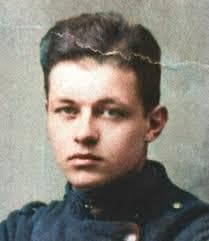
Pierre Eugène Drieu la Rochelle, born January 3, 1893 in the 10th arrondissement of Paris and died by suicide on March 15, 1945 in the 17th arrondissement of Paris, is a French writer.
Brief apology for Drieu
I am not defending suicide. He's a criminal if ever there was one. He is even the criminal of a particularly serious and vast crime. For the murderer certainly wrongs his victim, and the thief his stolen. But suicide offends us all. He withdraws from us, he withdraws from us. He no longer wants to have anything in common. When he died by suicide, it seems to me that all his friends (and his strangers and his indifferents, and why not the animals and the flowers) surround him and say: “So, we weren't necessary to you? What did we do to you?” What had we done in Drieu? Or better, what had France done to him? These are political questions, about which I hear nothing. However, his death agitates them. Yet Drieu thought that these are questions that each of us can deal with directly, without much concern for method. And I only try here to follow him, and see first through his eyes.
The madhouse
France between the wars, what a madhouse! I no longer know who was talking, in nineteen, about the ball of victory. (Calling victory a ball was already a bit strong.) In any case, the ball was not heavy to drag around.
Drieu hardly stopped feeling this - shouting it - to the point of anguish. Yes, the French people from twenty to forty were indeed such as he judged them to be — such as he happened to judge himself: without children, without leaders, without referees. Indefinitely divided, but proud of their divisions. Disdainful of their army, but aggressive: offered to any invader. Incapable of building anything: leaving the wretched to their misery, but the exploiters to their exploits. Above all, and even among the elite — and first among the elite! — deprived of civic-mindedness. Who prided themselves on paying a little more taxes than their neighbor? Who was avoiding receiving the pension due to them? (I seem to be joking, that's the height of it.) Who was doing the State a favor?
And yet this France (of whom Drieu spoke as of a goddess; at least, of a woman who would have held him in her confidence), this France was surrounded by enemies - an enemy, what an urgent invitation to stick together, to stand together...! From enemies who watched her closely — ... to behave well, to appear irreproachable. From enemies who developed in them courage, self-sacrifice, rigor, all the civic virtues — ... to be powerful and devoted. Enemies so numerous, so well equipped, so rich in industry that one could wonder in advance whether resistance would even be possible.
Actually, maybe that's why.
If France had done it on purpose
Well, I imagine that the French between the wars found themselves as courageous, patriotic, methodical, as Drieu sees them as inert and cowardly. Let them have honest ministers and intelligent generals. That they closed brothels and bars. That they provided themselves with the latest model planes and armored vehicles. That they only cared about serving. Even more, to call every French person to serve: to make our workers, not the most deprived, the most honored workers of Europe; and from each peasant, an owner. In short, to honor the man. What would remain of France today?
I think the answer should be: nothing. Or as little as nothing. We were not strong. Against a Germany hellbent on its revenge, strong in 40% of Russian aid, we were one to ten, ready to bleed dry. At best, the best French people would have been killed, 40 to 44, while waiting for American aid, on a stabilized front.
I'm only stating the obvious, which is obvious. This evidence, is it going too far to say that the French also may have suspected it; that they are after all no more stupid than others - no more stupid than me? That they more or less clearly did what was necessary to ensure that an inevitable catastrophe happened as little as possible. That they felt that our salvation could one day lie in the flight of soldiers, the resignation of generals, the unconsciousness of ministers. In short, they played up the vices they didn't have.
We can see that they didn't do so badly. But I have another proof, which I will say later.
The deceived man
Am I going too far? Do I attribute to the French more calculations and cunning than a people can have? So, this is an error that I share with all historians. Of course, France is no more a woman than Germany is an eagle or England a lion. However, whoever thinks of the conditions of any order implied by the very existence of a nation - the united territories, the freely recognized leaders, the repressed foreigners, the obedience and the abnegation - does not avoid taking this nation for a person. Better, follows her and knows her all the more faithfully because he attributes to her a simple will.
Drieu hardly stopped thinking about France. It happened that it was embarrassing. “He speaks to me as if I were French,” said a surrealist. At that time, Drieu had Aragon as an inseparable friend. Yet: “He distrusts me,” he would sometimes say. And again: “They take me for a town sergeant.”
He was, I think, very handsome. The very negligence which bent this great body seemed a form of his frankness.
It's curious that a man so loved, so sought after, should nevertheless have the impression that people loved him badly. “I would have lived in terror of being deceived,” he wrote. And to specify: “... deceived, the day when my prestige ceased, when I had given everything I can give.”
In fact, he had given his nation a lot of care, a lot of love. Besides, hero of 14...
Where was I? To this: my final proof is that the France of the Occupation was able to find, in the maquis of the mountains and the city, as soon as it was necessary, so many forgotten virtues: courage and silence, the joy of obeying, forgetting oneself, civic-mindedness. But Drieu didn't notice it.
Of the reasons that Drieu gives for his suicide – however direct, however pressing the story may be – no, I am not fooled for a second. Of course, death tempted him more than once. (Like all of us.) He put himself in the tomb in advance; he marveled at the power each man has to suppress himself. (Every man, and all humanity.) He confused the old age of the soul and the old age of the body. (Here, the confusion is already so gross that I wonder if he is not cheating. I am surely wrong.) But I prefer my reason: it is that he decided to leave us, the day he knew that France had not informed him - had not kept him in her confidence, had very precisely deceived him.
Jean Paulhan, 1945, in Complete Works, Tchou
Resources
Pierre Drieu la Rochelle recounts his trip to Weimar
Pierre Drieu la Rochelle: Fascinating author or cursed writer?
Intellectuals and Collaboration - Apostrophes
Drieu or the need for absolute admiration - Le Figaro
Drieu la Rochelle resources — Mélusine site
Works available on Gallica
- The Man on Horseback, Paris, Gallimard, 1943.
- The Young European, Paris, Gallimard, 1927.
- Diary of a Deceived Man, Paris, Gallimard, 1934.
- Fascist socialism, Paris, Gallimard, 1934.
Correspondance : Pierre Drieu la Rochelle & Jean Paulhan, 1925-1944
Bibliography of texts published in the NRF
The texts below, published in La Nouvelle Revue Française, are grouped into four main sets: texts by Pierre Drieu la Rochelle, notes and columns by the author, texts about the author, and, when available, translations by the author.
Texts by Pierre Drieu la Rochelle
- Poèmes, 1919-07-01
- Le dernier Capitaliste, 1919-10-01
- Nouvelle Patrie, 1920-04-01
- Le retour du soldat, 1920-08-01
- La Valise vide, 1923-08-01
- Chronique des spectacles, 1923-11-01
- Chronique des spectacles, 1924-01-01
- Sacha Guitry, 1924-02-01
- Encore le cirque et le music-hall, 1924-03-01
- Le Pique-nique, 1924-10-01
- La véritable erreur des Surréalistes, 1925-08-01
- L'Aumône, 1925-11-01
- Lindbergh et ma vie, 1928-05-01
- À propos d'un roman anglais, 1930-11-01
- Malraux, l'homme nouveau, 1930-12-01
- Le Voyage des Dardanelles (I), 1933-09-01
- Le Voyage des Dardanelles (Fin), 1933-10-01
- Mesure de l'Allemagne, 1934-03-01
- L'homme mûr et le jeune homme, 1935-02-01
- L'agent double, 1935-07-01
- Rêveuse Bourgeoisie, 1936-12-01
- Rêveuse Bourgeoisie (II), 1937-01-01
- Rêveuse Bourgeoisie (Fin), 1937-02-01
- La Duchesse de Friedland, 1938-07-01
- Avant-propos, 1940-12-01
- Repères, 1941-01-01
- Esquisse, 1942-05-01
- Récit secret, 1953-09-01
- Mémoires de Dirk Raspe, 1966-01-01
- Mémoires de Dirk Raspe (II), 1966-02-01
- Mémoires de Dirk Raspe (Fin), 1966-03-01
Notes by Pierre Drieu la Rochelle
These texts by Pierre Drieu la Rochelle may include reading notes, mood notes, performance reviews, miscellaneous pieces, or previously unpublished texts. They appeared in NRF sections such as Chronique des romans, L'air du mois, Le temps comme il passe, etc., or in tribute issues.
- Paul Adam, 1920-04-01, Notes
- Vauban, par Daniel Halévy (Cahiers Verts, Bernard Grasset), 1923-10-01, Notes : littérature générale
- Chronique des spectacles, 1923-12-01, Notes : littérature générale
- Nouvel Empire, par Fritz von Unruh (Simon Kra), 1925-11-01, Notes : letttres étrangères
- À propos d'À l'Ouest rien de nouveau, 1929-01-11, Correspondance
- Chacun pour soi, par Constance Colline (Plon), 1933-01-01, Notes : le roman
- Une semaine à Berlin, 1934-02-01, L'air du mois
- Air de février 34, 1934-03-01, L'air du mois
- Guerre et révolution, 1934-05-01, L'air du mois
- Essai sur la misère humaine, par Brice Parain (Grasset), 1934-06-01, Notes : les essais
- Anniversaire, 1935-02-01, L'air du mois
- Ce qui meurt en Espagne, 1936-11-01, L'air du mois
- Présentation de Swift, par A. M. Petitjean (N. R. F.), 1939-11-01, Notes : lettres étrangères
- Maurras ou Genève, 1940-02-01, Chroniques
- Ma vie sans moi, par Armand Robin (Éditions de la N. R. F.), 1940-12-01, Notes : poésie
- Le corps, 1941-02-01, Chroniques
- Un homme, une femme, 1941-05-01, Chroniques
- À certains, 1941-08-01, Chroniques
- Chardonne, 1941-12-01, Chroniques
- Entre l'hiver et le printemps, 1942-04-01, Chroniques
- Notes vraiment peu politiques, 1942-08-01, Chroniques
- Audiberti, 1942-09-01, Chroniques
- Pierre Emmanuel, 1942-10-01, Chroniques] La poésie en 1942 A. ROLLAND DE RENÉVILLE
Texts about Pierre Drieu la Rochelle
These texts may include thematic studies about the author, correspondence, reading notes on works by or about the author, interviews conducted by the author, or works edited by the author.
- État-Civil, par Pierre Drieu la Rochelle (Éditions de la Nouvelle Revue Française), by Marcel Arland, 1922-04-01, Notes : le roman
- Mesure de la France, par Pierre Drieu la Rochelle (Les Cahiers verts), by Jean Schlumberger, 1923-02-01, Notes : littérature générale
- Une lettre à Pierre Drieu la Rochelle, by Louis Aragon, 1925-09-01, Correspondance
- La Suite dans les Idées, par Pierre Drieu la Rochelle (Au Sans Pareil), by Benjamin Crémieux, 1927-11-01, Notes : littérature générale
- Une femme à sa fenêtre, par Drieu la Rochelle (Éditions de la N. R. F.), by Ramon Fernandez, 1930-05-01, Notes : le roman
- Drôle de voyage, par Pierre Drieu la Rochelle, by Marcel Arland, 1933-06-01, Chronique des romans
- Le Chef, de Pierrre Drieu la Rochelle (Théâtre des Mathurins), by Denis Meriel, 1934-12-01, Notes : le théâtre
- Socialisme fasciste, par Pierre Drieu la Rochelle (Éditions de la N. R. F.), by Julien Benda, 1935-02-01, Notes : les essais
- À propos de Rêveuse Bourgeoisie, par Pierre Drieu la Rochelle, by Marcel Arland, 1937-04-01, Chronique des romans
- Gilles, par Pierre Drieu la Rochelle (Éditions de la N. R. F.), by Marcel Arland, 1940-03-01, Notes : le roman
- Une conversation avec Drieu la Rochelle, by Jean Grenier, 1953-09-01, articles
- Drieu la Rochelle, by Marcel Arland, 1953-12-02, Chroniques : la littérature
- Drieu la Rochelle (II), by Marcel Arland, 1954-01-01, Chroniques : la littérature
- Drieu la Rochelle (III), by Marcel Arland, 1954-02-01, Chroniques : la littérature
- Récit secret, par Pierre Drieu la Rochelle (Gallimard), by Michel Deguy, 1961-10-01, Notes : littérature et essais
- Histoires déplaisantes, par Pierre Drieu la Rochelle (Gallimard), by Willy de Spens, 1963-09-01, Notes : le roman
- Drieu la Rochelle écrit sa dernière œuvre, by Pierre Andreu, 1966-01-01, articles
Chronological distribution of texts published in the NRF (1908-1968)
This chart shows the chronological distribution of texts across the four categories defined above: Texts, Notes, Translations, and Texts about the author.