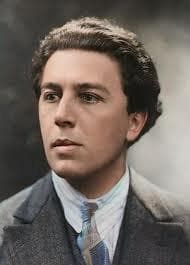
André Breton
Tribute
To those who apply themselves less to brushing aside the reasons, pretexts and differences proposed to us all by the proponents of an inconsistent and very precisely perverted world, than to pushing them to the limit, to pressing them with a rigorous doubt, to questioning them tirelessly about their sources and their proofs and as if to make them drunk on themselves, it appears more or less quickly that the illusions patiently denounced and the laws finally discovered remain probable, and if we want to hold up only at the cost of a transmutation of their elements, unthinkable if not unspeakable, and such that he cannot penetrate - he detects it, at the moment of unsustainable evidence - into the domain promised to him by who knows what assurance, only on the condition of being in all circumstances capable of exchanging the word for the idea (or the idea for the word), the matter for the mind, up for down, left for right.
He does not, however, reject his previous inventions: he simply weighs and gauges them. He leaves for a moment. He tries to add this element of secrecy to each of them. Now it is here that he meets André Breton, firmly stationed on this square, and master of this moment. He admires that a man can immediately assume what he hardly dared to expect from great patience and exhaustion. He shyly observes this crystal at the center of the storm, this transparency at the intersection of the black rays. He sees the hand rise up, which is still smoking a little, like a poorly extinguished branch, and with the back of his fingers, sweeps away...
Jean Paulhan, 1950, in Complete Works.
A hero of the Western world
I do not see any praise that fashionable doctrines do not deserve. From their point of view of course. They are subtle and vast. They only advance cautiously in a thousand small steps. They complement each other. Sartre gave a guilty conscience to more than one satisfied bourgeois, but Freud cured more than one anxious bourgeois of his guilty conscience. Marx created empires (in which he would have difficulty recognizing himself). But Einstein found a way to rid us of empires, and at the same time the continents that support them. Advances in child medicine mean we have a few million extra children each year; but the progress of atomic science promises us in a short time the elimination of the same children, as soon as they reach adulthood. Moreover, these doctrines are modest, and which, far from knowing them, only aspire to change the world and eliminate themselves at the same time. Who would still think of reading Marx in a classless society, Freud in a world free of complexes, Einstein in a universe reduced to a few wandering citizens? Alongside such merits, the doctrines in question nevertheless offer a singular defect.
They are disappointing: they explain everything, and nothing seems worth explaining anymore. Each event becomes clear, and it is mysterious, it is truly incomprehensible - I quote Einstein - for each event to be clear: it is as if we had done it on purpose. Besides, however well arranged they are, their worlds hardly resemble ours. There we find neither the emotions of a first love (and even a second, or a third) nor the terrors of the night. They don't make you want to plant a tree or roll around in the grass. To tell the truth, there is nothing worth living for.
Where does hope go? Ah! certainly not on the side of societies of thought, nor even of established religions — too established, and moreover doubting themselves, too anxious to keep up with the times. However (we say to ourselves), all it takes is one man, one gesture, one look. From a voice: I thought for a long time that it could be that of Breton. Saint Augustine says somewhere that it is given to poor people like us to pronounce, without having anticipated it, sentences capable of making us equal to God, truly divine sentences. It would be, why not:
I would agree to fulfill the right that I had given myself once and for all to express no ideas other than my own.
Or
my refusal to go through what almost everyone else goes through, whether they are in one camp or the other...
For Saint Augustine, it is a matter of using words in any case, not only before they resonate, but even before the soul forms the slightest idea of their sound. André Breton says again:
The centuries of snowballs only collect the small steps of men as they roll.
(where it would be very wrong to see an “image”. Besides, what image?) And:
Dada gives himself to nothing, neither to love nor to work. It is unacceptable for a man to leave a trace of his passage on earth.
As close as possible:
His eyes (I never knew how to tell the color of the eyes: these for me only remained light eyes), to make me understand, were those that we never see again.
And again:
It's enough, for now, that such a pretty shadow dances at the edge of the window, through which I will start to throw myself again every day.
I am not saying that the rather mysterious influence of these sentences can be analyzed. No, it's the opposite: everything happens as if they were more made to explain than to explain:
This sensitive royalty which extends over all areas of my mind, and thus holds in a sheaf of rays within reach.
or:
This enchantment continues and will continue to be one with you, it is strong enough to overcome all the heartbreaks in me.
Whoever thinks of the history of surrealism: of so many loud manifestos, exclusions, congresses and universal federations (even if Trotsky was president), does not avoid thinking, not without sadness, that it is not always possible for a man to say what he knows. Breton is dead. Everything has to be started again.
Jean Paulhan, 1967, in Complete Works.
Resources
André BRETON – Legendary documentary: Passage Breton (1970)
André Breton, A life, a work - France Culture
Interview with André Breton (1960)
In 1961, André Breton recounts and explains the surrealist movement
André Breton recounts the birth of surrealism
The true story of “Nadja” by Breton
Surrealism after Surrealism - France Culture
André Breton resources — Mélusine site
10 episodes.
Correspondance : André Breton & Jean Paulhan, 1918 - 1962
Exhibitions :
News :
- Ecrire la Terreur (Sorbonne-Nouvelle, Paris), appel à communication – 2023-03-04
- Nadja, un itinéraire surréaliste – 2022-04-25
- André Breton, Jean Paulhan, Correspondance (1918-1962) – 2021-12-02
- Chercher l’or du temps : surréalismes, art naturel, art brut, art magique – 2021-09-08
See also, by Jean Paulhan :
- Congrès de Paris, 1921
- Quelques lettres à Joë Bousquet
- Quelques lettres à Paul Éluard
- Note de travail de Jean Paulhan envoyée à Jacques Rivière (6 mai 1920)
- Note de travail de Jean Paulhan envoyée à Jacques Rivière (17 mai 1920)
Mention of André Breton in a text by Jean Paulhan :
- Le bouquet de violettes de Jean Paulhan de Paule Thévenin
Mention of André Breton in a text about Paulhan constellation :
- Esquisse d'un double portrait de Léon Pierre-Quint et de Jean Paulhan en maîtres de jeu de Bernard Baillaud
Text by André Breton within the Paulhan constellation :
- Au grand jour de André Breton
- Lautréamont envers et contre tous de André Breton
Bibliography of texts published in the NRF
The texts below, published in La Nouvelle Revue Française, are grouped into four main sets: texts by André Breton, notes and columns by the author, texts about the author, and, when available, translations by the author.
Texts by André Breton
- Pour Dada, 1920-08-01
- Limites non frontières du surréalisme, 1937-02-01
- Constellations, 1959-03-01
Notes by André Breton
These texts by André Breton may include reading notes, mood notes, performance reviews, miscellaneous pieces, or previously unpublished texts. They appeared in NRF sections such as Chronique des romans, L'air du mois, Le temps comme il passe, etc., or in tribute issues.
- Lettre à A. Rolland de Renéville, 1932-07-01, Correspondance
- Sur la mort de René Crevel, 1935-08-01, Correspondance
- Francis Picabia, 1954-03-01, Chroniques
- Le surréalisme même, 1956-08-01, Les revues, les journaux
Texts about André Breton
These texts may include thematic studies about the author, correspondence, reading notes on works by or about the author, interviews conducted by the author, or works edited by the author.
- Clair de Terre, par André Breton, by Jean Paulhan, 1924-02-01, Notes : la poésie
- Les vases communicants, par André Breton (Éditions des Cahiers Libres), by Julien Lanoë, 1933-02-01, Notes : la poésie
- Point du Jour, par André Breton (Éditions de la N. R. F.), by A. Rolland de Renéville, 1935-01-01, Notes : la poésie
- L'Amour Fou, par André Breton (Éditions de la N. R. F.), by A. Rolland de Renéville, 1937-04-01, Notes : la poésie
- La Clef des Champs, par André Breton (Éditions du Sagittaire), by Georges Perros, 1953-11-02, Notes : littérature
- L'Art magique, par André Breton (Club Français du Livre), by Henry Amer, 1957-10-01, Notes : les arts
- (André Breton) Plénièrement, by Julien Gracq, 1967-04-01, Hommages
- (André Breton) Souvenirs, by Philippe Soupault, 1967-04-01, Témoignages
- (André Breton) Heptaèdre Héliotrope, by Michel Butor, 1967-04-01, L'œuvre
- (André Breton) Un discours à crête de flamme, by Philippe Jaccottet, 1967-04-01, L'œuvre : les Mythes, la Poésie
- (André Breton) Breton? Un beau classique, by Étiemble, 1967-04-01, L'œuvre : Philosophie et Morale
Chronological distribution of texts published in the NRF (1908-1968)
This chart shows the chronological distribution of texts across the four categories defined above: Texts, Notes, Translations, and Texts about the author.
Bibliography of texts published in the journal Commerce
The texts below, published in the journal Commerce, are grouped into two sets: texts by André Breton and texts translated by the author.
Texts by André Breton
- Introduction au discours sur le peu de réalité (p. 27-57), hiver 1924 [258 p.]
- Nadja (première partie) (p. 79-120), automne 1927 [196 p.]
Bibliography of texts published in the journal Mesures
The texts below, published in the journal Mesures, are grouped into two sets: texts by André Breton and texts translated by the author.
Texts by André Breton
Bibliography of texts published in Les Cahiers de la Pleiade
The texts below, published in Les Cahiers de la Pleiade, are grouped into three sets: texts by André Breton, texts translated by the author, and texts about the author.