Lautreamont against all odds
par André BretonPhilippe Soupault
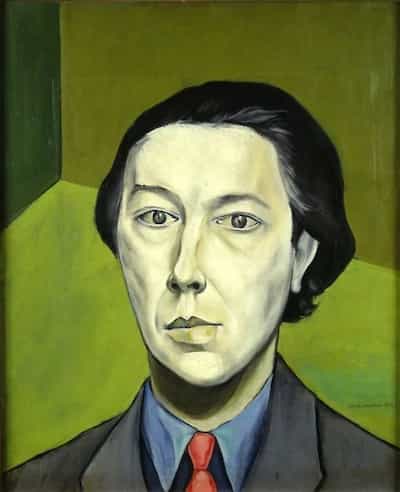
All research on Lautréamont has been in vain. On April 2, 1921, Félix Vallotton, author of the portrait of Lautréamont published in the Livre des Masques, wrote to us: “This portrait is a pure invention, made without any document, no one, including de Gourmont, having the slightest insight into the character. However I know that we searched. It is therefore an image of pure fantasy, but circumstances ended up giving it substance and it is generally considered plausible. » The shadow only grew as new “works” of Lautréamont were unearthed, only the Poems and a few letters, which only allowed, with great bad faith, to be put on the agenda. The image of pure fantasy ended up getting the better of the true image, the one that escaped the contingencies of time, mood, reading. All of Lautréamont's portraits, none of which are from nature, follow one another and resemble each other. The author of the latest, Mr. Philippe Soupault, has proven himself. We've known him for too long. He will put his name, more and more ignoble, on the front of all the books that we thought were closed to us forever.
Humanity is in the bag and everyone's complete works continue to appear. Those of Count de Lautréamont (but I see myself living, you see yourself living, they die, we are transparent as if Lautréamont were a thousand years old) these works appear for the sixth and last time (1). All studies, all comments, all notes past and future, by Philippe Soupault. “Come on music. » But what music! The end of the 19th century, the chancellors, the exotic, the bizarre, the bourgeois houses, Edgar Quinet, the quotations to cry, the Ecole Polytechnique, the imbecile nostalgia of women and the rest, Ducaise, Ducaire, Dutiers or Duquart, these "great butterflies that we still call today prostitutes", which is done in less or more than a year, the despair of the tenants, the small cups of coffee and the large cup, knowing where one is going, literary criticism, the fatal broth of genius, a Plutarch to write the Lives of Illustrious Editors, offers more attractive than requests, moving, the fat Madame Lacroix, morality which can make one think of that of Robespierre or of Saint-Just but not of one of the two, the unattended funerals which go at full speed and which arrive too late, the absence of a file at the police headquarters, all of that, everything this, all this so that we are cowards, cowards like the preface, so that we wear out our hearts on the steps, so that the door is closed, so that we rasp our tongues on the top of the walls, and so that the break-in stops there, all this surrounds this book, hides it, defiles it, trivializes it, extinguishes it under the petty passions of those who read it, under the betrayal of those who pretend to understand it, under the free detachment of those for whom it is not made.
Some amateur revolutionaries have no other desire than to use today everything that helps us live to do Father François' trick. We will abuse our love of Lautréamont and our hope in communism to reduce them to one and the same expression, so as to discredit them in our own eyes, to abandon ourselves to a sort of dead center from which we can no longer distinguish the absolute from the relative. For our enemies, everything would obviously be more convenient if there was only one bridge to cross from spirit to life. This is not the case. Whether or not Lautréamont was a revolutionary activist, whether or not he spoke to the crowds, we don't care. But, until further information is given, everything leads us to believe that he was desperately self-sufficient and that it was in vain that anyone would have wanted, as long as he lived, to brandish him on a platform. We would like to make it known that the man named Ducasse who, in the public meetings of 1869, took the floor to quote the epistles of Saint Paul and draw oratorical effects from the Gnouf-gnouf tic was not Isidore Ducasse, the one we claim to support against all odds. Our friend Robert Desnos, when he suggested that the author of the Chants de Maldoror and the orator cited by Vallès in L'Insurgé could be one and the same, was unaware that the second was identified by Charles Da Costa who had known him intimately, as well as Alphonse Humbert, Breuillé, Charles Longuet and Ménart (2). The Ducasse in question was called Félix Ducasse (Cf.: The Blanquists, by Charles Da Costa, Librairie Marcel Rivière). The Count of Lautréamont, whom political problems do not seem to have otherwise agitated, therefore had nothing in common with Félix Ducasse other than the very vulgar homonym which imposes on Mr. Soupault for an "overwhelming resemblance." »
We say that Mr. Soupault cheats, most apparently, most miserably in the world, in the only part where he perhaps should not cheat. He cheats, not to cheat, but to gain what, in exchange for his worst renunciation, the editions of “Sans Pareil” grant him. How much ?
However, there was once a question of refusing the poor man's share and of exaggerating silence, the only dignity that the Count of Lautréamont deserved. Suffice it to say that it was an attitude in the world which highly defied any attempt at popularization, any interested classification, any desire for opportunism, which was nothing but eternal. We oppose, we continue to oppose, Lautréamont entering history, being assigned a place between Un Tel and Un Tel (3). On earth, Mr. Soupault, if even Lautréamont's place were at the corner of earth, fire, air and water, where could yours be, if not between wine and the water which cuts it?
But, as the place of Lautréamont is elsewhere, you are no longer there.
Louis Aragon, André Breton, Paul Eluard
1 - Let's not talk about the (illustrated!) edition that the art bookbinder Blanchetière is preparing. The copy: 1,200 francs. At this price, we are heartbreaking. ↩
2 - All five were sentenced to fifteen days in prison following a demonstration against the Emperor of Austria during his visit to Paris in 1867. ↩
3 - For example, between Baudelaire and Rimbaud. (Strip from the “Complete Works” volume.) ↩