The argument: a penny is a penny
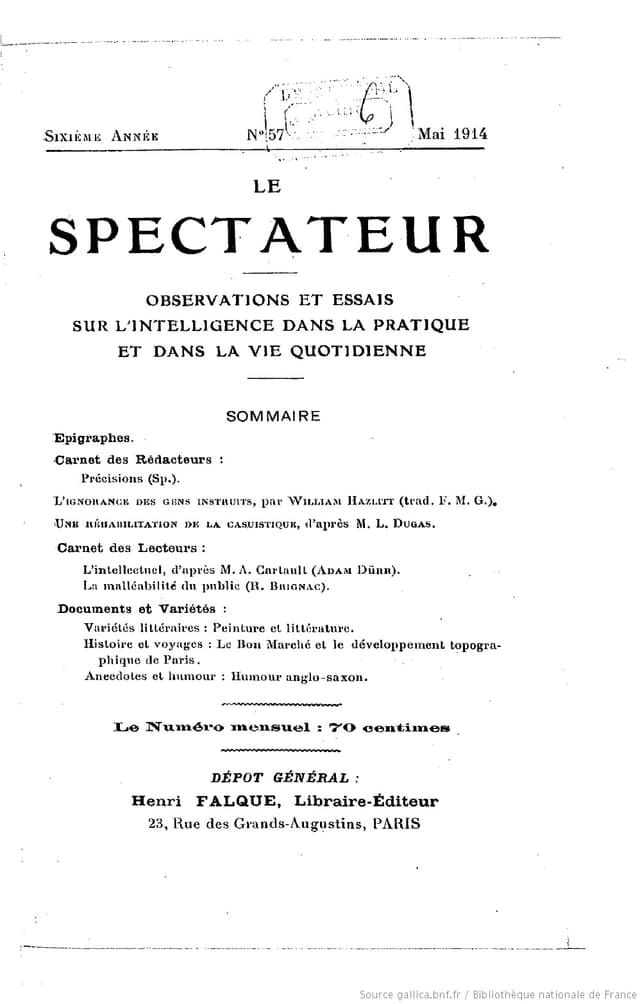
Jean PaulhanArticle published in Le Spectateur, n° 32, February 1912, p. 62-75
Few claims seem so irrefutable. A penny is a penny. And what could it really be if it were not a penny? A is A. Philosophers wanted to see in this proposition (1) the essential principle of all thought. And popular wisdom does not fail to make use of it:
Business is business,
God is God,
Man is man,
I am as I am,
The world is what it is,
I'm me, and you're you,
When we are dead, we are really dead,
In war as in war.
All easy eloquence, which does not lack authority, is based on such common places:
France will always be France,
The homeland is the homeland,
A woman is always a woman,
“What do you think,” asks a journalist, “of the excessive display of jewelry displayed by women today?” And a young girl replies: “Enough is enough. I love a cute ring, but I am the enemy of an overflow of jewelry.” (2)
I heard this:
“On the train, I had a painter next to me. Oh, an elegant man, very well dressed, a man of the world.
— Yes, but he was traveling third.
— You know, painters don't do anything like everyone else.
— Finally, a third is a third.
— Yes, but a painter is a painter."
The commonplace is here, on both sides, the essential argument of the discussion.
In such exclamations: "That's it!" (3), "That's all that!" we would find it again.
Sometimes, without it being clearly expressed, an allusion evokes it:
"No thing, no man, no fact has its true face and bears its true name. Mr. Bonaparte's crime is not called crime, it is called necessity. Mr. Bonaparte's thefts are not called thefts, they are called state measures. Mr. Bonaparte's murders are not called murders, they are called public safety." (4)
Which amounts to saying, what means to say: "_The crimes of Mr. Bonaparte are crimes. The thefts of Mr. Bonaparte are thefts..."
Such statements contain nothing that seems paradoxical, or too obviously contrary to the truth. They appear, to those who consider them in themselves, to be dictated by a sincere and somewhat naive taste for the obvious.
*
* *
It is curious that these propositions: "France is France, a penny is a penny" usually offer a meaning that no one misunderstands. This meaning is that France, insofar as it is France, and a penny, insofar as it is a penny, have a precise value.
Value which can, moreover, vary, be large or small. Alongside "a penny is a penny", it would be appropriate to quote: "a penny is always a penny" — that is to say, a penny has a determined value, which is rather large — and "a penny is only a penny" (5) — that is to say: a penny has a specific value which is rather small. — If it is a question of spending the penny, "a penny is always a penny" will advise the economy, "a penny is only a penny" will advise the expenditure. Such a remark would apply to most of the commonplaces cited above. “A man is always a man” means: “every man should be respected”; “a man is only a man” means “each man has his faults and his weaknesses”, or “there will never be a shortage of men, and there is little need to worry about their fate”.
As for "a penny is a penny", "a man is a man", these two common places seem to take in turn, and depending on the intonation which accompanies them, the meaning of one or the other of the preceding propositions:
“I would like to give something to this beggar.
— So give him: a penny is a penny (a penny is never just a penny) (6)
— He won't be able to afford much with that.
—What do you want? For him, a penny is a penny. (a penny is always a penny) (7)"
The commonplace, at the same time as it affirms the value — great or small — of the penny, in some way purifies this value, isolates the penny from what surrounds it and can be confused with it. “Man is man” means: man is neither angel nor beast, he is man and that is all he is. “Luck is luck” means: “luck is nothing other than luck; it has nothing in common with justice, or with our desires”. And more precisely: "luck, man are not what you imagine, they are luck and man, and nothing else". And this value in itself of man, of the penny, of luck, which the commonplace affirms, must be so intense, so recognized, that it can still exist, all other reasons for esteem or respect having been rejected.
There are discussions where one of the adversaries, finding no more arguments, and nevertheless not wanting to admit defeat, only repeats: "Whatever you tell me, a nobleman is always a noble." or: “No matter how pessimistic you may be, France is France.” Or again: “What do you want, I am as I am”.
This statement: "man is man" seemed to us, considered in itself, to be nothing more than an uninteresting truism. And we were only able to recognize a meaning in it after having imagined, around it, a whole discussion. Thus, this first person having said: "I do not understand how A..., in whom I trusted, could have acted so badly" was told: "After all, man is man". So again, this commonplace: "a penny is a penny" can only be explained if it is a response or advice given to a person who wanted to spend a penny: we must, to understand it, situate it in a discussion where it is nothing more than an argument. And it is also as an argument that we will study it now.
*
* *
“Let go of your writings, which are getting on my nerves!
— But, my dear, I write strips.
— Ah yes! your bands at three francs per thousand. If it is with these three francs that you plan to marry your daughters!
— Three francs is three francs, he replied in his slow and tired voice. These three francs allow you to add ribbons to your dresses." (8)
Three francs is three francs means: "my three francs, which you despise, nevertheless have their usefulness. Three francs, you say, are not useful for marrying our daughters. These three useless francs are, however, equal to the three francs which I acquire with difficulty, and which give you ribbons."
And the commonplace only has meaning because it gives "three francs" - attribute a slightly different meaning from that which "three francs" - subject had. What we would present like this:
Three francs (definition: three francs is a sum with
which we cannot marry our daughters)
_this is**
three francs (definition: three francs is a sum which you
allows you to add ribbons to your dresses:
thus, allowing you to dress them better,
these three francs can make your daughters’ marriage easier.)
Consider this example again:
Thomas Diafoirus: "We read from the ancients, mademoiselle, that their custom was to remove by force from the fathers' house the young girls who were being taken to marry."
Angélique: "The elders, sir, are the elders, and we are the people of now" (9)
The argument is based on a play of ideas to which the word "the ancients" lends:
The ancients (definition: the ancients are people whose life
and morals must serve as models for us.)
are
the ancients (definition: the ancients are peoples whose morals
and the rules of life no longer suit the men of today.)
M. D. Berthelot, presenting in a report the means of preventing the deflagration of powders, said first of all: "An explosive is an explosive. It must be surrounded by constant precautions..." (10)
Which means:
An explosive (definition: an explosive is a body whose explosion
provoked launches projectiles placed in a cannon.)
_is
an explosive (definition: an explosive is a body capable of
to make an explosion.)
The whole difficulty here is to translate the words: "is, are, it is..." because if the new meaning, the new idea that the attribute introduces is simply added, sometimes, to the meaning of the subject, it can also be clearly contradictory to it. So with these last two examples (11): the explosive (whose essential quality is to explode at the right moment) is clearly contrary to the explosive (which can explode in any circumstance).
And, on the other hand, there is a very clear opposition between the elders (whose teaching we must follow) and the elders (whose teaching we must neglect). So that the true meaning of the copula would be, not: “is equal to” but “is rather, is preferably…”
This new meaning of the word, which the attribute introduces, is usually clearly expressed. A commonplace often gives it more precision and clarity:
A woman is a woman. And you should not hit a woman, even with a flower.
A penny is a penny. And a penny cannot be found under a horse's foot.
Twenty sous are twenty sous. With the money from a pot of flowers, I can buy a sausage (12).
Sometimes, the commonplace speaks for itself and it becomes useless to quote it:
I am as I am. (And you have to take me as I am).
Those who died are dead. (And the dead don't come back).
The man is the man. (And the man has his faults).
Often the intonation (13), the memory of previous experiences or reflections are enough to give the repeated word its strength and its new meaning. The child, who remembers the principles of economics repeated many times by his mother, understands perfectly, when he was about to buy an apple sugar, the meaning of the recommendation: "a penny is a penny".
*
* *
We can define the argument: an attempt to make his interlocutor accept, thanks to the very word he has just said or that he thinks, a new idea, opposed to his own. And the existence of the argument therefore supposes that a single word lends itself to two or more different meanings.
It is therefore appropriate to remember that the word is a sign, drawing its value and its meaning from the associations of ideas that it awakens in us. Yet these associations of ideas can vary with each man. The painter understands the words "wheat field" differently than the farmer, and the baker than the harvester.
However, two meanings of the same word can be opposed to each other, mainly when the meaning of the word is complicated by a moral nuance:
"...The count tore the clothes of the countess and hung her on a tree.
— Heaven, Athos, cried d'Artagnan, murder!
— Yes, murder, no advantage, replied Athos" (14)
"A murder is just a murder", Athos' response could be said. It means: “a murder does not have all the importance that you seem to attribute to it”. In this way it must at least invite the mind of the interlocutor to seek the reasons which can lessen the seriousness of the murder. It only makes sense, to tell the truth, to the very extent that we discover these reasons.
Consider this example again. V. Hugo wants to criticize the constitution of the Second Empire:
"There is in this constitution a Senate. Without doubt. This large body, this weighting power is even the main splendor of the constitution. Let us take care of it: Senate. It is a Senate. Which Senate are you talking about? Was it the Senate which deliberated on the sauce with which the Emperor Domitian would eat the turbot? Was it the Senate which had it said to Charles XII: Send my boot to Stockholm - Why do that, Sire, asked the minister - To preside over the Senate" (15)
And here we see the reasons which allow the existence of the argument. The same word can be used to evoke experiences of very different nature and sentimental nuances. “Senate” means “weighting power”, or “slave chamber”. Language, however, retains a single word, when it comes to designating a fact, a determinable object, and, according to current expression, "exterior" (16). Thus, although the idea of the republic or the senate is essentially different, in the mind of a radical, from what it is in the mind of a socialist or a royalist, although it is accompanied in them by opposite feelings and judgments, the same word serves all three of them. We can see there an imperfection of language, and we can also, from certain points of view, find its reason for being there. The argument knows how to take advantage of this imperfection or reason for being: it allows it to classify under the label accepted by an adversary, the experiences and memories likely to ruin the cause he defends.
But there is more: the same word, depending on the sentence in which it takes place, can take on, for the same person, very different meanings: this mainly in cases where the word has, in addition to its proper meaning, a meaning of a common place - that is to say that being commonly used in such a common place, it has found itself participating in its general meaning. — Thus, by association with the commonplace "a penny is not found under the foot of a horse", the word sou still retains its original meaning, but it can also mean: a rare thing, and which one cannot acquire without difficulty. And we have seen that it is very often such words, for the double meaning to which they are susceptible, which are objects of the argument "a penny is a penny".
We can go even further: the mere fact of paying attention to a word, of isolating it from the words that surround it, of repeating it, is enough to modify its meaning. It is possible to distinguish one word center of thought in a sentence, sometimes two, rarely more. The other words are there by necessity of language and do not hold the mind.
“You are naughty
— I am as I am."
Only one important word here, first of all: nasty. He might say to himself: “Bad guy!” and would take the place of the entire sentence.
However the answer neglects it. It applies to the words "you are" and gives them a new meaning: it pretends to consider them as an integral part of the sentence where they were only a convenience of language. Thus the argument shifts, as it were, the center of thought of the sentence it refutes. And through this the word he uses, since it was previously empty of meaning, will easily receive the new meaning that we want to give it.
Let the dialogue continue:
“I’m going to buy this ten-cent toy.
— Ten cents are ten cents."
The center of thought is in the first sentence buy the toy; “ten sous” simply specifies what toy it is, and that it does not cost five or fifteen sous, but ten.
But the answer pretends that the center of thought of the first sentence was "ten sous" (I want to spend ten sous at...). And it will impose itself all the more easily since no feeling, no opinion contrary to its own, or even different, previously accompanied the "ten sous".
And the definition of the argument would now be clarified as follows: the argument "a penny is a penny" consists of introducing a new idea thanks to a word already pronounced: whether this word has two different meanings, or whether it had no meaning of its own in the first sentence in which it was said.
*
* *
What makes the “a penny is a penny” argument so successful? Basically, as we have noticed, he simply states this: "The idea you have of a penny comes down to the one I have myself"; “It is not your conception of a level-headed and impartial Senate that is correct,” says V. Hugo, “but my conception of a subservient and cowardly Senate”; or, more simply: “You are wrong and I am right.” To what circumstances can the success of such a simply authoritarian assertion be due?
Perhaps a large part of it has to do with our trust in language: the argument can only use a word with two distinct meanings, and it plays with these two meanings. But common thought seems to refuse to admit that the same word can have two meanings: it prefers to move from one to the other without wanting to notice their difference and thus finds itself duped by the argument. In fact, the usual conception of language, which we find expressed in a number of commonplaces, would translate as follows: language is a set of useful signs; the same sign cannot designate two facts, two different objects at the same time - because that would lead to confusion -, and two signs cannot on the other hand designate the same fact, the same object - because one of the two would then be useless.
Nothing is more curious, in this respect, than the common reluctance to admit the existence of synonyms. “What’s the point of two words saying the same thing?” If we want to insist, say that between the two words bravery and courage, for example, the differences in meaning appear very slight and perhaps non-existent, we hear ourselves answering: "If both meant the same thing, one of the two would have long since disappeared or would have taken on another meaning". Or our interlocutor will endeavor to better clarify the meaning of the two words, and will grant to one of them such a nuance of meaning that he refuses to the other. Perhaps he will succeed: it doesn't matter. The main thing is that he does not want to admit the existence of synonyms. And grammarians do not fail to give this desire dignity, admitting and justifying it in their works (17): such justification cannot come, in any case, from the simple observation of the facts - there are words that each of us, in conversation, uses indifferently to the other; — it undoubtedly comes from our belief that language is a perfect instrument, where two different cogs cannot be used for the same work.
We have noticed, in the same vein, this: children who study a foreign language have difficulty admitting that the new German or English word they have just learned is only the exact equivalent of the French word they already know. Like the child who said: "I didn't cry, I geweint" (18). The Malagasy children, whom I have been able to observe in this regard, attribute a new meaning to each French word they learn: the Malagasy word trano meaning "house" has taken on for them the meaning of "beautiful house" and more particularly "house which has a balcony"; the Malagasy word tanimboly meaning "garden", the word jardin took the meaning of "pleasure garden". So for each word.
Here is the second aspect of great confidence in language: when the same word obviously offers two different meanings - such as flight - popular consciousness affirms that this word is in reality, and despite appearances, two different words. "There are two words since one means... and the other..." Sometimes, for greater clarity, the distinction comes to be translated by a different spelling: dessein and drawing, compte and conte, after having been confused for a long time, and being moreover only one and the same word, are today carefully separated.
To each object, to each feeling, to each thing capable of being designated corresponds to one word and only one. This too is a commonplace. "I don't know what this herb is called in French, they say, but it must have a name." "Mediocre minds," says La Bruyère, "do not find the only expression..." And we see all the support that such a belief gives to the argument "a penny is a penny." There is only a penny, a penny is always identical to itself; This new meaning that you attribute to the word penny is therefore not a new meaning for me, but I already knew it, it was undoubtedly involved in my idea of the penny. I can therefore do nothing other than welcome it without suspicion, and since it is indeed a question of the penny, admit, in advance, its truth.
*
* *
What defense do we have left against the “a penny is a penny” argument, and what response to it? This one perhaps, a little obscure, but which reveals the ruse: “It is not your penny that I am talking about, but mine” (19). J. Renard offers us another answer, which is not lacking in accuracy:
"Poil-de-Carotte makes a fist and shouts to Madame Lepic, who is far away and cannot hear her: Bad woman, I hate you!
— Shut up, Mr. Lepic said to him. She's your mother, after all. A mother is always a mother.
— Oh! replies Foil-de-Carotte, “I’m not saying that because she’s my mother.” (20)
Jean Paulhan
Read also "About 'Un sou est un sou'", by F. C. in Le Spectateur n° 33 of March 1012
1 - Called, for the occasion, principle of identity. ↩
2 - O. de Trévile, Young girls painted by themselves, p.498 ↩
3 - This is it ↩
4 - V. Hugo, Napoléon le Petit, Ed. Nelson, p. 24. ↩
5 - Or again: "a penny is never just a penny" ↩
6 - That is to say: "it's never more than a penny lost for you" ↩
7 - That is to say: "it's always a penny earned for him" ↩
8 - E. Zola, Pot-Bouille, Ed. Charpentier, p. 29. ↩
9 - Molière, The Imaginary Sick, II, 7 ↩
10 - Quoted in Gil Blas, December 10, 1911 ↩
11 - Cf. "the dreams (projects for the future) with which we were lulled are only dreams (chimerical projects)" - Secretary of Love, p.48 Lib. J. Taride. 1884 ↩
12 - J. Vallès, The child. Ed. Charpentier, p.76. ↩
13 - The argument would often be transcribed more accurately: a penny is a SOU. ↩
14 - A. Dumas, The Three Musketeers. Ed. Calmann-Lévy, p.257. ↩
15 - V. Hugo, Napoléon le Petit, Ed. Nelson, pp. 48, 40. ↩
16 - It would be easy to show that it is not the same for words designating facts of a moral nature. Here the change of sentimental nuance requires a change of words. “Will” and “stubbornness” designate the same order of facts, only adding to the idea of these facts a pleasant or unpleasant emotional nuance. (So modesty-prudery, courage-rashness, kindness-weakness, justice-severity, etc.) ↩
17 - The Dictionary of the French language by Hatzfeld, Darmesteter, Thomas defines the synonym: "A word which has with another word a general analogy of meaning but a different nuance of meaning". This definition is a whole theory. Not only does she affirm that there are no synonyms, but she also denies that the word "synonym" has the meaning of "synonymous" - undoubtedly since there are none. — The paradox is strange: moreover, the example which follows the definition is enough to destroy it: "For many, scholar and pedant are synonymous". (La Bruyère). This obviously means: for many, the words savant and pedant have the same meaning and the same meaning ↩
18 - This example is given in issue 3 of the Spectateur with the indication: R.....d, R.....d, July 1908. ↩
19 - Answer to which another common place: "There are sous and sou" could give support. ↩
20 - Poil-de-Carotte, ed. Flammarion, p.240. ↩