Memories, Frédéric Paulhan
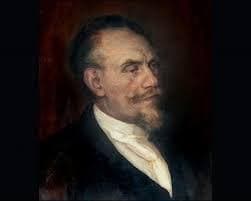
Frédéric PaulhanFrédéric PaulhanMemories written by Frédéric Paulhan (1856-1931), philosopher, father of Jean Paulhan, about his father, who was called Jean (1818-1901). Jean was a hardware merchant, retired from commerce at the age of 41 (1869) to devote himself to managing the fortune of his two nieces who lost their father at the ages of fourteen and sixteen. He also did “business” financial.
Frédéric's uncle, older brother of his father Jean, was called Casimir (1815-1885)
After dinner, or as we called it, after supper, my father and I would both stay up in winter by the fire. We were chatting. I really liked talking with my father; from time to time, during the day, I asked him: “Shall we talk this evening?” We talked about a thousand things, sections of our newspaper, events of the day or of the past.
My father told me about his hunts, his trip to Paris, one of the great events of his life, and also the happiest. He spoke to me about the Opera of Dupuy and Levasseur, of Rachel and Frédérick Lemaître, told me of his long walks (I believe that for a month, he took neither car nor omnibus, even to go from the Rue du Mail, where he lived, to take a walk in the Bois), his lunches at the Palais-Royal, his visit to the Louvre, where one of his friends, tired, was waiting for his companions on a chair. They found him sleeping. Versailles had struck him with its grandeur. He pushed as far as Rouen but quickly returned to Paris, which he had not forgotten.
Other times I played with the ashes, I built with pieces of paper a sort of Arab encampment which I then set on fire.
My father, however, smoked his pipe in front of the blazing branches, the olive pomace which was flattened in the hearth, the green oak branches which were slowly consuming. This evening was one of the good moments of the day for me and I asked myself: “Will you smoke another pipe?” (They were small pipes made of white clay or wood.) “Perhaps”, or “Yes”, or “No, you have to go to bed.”And we went to bed early.
As we lived in the same room, the chat continued a little: “Are there wolves in England?” I had read somewhere that a king had them exterminated there and I was curious what happened next. My father was already dozing: “We’ll see.”
*
* *
We were walking on a winter Sunday in the plain. The air was warm, a little humid. On the path, a little melting snow, here and there, last remnants of a recent fall. I was a few steps ahead and, without expecting it, I received a snowball on the head. I turned around, annoyed and happy, and it was a battle, the snow did its best and took admirably.
My father happily played with me like this. From my earliest childhood, he had taught me card games, piquet, imperial, spread, etc., checkers, even chess; we played bowls in the garden. He bought me small ones. At home I sometimes trained him to play boules with marbles. Sometimes a game of billiards. Billiards interested me a lot, but I was always not very skilled at it, while I was brilliant at boules a little later.
The failures came when I was, I think, about six years old. I was intrigued by this sort of checkerboard with rarer and larger squares which was hidden behind the other. One day my father brought a box from which came the king and the queen, the rooks and the bishops, and all the rest. To make things clearer, I wanted to write the title of its contents on the box and I carefully put it: jue de chèce. I was already worried about spelling and I knew that the word game had a u and an e, unfortunately I still didn't know the order.
*
* *
My father also taught me to read and count. At three years old, when he carried me on his shoulders in the street, I spelled out the words on the signs. Before I was six years old, he had pushed me to multiplication. And as far as I remember, he also led me to think and reason, he readily appealed to my common sense.
*
* *
He was very lively and gentle, kind and not very expansive in his feelings. Common sense and justice seemed to him to be things of absolute value and he was uncompromising when it came to probity and truthfulness. Although his business was small, he was ranked among the first-rate merchants and told me this one day with satisfaction. Deliberately ironic, with a lot of enthusiasm and quite inclined to cheerfulness despite rather pessimistic opinions on men and on the things of this world.
He had respect and curiosity for things of the mind, letters and sciences, the arts, books. He was happy to own the Dictionary of Conversation, an encyclopedia which is now obsolete but where one can still read certain articles with pleasure and benefit, and he found information on what interested him. The question of prehistoric man fascinated him and he spoke to me about it too. I had found some shards of glass which, in my eyes, simulated very well the stone axes of my ancestors. Until his death, he was interested in similar readings. He was a great admirer of Molière and Paul-Louis Courier.
In 1869, he left his business. I believe that he had not taken any vacation other than Sundays since his trip to Paris in 1844. He came to spend the vacation with me, with his brother, Uncle Casimir. I was really looking forward to going for walks, fishing and hunting with him because he had promised to take me. And he sometimes passed me the gun. I was thirteen years old, with my first shot, I killed a shrike sitting on a mulberry tree in a meadow. I was not a little proud of it, and I was delighted to bring to the family table a roast of which I would have my share. But a fly laid its eggs on the creature and I was disgusted. Flies abound in this world.
My father raised me gently, and always gave me as much freedom as possible. He liked to appeal to my common sense, to persuade me, to convince me that I could not think otherwise. He was only intractable on a few points, such as truthfulness, probity, loyalty. I don't remember receiving any slaps from him. However, he could very well have given me some, because he was lively; it was at least very rare. I know that once he got my grandmother to send me one. Perhaps I had been impertinent with her, and certainly I had not passed it on. My grandmother was deeply respected by her three children. They did not speak to her informally, which was very rare, almost without any other example, in our environment, and showed her the greatest reverence. My uncle Casimir, in a lively and independent mood, a very good man, quick-tempered, good and upright, had a carriage and a horse. He used every possible trick to get my mother to ignore him, because she didn't like it, fearing, I think, some accident. And for example, when returning from the countryside, he tried to arrive in Nîmes at the same time as the diligence so that his entry into our house would not arouse any suspicion. When we came back together, it seemed to me that the car he was driving was lent to him by a neighbor.