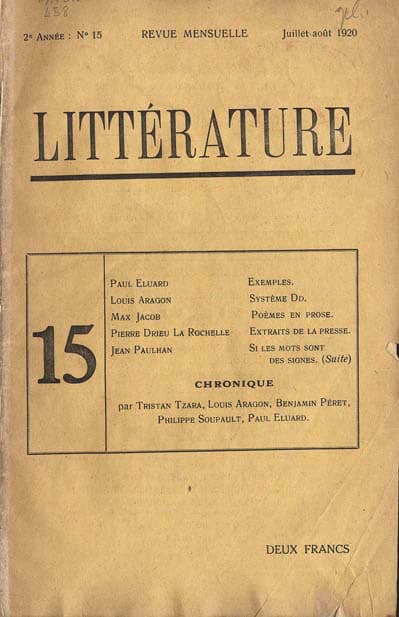
If words are signs (continued)
Jean Paulhanarticle original, Littérature n° 15, juillet-août 1920
If words are signs or Jacob Cow the Pirate
(Following)
However, all three were to be understood under the word “reader”. What the demonstration is about: it only receives its value and its own meaning on the condition of first appearing to say a little more than it actually says.
We will think: “They wanted to play us”, everything will be said.
She wouldn't be in demand if everyone could easily get rid of her. By observing it without malice, we will experience its virtue: it is that our first error, in part, compromises us, and further commits us to ensuring that any reader (and the one for example at our disposal: ourselves) obtains for nothing... Thus she invites us to make it true.
Everything happens as if it were unnatural for us to admit, under the single word reader, certain realities, and precisely to take this word as a sign.
III. RUSE OF MARCUS AURELE
I have often wondered with astonishment, writes Marcus Aurelius, why each of us loves ourselves more than all the others, and yet attaches less value to our own judgment of ourselves than to that of others. It is certain that if a God or a wise master P. 16 came to order us never to conceive anything, nor think anything within ourselves without immediately expressing it outside, even shouting it, we would not bear it for a single day. It is therefore true that we fear our neighbor's opinion of ourselves more than our own.
We experience reasoning the passage, and the difficult place. We must admit, or the rest collapses, that it is on the same thought that others pronounce themselves, and we - and therefore that this thought can, at will, be carried from the inside to the outside, or the reverse: the words do not make their mark on it, these words are as if they were not.
(I suppose that such an acute idea, and threatened at every moment, worried Marcus Aurelius. He only wanted to convey it by offering attention to a pleasant paradox.)
Common judgments on lying or sincerity presuppose the same basis: namely that one speaks one's thoughts directly, without intermediaries, rather than speaking one's words (whose sequence and play can follow different laws, giving three hundred unexpected combinations.)
Some feelings come from there: that, among others, of the duplicity of the liar who, at the same moment, assumes morality, thinks the truth and says the false - (but a slight habit of lying is enough to recognize here a miserable illusion). And all other judgments due, as happened with sugar advertising, to the fact that we behave with words as if they were the things themselves.
IV. REASON FOR THE RHYME.
Agrys, when he has followed the adventures of a word since the Romans, speaks proudly of its true meaning: religion, he says, is the bond of citizens, since religio... (he thus hopes to know the thing better at the same time as the word).
But what is the need to go and get Agrys. Myre says: "We are right to call them Protestants, they protest all the time" and Béril: "Do you know why I can't tolerate carpenters? It's because they harm me." Would we answer that Béril wants to laugh, I am not sure that Agrys is speaking seriously. What right can all the science of the world have here? A particular word changed its meaning, it was to escape its first error or confusion (thus we no longer treat an image, the hair, the eyes of the head, but the milk alone); another, it was thanks to a new confusion, a play on words: so that the exact etymology will inform us about its meaning less precisely than the supposed etymology does (legacy, in this way, does not receive its meaning of leaving, from which it comes, but of bequeathing, which it imitates).
It remains that this eymology, where it uses exhausted words, runs little risk of being found faulty: none of these words can be found, the next moment, with too different a meaning (as happens with the pun) - But this is already a question of measure, and of success: and precisely of the success of this conviction, of this wish - to which the analysis of the grammarian, the divine play on words of the Pythian, also relates - that thoughts and words are confused to the point that there is not a fragment of a word that does not preserve, in every adventure, ITS fragment of thought.
We readily speak of the charm of rhyme: for lack, perhaps, of reasons. It will not surprise us, it falls in the exact line of our remarks, that the task of this rhyme is to found, for a moment, a pretension of neighboring sounds to neighboring thoughts - and thereby flatter our concern for a perfect language. We would not reproach it, on occasion, for harming meaning, if we had not expected that it would favor it. We would not have this disappointment if we had not had this hope.
(To be continued)
JEAN PAULHAN.