If words are signs
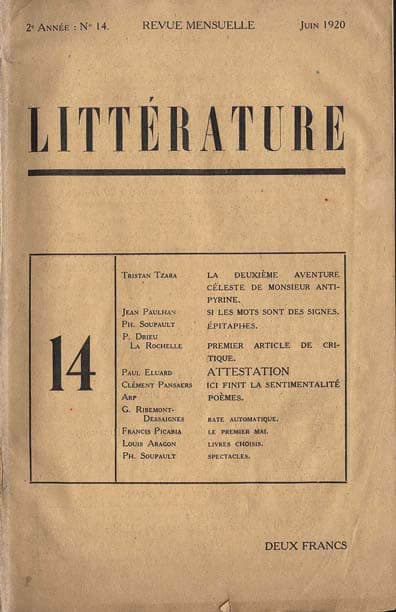
Jean Paulhanarticle original, Littérature n° 14, juin 1920
If words are signs or Jacob Cow the Pirate
To Mr. Paul Valéry
It is difficult to speak of words in a detached way, as a painter describes the grinding of colors: they touch too closely on our life, and sometimes favorable or harmful, or insensitive and refusing to carry meaning. Thus they find themselves mixed up in our concern to have them served, and known through this concern.
Above, there is no visible difference, and no gap, from word to sentence, from sentence to story. The writer, who appears to himself to be a maker of language - as happens to a child, or in our language abroad - it is by imitating his first opinion on the nature and play of words that he foresees or composes himself.
Where does the gravity of this opinion come from, and the singular scope of any error it may contain?
I. IF WORDS ARE SIGNS.
We most readily assume - I mean grammarians or critics - that words are used by people to express themselves. They are signs of thoughts; and, with them, these junctions and these fibers which unite them in every sentence; and down to their smallest variations: the imperfect of the verb, says grammar, expresses...
Such an idea of the sign is not so clear-cut that it cannot offer a double figure: of distrust with regard to isolated words. Because these words are not enough, but the thought, which we discover beneath them, is the only reason for being and source of their meaning. Outside of this thought, they can mislead us: “These are, they say, only words…”, or: “think before speaking”.
and a figure of confidence, however, as soon as one has united the thought with the word. It then seems that each word can be illuminated by this thought; (it is not irreducible: it is difficult to imagine a sentence that would mean nothing at all). Or, conversely, that every thought has its word. “Look for the proper word,” advise the critics, and: “Everything can be said.”
This way of seeing leads to some obscurity. If the word is appearance, the idea is reality, it becomes difficult to explain that this idea sometimes follows the word, comes out of it, translates it. Cilia, who tries to explain to the doctor the illness from which her child suffers, as she speaks discovers her true fear, and is surprised at herself. Or Atys, when he managed to say to Chryse: “So you lied”, each of them reconstructs his real thought from a word. Their idea is a sign here of this word, and a way of sharing it, far from the word being the idea. (Of such a poet again, we know that he is first thrown among the words, presses them, spies on them, waits for them).
II. FIVE KILOS OF SUGAR FOR NOTHING.
Both opinion and criticism can be overcome: this is where we grasp the spontaneous use of words, crude, without reservations.
We saw:
FIVE KILOS OF SUGAR to any reader of “L’AVENIR”
Demonstration
A buyer with the number pays per year for 365 copies at 0 francs. 10, or .... 36 50
A one-year subscription for Paris costs.... 25” or 36”
and entitles you to a purchase of 5 kil. of sugar at 2 fr. 20 per kilo.... 11 40
It is therefore FOR NOTHING that any reader of “L'AVENIR” can obtain 5 kilos of sugar.
It is obvious that the only reader who gets, more or less, five kilos for nothing, is the buyer of the issue who subscribes, thanks to this change. The subscriber can spend eleven francs if he wants sugar, and the buyer with the most loyal number will get nothing.
(To be continued.)
Jean PAULHAN.