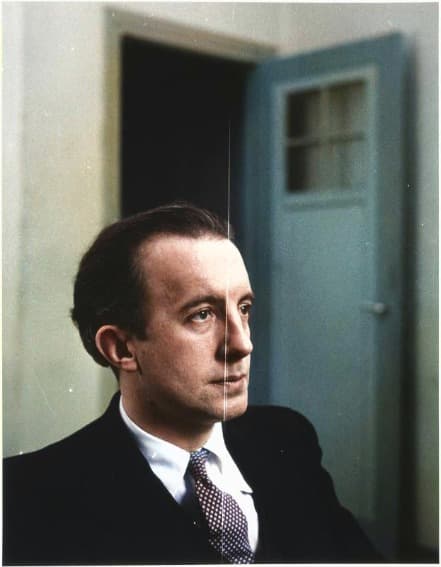
Interview with Paul Éluard
Jean PaulhanClaude ElsenPaul Éluard[Claude Elsen talks with Jean Paulhan]
In his bedroom-office on rue des Arènes, Jean Paulhan is bedridden with the flu. On a pedestal table, next to his bed, a curious luminous aquarium, where tiny Japanese fish flutter, alone illuminates the room - night light of the eternal watchman who, for thirty or forty years, has kept watch over our Letters...
— Paul Éluard... I knew him since the other war. It was in 1916 that he wrote to me for the first time. His letter said: "I am poor and weak. Come see me in my little room, where I live with my wife Gala whom I love"... This letter was accompanied by the manuscript of the poems that he would publish the following year, in 1917, under the title Duty and Disquiet.
_Jean Paulhan hands me the thin brochure, published by Gonon. A handwritten dedication: "To Jean Paulhan, to the Applied Warrior, as a faint expression of my gratitude, this young, but old book."
How can we not think, a little, of Laforgue?
The soldiers leave on the tall oats
Singing a chorus in the air...
Light in the right way
Ignorant of the bag that doesn't move
And the gun that paints red
Oh! live a less terrible exile from heaven, very tender!
Other memories:
— It was me, said Jean Paulhan, who in 1917 introduced him to André Breton... His real name was Grindel. His father sold land in the suburbs, in Choisy-le-Roy, where he sat in a cabin, waiting for customers. It happened that, on Sundays, Paul Éluard would replace him...
Let's skip a quarter of a century, during which Éluard's adventure merges with that of his friends, of Dada, of Surrealism:
— During the Occupation, continues Jean Paulhan, I saw him every week. I remember the day when, in my office at The NRF, he slipped a beautiful poem by Jacques Decour into my hand... The day the Germans entered Russia, Éluard said to me: "I feel very well that today this war is becoming my war". He led it with extraordinary tenacity and great courage. He, so delicate, sometimes found himself in the evening completely exhausted from all the errands he had done during the day, from all the leaflets he had printed, read to his comrades, distributed everywhere...
I never stopped admiring and loving him. And I don't think his feelings have changed either. But we agreed not to see each other since the war. He said to me one day: "I will probably have to say bad things about you publicly. Forgive me once and for all...". In fact, he later called me a "traitor"...
A question inevitably comes to mind. I put it to Jean Paulhan :
— How do you interpret Éluard's total adherence to militant communism?
— Éluard was a being of nobility and goodness, with also a certain weakness (I do not give this word any pejorative meaning, of course). Look at his signature from 1917: it was only much later that he added this sort of cross of swords... There was in him a nostalgia for strength, for discipline, and this could be one of the reasons for his conversion to communism - all the same, for example, as that of Cézanne to Catholicism.
— What do you think of his “engaged” work?
—Why not tell the truth? Yes, Éluard's communism was very sincere and very ardent. But his communist poems are absolutely worthless.
— Would you therefore forbid a poet from becoming a communist?
—Ah! but I don't forbid anyone from writing bad poems! All I think is that conversion was even more successful for Paul Éluard than for Francis Jammes, for example.
— But why?
— I don't know! There is no law. Note that Verlaine's Catholic poems are the most beautiful he wrote. Éluard, it was the best thing in him that made him a communist: I mean his goodness, his taste for simplicity, for poverty... Well! his poetry was elsewhere, one must believe. It is in preciousness that it finds its deepest accent, not in simplicity; in cruelty, not in tenderness; in sharpness, not in vagueness. As soon as he moralizes, he becomes flat.
— However, we need morality...
— That's why I would like poets not to disgust us with them... I have nothing in principle, I repeat, against "engaged" poetry. Some writers benefit from “commitment”: see Hugo. Éluard, no. He felt it himself, already around 1920, he told me that his poetry had nothing to gain by mixing it with rational "thought".
_Jean Paulhan is silent. I understand that, for him as for so many of us whose taste for poetry has sometimes been awakened by reading Capital of Pain, Love and Poetry, Paul Éluard was above all, remains and will remain one of the greatest poets of love and the unspeakable.
1952