Éluard, Paulhan, around Proverb
Jean PaulhanPaul Éluard[Extracts from Paul Éluard & Jean Paulhan, Correspondance 1919-1944, Éditions Claire Paulhan 2003]
January 6, 1920
Jean Paulhan,
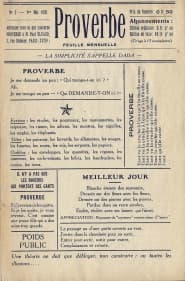
PROVERBE will be published on February 1st.
I would no longer believe myself authorized to ask for your collaboration if you had not promised it.
My dear friend, I would like, at the end, which is close, a yes or a no.
And then I will do what seems right to me
or good.
(...)
*
* *
January 16, 1920
Jean Paulhan,
You will forgive me for my somewhat blunt letter the other day, but I didn't want to surprise you too much. If you had not sent me anything, I would have published, incomplete, your note for my examples.
But, my dear friend, now I can only repeat to you that I am happy - and also as director - I have something perfect and PROVERB of February 1st, PROVERB No. 1, the perfect number, competes with the N.R.F of February 1st.
(...) Will Albert Uriet agree to collaborate on No. 2, in a very short way? 10 lines at most, on half a page. 4 pages force me to recommend brevity to my collaborators. Paul Valéry refused me his support, very kindly — and reserving himself for the future.
No. 1 really appeals to me. What I was given seems better than everything else.
I want to leave you with the surprise of this beginning. You will read everything carefully.
(...)
I hope to have many subscribers among people of your rank, since it is PROVERB.
I need an advertising line on my subscription forms.
I have yet to find any definition that satisfies me.
If you don't know anything, I will resign myself and purely and simply PROVERB, monthly sheet, will be "the first, the only perfect magazine".
(...)
*
* *
January 18, 1920
I will give you subscription bulletins to Proverbe, monthly sheet FOR THE JUSTIFICATION OF WORDS.
*
* *
[very early February 1920, before the 5th]
Jean Paulhan,
Thank you for your letter and for this announcement which I really like for PROVERB — very much, because it will change from the 1st issue, too short, too monotonous.
(...)
Will you come to the Dada Matinée at the Indépendants next Thursday?
(...)
No. 2: I asked Valéry again, Reverdy who asked me to participate in a morning, still with the independents.
And I, and Picabia for this sentence, I hope: "I have never succeeded in anything but putting water in my water" — Can you give me another text for the announcements, for this: for example:
"this sentence from Forain, which we could give as advice to some young avant-garde: You have to violate the rules, but to violate them, you have to know them" L'Intransigeant.
In the announcements, this other oriental announcement: (Goha the Simple)
“The world is big, some are fat and others are thin.”
Or even, for fun: On the sides of the knife... you confessed, etc.
(...)
But Proverb is entirely for you
*
* *
Tuesday [February 1920]
[Jean Paulhan to Paul Éluard]
Please don't make me wait too long for your opinion on Severe Healing. I miss him.
DANCINGS are an excuse
naturally all these announcements (if you publish them) without signature or initials.
I'm happy Gala is back. And quite strong?
There is a Valéry in les Marges.
Your friend,
PRESTEXTS are a dance hall
(...)
*
* *
Friday [February 20, 1920]
[Paul Éluard to Jean Paulhan]
(...) I will not continue PROVERB if you persist in not wanting to sign or if you do not give me anything for the next issues.
Basically, I really like that you don't sign these little things. (...)
*
* *
Tuesday [February 1920]
[Jean Paulhan to Paul Éluard]
Do you love me, I prefer it to be despite than for. If you came to pick him up on Wednesday — we would go together to the Literature café (why: “or anti-literature?” that was already there).
(...) Do you want to:
which are perhaps big words, I always saw
that everything happened as if.
I was told two or three times that we would subscribe to Proverbe.
*
* *
Fri[Friday early 1920? before May]
[Jean Paulhan to Paul Éluard]
(...) Why don't you make Proverbe a special anonymous issue. That would fit perfectly with the title.(...)
*
* *
[before May 1920]
[Jean Paulhan to Paul Éluard]
but quite seriously, you know: it is understood that you only put my name in Proverb if I ask you to do so — that is to say if it is worth it. Can't I have this confidence in you?
I wonder a little: "Who are we fooling here?"
Ah
I'm a little wrong — "Who are we ASKING here?"
[Texts intended for Proverb]
So much does the jug go into the water that in the end it breaks
So much does the jug go into the water that it breaks
So much does the jug go into the water that it breaks
As long as it breaks
So much
*
Who experiences long wars basically? It's you, it's me. Bundles of dead wood and green wood, the flame is not at ease there.
*
If I come back, I'll leave them. If I leave them, I want to come back. It's like a young girl whose breasts are too big.
*
The poet who has just written a beautiful verse looks at himself with the same shame as a young woman in mourning who gets up at her station, in the North-South, with too much vivacity.
*
Speak, speak. I am like bread that cannot hide its crust.
*
No, I don't want the wooden doll alone, nor the flower. It's like when the donkey kicks: both of them.
[Text intended for Proverb]
X, or contemptuous silence
Madame Rachilde wrote an article on Dada. It shows that one should not write an article on Dada.
Mr. Georges Courteline spoke about Dada for an hour in Comoedia. He said that we should not talk about Dada.
Mr Fernand Divoire never mentions Dada. He says: the "child's horse" party.
IF WE HAVE TO TALK ABOUT DADA YOU HAVE TO TALK ABOUT DADA
AND IF WE SHOULD NOT TALK ABOUT DADA YOU STILL HAVE TO TALK ABOUT DADA