Henry Church
The school of modesty
It is difficult, once we have once formed it, not to be more preoccupied than is reasonable by the idea that as children we had to make certain very serious interior decisions, to which our mood, our fantasy, who knows our conduct, still stems today. But what if we had taken them lightly, without knowing the facts? This is apt to worry us. We then decide to flatter the child we must have been. We try to win it – to start it again. We say to ourselves that childhood, after all, was the virgin world, faith, poetry. We even end up believing it.
But Henry Church hardly shows this concern. Did he even have a childhood? He doesn't see her. It is as if the decisions in question were taken yesterday, and there was still time, in haste of course, to take them again.
There has been no shortage of works for some fifty years, the main theme of which was anxiety, cataclysm, catastrophe. We can even say that there were too many. Don't come and tell me that the world wasn't happy. First of all it would have been a reason for literature to be so, what is this resignation? Then, it may be that a single joyful writer would have changed many things. Let's leave it at that.
Henry Church was not exempt. Anxiety erupts on every page of his stories in the form of allusions, such as assassination, suicide, fits of drunkenness or madness. But madness, suicide or assassination remain spontaneous and rather innocent for him. As if it had been so close. As if there was still time to start all over again. Other worried people were more violent or more concentrated, more passionate or more lyrical. He shows us worry in all its freshness.
In all novels there is a painful moment to go through: it is when the hero takes off from his character (and from reality), and cheerfully advances towards the great meaning, the symbol. Here the good novelist knows how to arrange slips, organizes traps, finally chooses, to deprive his man of a last remnant of humanity, the moment when no one is looking at him.
But it is enough for Henry Church, in his tales, to let the deep embarrassment act, and to form the unbreathable atmosphere which pure and restless hearts spread around them. His characters resist as long as they can, before modestly withdrawing.
Here is the tale of the Clowns: a young American is going to spend the evening at his club. It is a circle richly housed for several months: in marble. (Here, a little story of the circle.) There he dreams of the platitude of the time, of trade unionism, of free thought, of symbolism — then dozes off. A new character appears, the Colonel. He downright misses the good old days (candles, nymphs, pleasures of the fields). As proof, he will tell a little story.
The hero of the short story is a good drunk, Jack, who puts on a frock coat and top hat to pilgrimage to the vineyards of Burgundy (short story of the pilgrimage). Now this Jack one day takes the Colonel on an excursion to the Blue Meadows. The two friends climb a mountain, contemplate the Ohio valley, have lunch on the grass. And then...
Notice that the tale is coming to an end. Well, that's when they meet clowns in the open fields. Real clowns, whose faces are smeared with white, their eyebrows drawn in black pencil. But these clowns ask them for advice. They are dealing with a clown candidate, whose behavior baffles them. But here is the candidate:
The strangeness of his appearance, from the beginning, surprised us. He wasn't doing anything that clowns usually do. At first he stood still, making vague gestures with his hands as if juggling imaginary objects, opening and closing his mouth in a slow rhythm. Then he looked at us to see if we were following his idea. Suddenly he started running like a madman. Then, stopping suddenly, he did a pirouette and seemed to sketch the movement of a somersault, without actually doing it.
The end of the tale is sad. The indignant spectators rush towards the unfortunate joker and more or less massacre him. Hurdley and the Colonel just have to go home. The Colonel and Church meet up at their club. Everything folds up, everything is finished.
It seems to me that Henry Church founded a school that day that I will happily call the School of Modesty. It is a school which has followed its course, and exercised its influence, modestly.
Jean Paulhan, 1948.
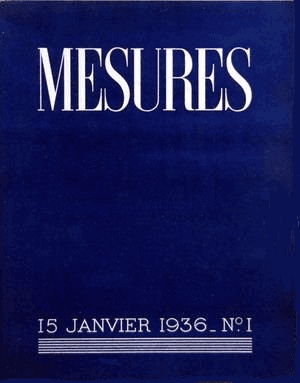
See the tribute issue of the magazine Mesures
Resources
See The editorial staff of "Measures", Sylvia Beach, Barbara Church, Vladimir Nabokov, Adrienne Monnier, Germaine Paulhan, Henri Church, Henri Michaux, Jean Paulhan, Michel Leiris - photographed by Gisèle Freund in 1937, CGP.
Correspondance : Barbara Church & Jean Paulhan, 1950-1958
Bibliography of texts published in the journal Commerce
The texts below, published in the journal Commerce, are grouped into two sets: texts by Henry Church and texts translated by the author.
Translated texts by Henry Church
- Richard Aldington, Le cœur mangé (p. 165-189), printemps 1930 [260 p.]
Bibliography of texts published in the journal Mesures
The texts below, published in the journal Mesures, are grouped into two sets: texts by Henry Church and texts translated by the author.