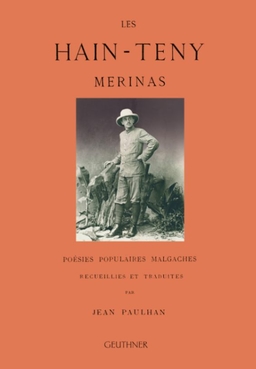
Les Hain Teny Merinas, poésies populaires malgaches
Jean PaulhanBy publishing the first collection of hainteny in French with Paul Geuthner in 1913, Paulhan made part of Malagasy culture accessible. He turned Imerina (the land one sees from afar) into a distinct yet shareable domain, a distant sign that still beckons.
Intended for scholars, this book also circulated among poets, for whom it raises the question of how language produces effects. Highly poetic in its translations and rich in pure narrative moments, it is also marked by a double anxiety: the words recorded here might have been lost, yet collecting them may itself be experienced as a loss. The antiquity of hainteny is the quality most often associated with it, along with respect for ancestral wisdom. Unlike the Malay pantoum or the Japanese haiku, the word hainteny has not entered modern French dictionaries. What is a hainteny? An adage, a saying, in any case a popular proverb, originally in an erotic register.
If Paulhan retained the thesis of the popular character of these texts, their erotic value was erased from later dictionaries, because the genre evolved, perhaps, but also because the self-censorship of informants and collectors was influenced by the missionaries. Paulhan has a sense of the progressiveness of meaning. Also “the discovery of a meaning is not an immediate datum of consciousness, but the result of an “experience of the proverb”, which emerges from the depths of “the observation of the proverb”, when the latter has been exhausted. It is a process punctuated by scrupulousness, and regularly punctuated by formulas.”
Paulhan's Malagasy work remains a critical work, which leads to the denunciation of two illusions, that of the explorer and that of the translator. All of this is basically already in the very word hainteny, understood as “words-of-science” or “language-science”. That a text is scholarly, useful, possibly poetic, that it touches its recipient, that its fluidity is divisible into dialogues, this is the entire program of Jean Paulhan's reflection and life.
ISBN 10: 2705337822
ISBN 13: 9782705337827
Collection: Varia
Pages: 500
Format (mm): 125x180
Weight : 470g
Extrait, Traduction de trois poèmes malgaches.
THÈME DE L'HÉSITATION ET DES RIVALES
— Par ici, au Nord Sont deux petits citrons pareils.
L'un est mûr, l'autre encore vert.
Si je prends le mûr, j'ai honte devant le vert
Si je prends le vert, j'ai honte devant le mûr.
— Ne me touche pas, toi, je suis encore verte.
Laisse-moi mûrir dans la main de celui que j'aime
Un homme parle. Une femme répond.
Deux citrons : deux jeunes femmes.
THÈME DE LA SÉPARATION ET DE L'ABANDON
Dis aux nuages d'attendre
Car le vent diminue.
Dis au lac d'oublier
Car les oiseaux n'y viendront pas dormir.
Il est mauvais d'oublier tout d'un coup
Il est bon d'oublier peu à peu.
Une femme parle.
Le vent et les oiseaux sont la femme, les nuages et le lac l'homme qu'elle s'apprête à abandonner.
THÈME DES REGRETS ET DES REPROCHES
— Quel est cet homme, devant vous ?
— Je ne sais, je ne l'ai pas rejoint.
— Quel est cet homme, derrière vous ?
— Je ne sais, il ne m'a pas rejointe.
— Pourquoi donc restez-vous debout ?
— Je ne reste pas debout, je me suis levée par hasard.
— Pourquoi donc soupirez-vous ?
— Je ne soupire pas, je baille.
— Pourquoi votre esprit paraît-il égaré ?
— Mon esprit n'est pas égaré, mais je réfléchis.
— Pourquoi avez-vous les joues creuses ?
— Ce n'est pas exprès que j'ai les joues creuses,
mais mon enfant est mort.
(Elle se met alors à pleurer, et fait de la peine aux gens.)
Un homme parle. Une femme répond.
La Société des Lecteurs de Jean Paulhan a publié dans le premier numéro de son bulletin Jean Paulhan et ses environs un intéressant Dossier : Autour des « Hain-Teny »
À propos de Madagascar, voir aussi les Lettres de Madagascar, 1907 - 1910 et Le repas et l'amour chez les Merinas
Voir aussi en revue :
L'expérience du proverbe, Commerce, n° V, automne 1925
Editeur : Paul Geuthner