Jacques Rivière and the modernity of the 1920s
par Bernard BaillaudAlain-FournierAndré BretonAndré GideGuillaume ApollinaireLouis AragonBenjamin CrémieuxJacques CopeauJacques RivièreJean PaulhanJean SchlumbergerMarcel ProustPaul ClaudelPierre Albert-BirotPierre ReverdyAlbert ThibaudetAdrienne Monnier
Lire la version PDF du texte (avec les notes)
Modern ?
That the “circuit” of the N.R.F. was hardly keen on etymology, a discipline deemed classic, does not require us to neglect its contributions today. Modernus, modernitas : Félix Gaffiot retained neither the adjective nor the abstract noun in his dictionary of classical Latin - he is also the author of a work entitled For the real Latin, well aware that there were others other than the true one - any more than the online dictionary Olivetti does today, which advises us to check the spelling of modernitas, as this term seems foreign. There is a logic to the fact that classical Latin knows neither one nor the other, since what is new appears to be deprived of this type of foundation that the ancestors provide, one might as well say illegitimate - on the cultural level that is. On the other hand, modernus is attested in late Latin, in the sense of recent, current, the French adjective modern taking up the meanings of hodiernus: what is of today, of the present, without valuation of any kind, as the notion of beautiful today seems selective. By pejoration, Petrarch includes under the term modern all science of the faculties of theology, law as well as the Gothic style.
Conversely, talking about modernity seems today an obligation, a necessity, an obvious fact, which risks wear and tear as much as obsolescence, as this root seems perpetually linked to current events, not without success, since modernitas, failing to be recognized as a Latin word, is present in an international language like Indonesian. We will therefore admit that the word modernus comes from post-classical Latin. It is derived from modero, with the suffix –nus, derived from modus, which since measure has taken on the meaning of mode, way of being. If we follow this line of meaning, we will recognize that the title of the review Mesures, initiated by Jean Paulhan between 1935 and 1940, can be understood in the sense of Modernités, in the plural. But to be modern is not necessarily to have a sense of moderation, it is to be fashionable, to flow into the fluid form of modification.
The Dictionary of the Classical French Language by Dubois and Lagane (Belin, 1960, p. 327), which can be read as a dictionary of lost meanings, does not give any modern root term. Émile Littré knows the adjective modern in the sense of being of the latest times, and offers us the verb moderner in the sense of restoring for new uses, the adverb modernement, the noun moderniste in the sense of one who values modern times above antiquity - enough to fuel a whole quarrel, that of the Ancients and the Moderns - and modernity as a neologism: quality of what is modern. Logically, the antonyms are more stable than their opposing part, located on the side of ancien or even antique. Such as the agonistic principle of the quarrel.
That The NRF was a modern journal is nevertheless in little doubt, as evidenced by its difficulty in fitting into the post-modern era. It remains to be seen what this means, and to what extent it was. “_La Revue de M. André Gide is a school of literary arbitration. Arbitration, as it is taught there, is intended to replace criticism. It is distinguished above all in that it does not exercise any positive or creative action on the parties involved, and that with the air of judging it only records,” wrote Henri Clouard in 1912. The N.R.F. did not appear at a time when classicism, although established as a model in the classes, was dominant, romanticism having tried, in its different forms, to pass over it. She did not seek to found a movement, to add an –ism to those that were already available, any more than Jean Paulhan sought to add an idea to those that were already popular around the world. It belongs — and contributes — to an era where trends are in some way embodied by galleries, magazines, houses, collections, with their directors. To speak of his subject as modernism is from this point of view debatable. It is undoubtedly for this reason that we have long preferred, and still today, to speak of an nrf spirit - even if it means regretting the obsolescence of this name.
On the other hand, The N.R.F. offered its model, its typographical pad, its characters, its editorial form, its absence of illustrations also to currents established elsewhere, and which found in it, if not a sounding board, at least a critical reception and an extension of their initial domain. This was all the more true as the firm N.R.F. has two distinct meanings: a review, from November 1, 1908, then a publishing house, backed by the review, the two entities interacting variably with each other, depending on the authors, publishers and collections. It is also a place – and still today, the signature of Antoine Gallimard, toilets included. Let us add that modernity cannot be a blank slate, since it presupposes a pre-existing older than itself: thus we will call modern Sisyphus a condemned hero in search of an inaccessible goal or a modern Cassandra the incarnation of a lucidity dedicated to speaking the truth without ever being heard. But these expressions presuppose at least partial knowledge of their respective myths.
The case of Jacques Rivière is involved in what we have just said: he is modern in the sense that he seeks something new without omitting the past; he is modern in the sense that during his lifetime he opted for the most recent forms of literature (Proust), art (cubism), music (the Russian ballets); it would be modern in the sense that it would still take on the name of what is new today. On this last point it will be prudent to remain questionable but we can note that the avant-gardes of the 20th century are still considered innovative today, even a century later, as if the natural step of the avant-gardes was standing still.
The notoriety of La N.R.F. in the 1920s was strong enough for the magazine and its environment to be mentioned in current novels: Les Cinq Sens by Joseph Delteil, a light novel of slight anticipation, published in 1924 and which relates the plague in Paris since May 5, 1925, mentions the death of Louis Aragon and the panic at La N.R.F. in the face of the plague, trying to literally escape the pestilence: “The N.R.F. went around the world.”
Jacques Rivière
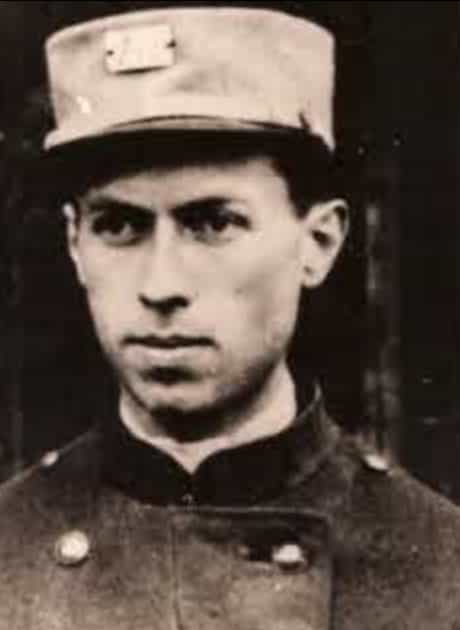
Jacques Rivière (July 15, 1886 – February 14, 1925) was active in literary life from the age of twenty and his premature death, on February 14, 1925, gave his notoriety the trait of an interrupted trajectory (we think of Rimbaud, to whose reception his name is linked, or to Apollinaire, if not to Orphée himself, but also to the many deferred victims of the war). She also gave him the accent of an injustice, but we will see that this injustice of fate did not give his name the relief that we had the right to expect. His premature death above all deprived him of the continuity of the exercise of a literary life, which, taking into account his precocity, will still have lasted around twenty years.
Among the effects of a premature death, we will count the absence of Jacques Rivière during the Second World War, to which his generation was doomed. That would be saying too much, since precisely the books of Jacques Rivière, and in particular L'Allemand, were in demand during this period: banned by the Germans, partially taken up by the Allies.
Among the signs of notoriety, the photos which accompany it and which have the merit of disseminating an image figure prominently. Jacques Rivière would have been linked to writers better known than him, like his brother-in-law Alain-Fournier, or greater than him, like Paul Claudel or André Gide, names from which he would have found it difficult to disengage. Let's say it right away: literary criticism being a total commitment for him, it was difficult to imagine that Jacques Rivière would easily let go of his admirations, a word which for him is synonymous with reading. His major admirations resist his most nagging scruples very well. And Gide himself wrote that if they had always been opposed, even adversaries, they had never been in a relationship of master and disciple.
However, Jacques Rivière avoided imitating the masters, even in the choice of the title of his first book, Études: the word suits music, painting, as well as literature.
“[Jacques Copeau] gave me a lot of very interesting reasoning which decided me (definitely, I don't want to come back to this again) to call my book: Études. _I think he is right. In any case, I'm jumping into this like a blind person. It's over.
I will tell you another time the reasons which detached me from: the Imitation of the Masters. _One of the most serious is this: Ernest La Jeunesse wrote a book entitled: The Imitation of our Master Napoleon. This alone seems sufficient to me.”
The controversies which followed his death will have had the first effect of shifting the reader's interest towards indiscreet areas (the private life of Jacques Rivière), or literally improbable (the faith of Jacques Rivière), as literary discourse, always ready to imagine that it is discovering unknown lands, struggles to stabilize in its area. Specialists in literature, we are neither in bedding nor in liturgy. The positions taken by each say as much about themselves as about their object. Distrust of abusive families made it easier to lose the information they legitimately held. And mutato nomine de te
fabula narratur…
If we try to stick to the facts, we will first say that Jacques Rivière is the friend of Henri-Alban Fournier, son of a teacher and future author of Grand Meaulnes. The publication of their correspondence, in 1925 and 1926, a veritable epistolary novel in four volumes, was the most effective sign of their common notoriety, making them inseparable, right down to the mortuary photograph, taken by a professional, distributed to relatives and for which a portrait of Henri Fournier was placed to the right of the deceased. By reading, from 1925, the correspondence exchanged between Jacques Rivière and Alain-Fournier, we look back to another decade, that of 1906-1914. The letters of 1906 will therefore have been read by the public from 1925, less than twenty years later, a relatively short publication period, for an edition of correspondence in the 20th century, the symbolic time hollowed out by the abyss of the First World War extending this period by twenty years. Modern in this way, Jacques Rivière's books have been from the start: even posthumous, they deal with recent times, present times, the beautiful and the terrible today. These short rhythms, these restricted chronological gaps, remain a characteristic of modern history.
This correspondence, which reads like a novel, is also a library in itself: a testimony to the readings of a generation, coupled with an involuntary bibliography, intended for those - the unfortunate ones - who do not know what to read. If you don't know what to read, at least read what the authors you're reading were reading. You will have the added bonus of not having to finish it. It is infinity that will open before you.
The name of Jacques Rivière is also linked, and in some way carried along, by two other names, those of Paul Claudel and André Gide. Two names of equal magnitude and contrasting reputations. For the first, the primitive scene takes place in a bookstore, in Bordeaux, when Jacques Rivière opens a book by Paul Claudel, L’Arbre, published in Mercure de France. It is a collection of theater, but the force that carries Rivière is that of the Claudelian (poetic) language as much as that of the theater. For the second, André Gide, one would be tempted to ask, regarding Rivière: what was he going to do in this mess? This would be to forget the genius of Gide's dialogue, a capital contemporary, his force of attraction, and his capacity to reveal others to oneself. Other names arise: two people from Bordeaux, Alexis Léger, future Saint-John Perse, perfectly silent in Gabriel Frizeau's living room, and François Mauriac, completely intimidated in front of Jacques Rivière, without forgetting Jacques Copeau, Parisian then Burgundian, who made theater a modern art. All these names are linked to literary modernity.
Jacques Rivière's compass opening is wide: narrative writing of novels, literary, musical, pictorial criticism. His political commitments relate to Franco-German rapprochement. Jean Paulhan will take up this opening of the compass, music excepted, but with a greater initial interest in the human sciences (ethnography, linguistics), and hot political interventions: Popular Front, war of 1939-1940, commitment to the Resistance, positioning in relation to the purge, European construction. Without overusing the comparison, Jean Paulhan, who is two years older than Jacques Rivière, has a longer lifespan than Jacques Rivière.
War, deliverance and recovery
June 1, 1919. The name of Jacques Rivière is associated with the resumption of La N.R.F. after the war, in a context which first reveals the differences in memories of the war. From the first day of the war, the editors of the magazine were dispersed, making any regular and joint work impossible (Le Mercure de France was able to postpone its interruption; other magazines were born during the war, such as SIC by Pierre Albert-Birot, but they were in a way individual magazines). Jacques Rivière was taken prisoner, for several years, with the destructive feeling of not having fought, and like many, of surviving without legitimacy. But from the moment the end of the war was anticipated, the prospect of the resumption of the N.R.F. became explicit. Gaston Gallimard, who made several stays in the United States in the wake of the Vieux-Colombier tour, wonders if he is not going to settle there permanently rather than in France, but it seems that this intention hardly lasted - or remained an idea. Jacques Copeau, André Gide, Jean Schlumberger, reconnect with Jacques Rivière, whose personal situation has just changed radically, from prisoner to free man, taking into account the airlock created by his new Swiss friends. Very quickly Jacques Rivière started giving conferences again in Switzerland. Jacques Rivière in turn informed Jean Paulhan of the plans to take over the magazine.
Letters or public addresses, several pretexts testify to this project to take over The N.R.F.
The first is that of Jacques Rivière, published at the top of the first issue, that of June 1, 1919. The first thing was to put an end to the Great War, which was not yet called the First World War.
“The war has come, the war has passed,” Rivière writes simply, not to deny the deaths – he mentions further “the enormity and the atrocity of the events we have just gone through”, he who has just lost his brother-in-law Henri-Alban Fournier – before directing his reflection on the aesthetic effects of the war.
Because it mobilized intelligence, diverted them from all other concerns, in a monarchical manner, the war was an aesthetic failure: “Who could cite a single truly ingenuous work, a single stem that is mounted straight?”, Jacques Rivière pretends to ask, no doubt thinking of the Latin etymology of sincerity: the pure line of plant growth. Rivière ultimately calls the war, by periphrasis, a “terrible emotion” — this search for metaphor in Rivière will remain a trait of his writing, even in the unfinished novel, Florence. And the most serious defect of war is to make sincerity, that is to say the growth of the plant, impossible. Incidentally, it is futurism that finds itself condemned, in its aestheticization of war and the machine. On the other side of the Alps, Fritz von Unruh.
In The N.R.F., war texts are not legion, to the point that one can wonder if war is still a literary theme for it. Gaston Gallimard himself fears war as much as he disapproves of it, he does not wish to publish too many war novels, and the magazine in his eyes is not made to host massive events whose first cultural result is to disperse writers and prevent literary growth. Published in 11 volumes from 1922 to 1940, Les Thibault by Roger Martin du Gard is an exception, and the edition of the last volume will be the subject of discussion - Jean Paulhan, in a letter to Jean Schlumberger, declaring inopportune the publication at the very beginning of 1940 of a novel entitled L'Été 1914. In fact, the works which deal with the war published by La N.R.F. smell of pacifism more than militarism.
On this point, the well-known examples of Paul Claudel and François Porché can create illusions. The editions of La N.R.F. published in 1915 a collection entitled You are men, by Pierre-Jean Jouve, a poet whose pacifist positions are known in Switzerland and whose collection opens with an address “To the enemy brothers”. The term warrior, used by Jean Paulhan as the title of his war story, The Applied Warrior published by Edward Sansot in 1917, demonstrates the difficulty of the fighter to coincide with this war, the discovery that patriotism constitutes in him, rather than youthful and complete adherence to a generational mission.
Jacques Rivière is divided between the obvious need to pay homage to those who sacrificed themselves and the risk of seeing ordinary words miss the reality at stake: “we cannot resume our task as writers today without meditating for a moment on their sacrifice, without representing it from within, without understanding with the despair that is necessary, how any reward that we can imagine will remain forever distant, powerless, ridiculous.” This “necessary despair” is more faithful to the memory of self-sacrifices than the ideas of homage or reward: ““Deaths for France”. And Jacques Rivière continues: “We must take away from this splendid title what it took, for having been deserved, alas! by too many people, too common, too natural. The ingratitude of the human heart is so deep and so active that it quickly made these four words synonymous with the most ordinary: we no longer realize what they contain; we put under them one of those “ready-made ideas” that Péguy hated more than anything in the world; we even use it, in many cases, to send more quickly and more conveniently memories that we do not have the strength to support. The schism between the impossibility and necessity of representation will remain untenable, unless we choose the only form of homage that is suitable for writers who died in the war, the reading of their works and the anthologies dedicated to them.
If we delve a little more precisely into the bibliographies, we note the verses of Georges Simon, placed under the title “War Surgery”, published in La N.R.F. of September 1, 1919. They relate the sensations of a seriously injured person, from the injury to waking up after the operation, without epic inflection or patriotic valorization. Raymond Lenoir, in “French thought in the face of war” notes that during the war “it was necessary to act and no longer think” and rejects the terms of race, Gallic spirit and Latin genius – “The real France is elsewhere”, he writes. Luc Durtain's collection, The Return of Men, through its hallucinated visions, terrestrial, aerial, maritime, makes fun of the parade of "July 14, 1919". Pierre Drieu La Rochelle writes “The Return of the Soldier” for the issue of August 1, 1920. The Poem of Deliverance by François Porché appeared elsewhere, by Émile-Paul Frères in 1919. On May 1, 1924, Alfred Fabre-Luce reflected “On the idea of victory”. It is therefore quite logical that Jacques Rivière, a former prisoner of war, internally tortured by the fact of not having fought and surviving, moreover his own brother-in-law, pleads for the demobilization of intelligence.
Meetings, correspondence, reviews, criticism
In terms of literary history, the impactful cocktail is made up of meetings, correspondence, reviews, critical notes. At the beginning are the meetings: André Breton met Guillaume Apollinaire, on May 10, 1916, in an annex of the Val-de-Grâce hospital, called Villa Molière, just after the poet's trepanation; on April 27, 1917, Albert Uriet asked Jean Paulhan if he was thinking of writing to Isabelle Rivière; At the end of September 1917, Louis Aragon and André Breton, young nurses, became friends in Val-de-Grâce; in October 1917, Jean Paulhan self-published his war story, The Applied Warrior; André Breton wrote to Jean Paulhan on June 27, 1918; Jean Paulhan wrote to Paul Eluard on January 17, 1919; André Breton and Paul Eluard met at the Hôtel des Grands Hommes on March 8, 1919; André Breton then introduced Louis Aragon to Jean Paulhan; all frequent the same bookstore, that of Adrienne Monnier, “La Maison des Amis des livres”, founded in 1915 at 7, rue de l’Odéon; Jacques Rivière and Jean Paulhan met on November 28, 1919, thanks to Roger Allard; André Breton wrote to Gaston Gallimard on March 26, 1920.
The N.R.F. appeared for the first time on November 15, 1908, with no other name than those of the collaborators, then on March 1, 1909, with Jacques Copeau, André Ruyters and Jean Schlumberger on the management committee. From 1909, René Martin-Guelliot, polytechnician, founded the magazine Le Spectateur, in which Jean Paulhan participated from 1911 and until 1914. Before 1914, Jean Paulhan, in relation with Jacques Copeau and Jean Schlumberger, tried in vain to collaborate with La N.R.F., as Jacques Rivière, armed with a refused text, took advantage of a visit of Gide at André Lhote to speak with him. In 1916, Pierre Albert-Birot founded the magazine SIC, which appeared until 1919; In 1917, Pierre Reverdy, who came from Narbonne, launched the review Nord-Sud, which had sixteen issues until October 1918; Jean Paulhan leafs through the magazine Dada (seven issues between July 1917 and March 1920, the last two published in Paris), in the bookstore of Adrienne Monnier already mentioned; in March 1919, Philippe Soupault, André Breton and Louis Aragon founded the review Littérature, which, after interruption, had a new series in May 1922, and ran until June 1924; in June 1919, La N.R.F. reappeared, under the direction of Jacques Rivière; in December 1924, the surrealists launched The Surrealist Revolution, the first four issues of which were printed in Alençon.
In The N.R.F. the reading notes assume the diversity of positions. André Breton gives La N.R.F. a note on Lautréamont, which Gaston Gallimard considers distant from its subject, but not from its author. On the verge of refusal, but it is a question of sparing the potential, for the journal, of the young author in question. However, certain notes are refused: a note from Roger Martin-Guelliot on Thibaudet's Charles Maurras is refused because the polytechnician is too close to Action Française; despite Jean Paulhan's efforts, Bergson's texts are absent from La N.R.F, notably because they are written in too specialized a philosophical language, and because La N.R.F. wants to remain a general journal.
We must recognize Benjamin Crémieux, as well as Albert Thibaudet, for having maintained, each in his own way, a discourse of literary history, particularly on the post-war period, which allowed successive generations to understand themselves. It is on the occasion of the publication of Benjamin Crémieux's essay, Disquiet and reconstruction that Denis Saurat wonders in La N.R.F. on “The post-war: the “modern” style” — we will have noticed the quotation marks. Benjamin Crémieux considers that the “modern” period, opened in 1918 by three distinctive signs, the absence of universalism, the refusal of reality and the fragmentation of the self (romantic), ends during this year 1930. Yet the moderns are not represented by Benjamin Crémieux as those who, after romanticism and the avant-gardes of the first twentieth century, seek to return to classicism, but those who, far from continuing the work of undermining romanticism, would have assumed a double vandalism: "The classics seek reason", "The romantics seek passion”, “The moderns break reason and passion”, keeping only sensation for themselves.
Why choose 1930 as a break? The year coincides with the publication of a novel, now well forgotten, by Jean Schlumberger, Saint-Saturnin, a great work which, in the eyes of Benjamin Crémieux, no longer relates to the “modern” mentality. Reason once again becomes a virtue, fidelity a romantic theme, and religion ceases to drag man into a painful drama. Saint-Saturnin: the discretion today of the example chosen by Benjamin Crémieux cannot make us forget either the fluidity of literary categories nor the precautions of The N.R.F. before the modern term. But by abandoning the immortality of a self, by taking the step gained, that of sensation, the moderns have conquered, or reconquered, sincerity, courage, the search for eternity. However, these three values are homogeneous in relation to Rivière’s work.
Currents, movements
For literary historians, the most striking thing is that the review does not adopt the current terms of literary history. At most, Jacques Rivière writes that the founders were seven (André Gide, Michel Arnauld, Jacques Copeau, Henri Ghéon, André Ruyters and Jean Schlumberger) — a timid allusion to a (classical) renaissance. Beyond this discreet allusion, two currents are named: “We will make Symbolism and all its derivatives appear as simple means, now powerless, to multiply in extremis the chances of life of Romanticism and to provide it with a sort of artificial respiration for some time to come.”
We will recognize the sharp tone of the avant-garde youth, tempted by a clean slate, who does not hesitate to rid literary history of its trappings, now described as impotent. But Jacques Rivière will recognize elsewhere that his first literary emotions came from symbolism, a symbolism that he had to overcome.
With these two exceptions, his critical vocabulary is modern, in the sense that he writes the language of the present time. The N.R.F. poses itself as a movement in its own right, it does not define itself as modern, simply because it does not seek to define itself. Such is his genius. In June 1919, Jacques Rivière spoke of The N.R.F. as a person, as others, in June 1940, spoke of France. She is naturally French, and first of all by her language.
An abstract term emerges, however: liberalism, not in the economic or political sense, but rather in that of tolerance. Still, intolerance is explicitly named by Jacques Rivière as a pitfall, which can be pointed out, with a compass, on the map of the magazine's relations with the avant-gardes.
The novelty (we think of the new one by José-Maria de Heredia) is part of this non-definition, which expresses the direction, in the singular, of The N.R.F.: "let nothing escape from the infinitely rich and complex novelty that France, barely recovered from its terrible turmoil, already, in secret, we are sure, is composing and premeditating." The intention could appear hegemonic, compared to other journals, such as Le Mercure de France, or, more dangerously, La Revue Universelle — or even, a little later, Le Navire d’argent or Europe. But not letting anything new escape is indeed an ideal of an editor, or of a magazine director, and not just of a writer. Attention to the new is the main trait of the modern editor; on April 1, 1936, Albert Thibaudet preferred to speak of “Attention to the unique”, an attitude that Jean Paulhan in his collection “Métamorphoses” and Georges Lambrichs at “Chemin” will try to extend.
This is part of the ethos of The N.R.F., severity, demanded as proof of friendship, from one's friends. “You have no idea how much you please me by telling me so frankly that my grade is bad,” Gaston Gallimard already wrote to Jacques Rivière in 1912. But in 1924, when he deleted a note from Charles Du Bos on Sindral, pseudonym of Alfred Fabre-Luce, which he considered bristling with abstract terms, the scrupulous Jacques Rivière already asked the question: “Does friendship admit diplomacy?” And it was to fear, the next day and despite the expected negative response, of having caused pain to Charles Du Bos. Jean Paulhan had suffered refusals from Jacques Copeau, before 1914.
Until the end, Jacques Rivière will be haunted by the somewhat chemical relationship – chemical analogies are in the spirit of the times – between the elements of matter, and literary material. These will be his last words, transmitted by Jean Paulhan: “This obscure world which must be rendered by the most ordinary means... Not external life, but the principle, the breath… All the cells in their work… »
The first sentence will be used for the banner of one of the editions of Études. The sequel, no more than the previous one, is not delirium, since we find it previously written by Rivière on two occasions. It is first in a letter to Antoinette Morin-Pons, sent from Les Treize-Arbres, about L’Égoïst by Meredith: “The book is made little by little, like a body that grows; we see all the cells, but in their work of natural generation. It’s admirable!” Then in the Racinian passage from Moralism and Literature, about feelings: “They influence each other like chemical bodies which would always be in a free state”.
We know that this is the text of a conference delivered the same year.
To Dada (dedication)
The NRF will quickly be confronted with the most unexpected forms of
novelty. She is not in spite of herself, she confronts it herself, in three stages: André Gide, André Breton, Jacques Rivière.
It was André Gide, an incomparable actor and interlocutor in literary life, who took the lead, placing at the head of the summary of number 79 of La N.R.F., on April 1, 1920, a five-page text simply entitled “Dada”. The initiative is surprising, because the magazine has not published any Dadaist text, and does not intend to do so, but it is in keeping with current events, as the Dadaists, before the Surrealists, first achieved press success. As of April 1, 1920, the prospect of the Paris Congress, which would bring together all the driving forces of literary and artistic creation, is still possible: it will fail, but this failure is not yet a reality.
In a footnote, André Gide spins the metaphor: Dada is a wave, which lifts the youth, and on which they let themselves float: “those who appear to be the leaders, in this case, are only the first lifted by the blade, and the more absent is their particular reaction, the better able they are to mark the height and direction of the flow. I observe them diligently; but what interests me is the flow, not the traffic jams. » The corks will appreciate it, whether their name is Tristan Tzara or otherwise. This footnote says it all, including the anonymous character of the Dada movement, which does not yet have its -ism. It is not a question of individually studying the work of Tristan Tzara or of his epigones, nor of leafing through the Dada magazines, as Jean Paulhan does, but of grasping a natural movement, which later, but this is not Gide's concern, will enter literary history. Modern, therefore, is what relates to the present time. In reality, Gide plays on the signifier “Dada”; the event that constitutes his text is at the same time realized, performed and evacuated by these four letters, D A D A, placed at the head of the summary of The N.R.F. Gide does not seek scandal, does not mention any author's name, does not cite any literary inappropriate text, but attempts to measure the effects of a certain idea - Dada - of literature.
If we stick to the interior of La N.R.F., this text by Gide has two effects, on the part of two authors who are both close and contemporary, André Breton and Jacques Rivière, whose reactions the journal published in No. 83, on August 1, 1920.
Between yesterday and today, author names do not have the same resonance. André Breton was not, on August 1, 1920, the leader of surrealism — even less the Pope. He looks for work, is employed for a few weeks in material tasks, and is not yet part of a publishing house which will nevertheless become his, the Gallimard bookstore. But he already has his tone, airy, lyrical, sharp, formulaic: "It is impossible for me to conceive a joy of the spirit other than as a call for air." Unlike André Gide, André Breton handles the names of authors and extracts from texts. He mentions Guillaume Apollinaire and Jacques Vaché, cites authors close to him: Philippe Soupault, Tristan Tzara, Paul Eluard, Francis Picabia and Louis Aragon — seven names again, his own Pléiade. He displays some of the principles that will become guiding principles: “Despite its pretensions a novel has never proven anything” (the prohibition of the novel); “What affects us is generally less wanted than we believe” (hatred of reason, reflection, will); “If youth attacks conventions, we must not conclude that they are ridiculous: who knows if reflection is a good advisor?” (hatred of reflection); “Jacques Vaché's fortune is to have produced nothing” (the hatred of the masterpiece, even of the work). It is clear that Breton responds to Gide, and designates Dada's adversaries: Henri-René Lenormand or Joseph-Henri Rosny, the eldest, for having control over the debate. “Don’t know. Don't know, don't know, don't know", in the first person singular, is the conclusion of André Breton's contribution. (We will nevertheless note that this last sentence from André Breton is rhythmic, and would contain twelve syllables, if it were a verse. Speak ill of syntax, no doubt, but while practicing, voluntarily or not, Alexandrian, a resistant form of language, if not of literature).
Jacques Rivière, whose text follows in the summary that of Breton, had first chosen to title it: “Other considerations on Dada”, before opting for “Reconnaissance à Dada”. His text covers twenty-two pages of The N.R.F. Beyond the emotional vocabulary and its nuances, it is the maintenance of dialogue that Jacques Rivière was looking for: “When we criticize the Dada (this is a point on which I believe we are in complete agreement) for refusing communication with other spirits, we thereby create the obligation to establish it on our behalf. Don't you think?” Communication with the Dada spirits will be another story, but the fact of keeping them on the edge of the journal by confining them to reading notes was already quite a program.
André Gide, André Breton, Jacques Rivière: the order of the three articles may appear to give the last word to Jacques Rivière, responsible for the synthesis, if we retained the dissertation outline, here irrelevant. Let us also say that it is not a question, for The N.R.F. — any more than for us — of being for or against Dada, but of contributing to understanding an innovative, existing movement.
The degrees of a rise in power (Gradus ad enerefam)
Significantly, this Dada sequence accompanies the installation and confirmation of Jean Paulhan as writer and secretary of La N.R.F.
The name of Jean Paulhan appears for the first time in La N.R.F. as author of “La Guérison Severe” (No. 77, February 1, 1920); then two deliveries of “Optique du langue”, March 1 and May 1, 1920; finally notes on the “Various Dada Reviews” on June 1st. In five months, Jean Paulhan was established as the author of two stories, texts reflecting on language, and literary criticism devoted to magazines. This “rejuvenation of executives” is welcomed by two periodicals, L’Intransigeant and, in a more reserved manner, Action.
In terms of publishing and journal management, on February 2, 1920, Jacques Rivière promised Jean Paulhan to “study the question of knowing what work” he could entrust to him. On February 7 of the same year, he entrusted him with the task of cleaning up the manuscripts of Alain-Fournier, in particular Colombe Blanchet. From May 6, 1920, the dialogue sheets between Rivière and Paulhan began, for the preparation of the June and July 1920 issues of La N.R.F.; in June, we prepare the August issue of La N.R.F. We read July 1, 1920, on the second cover page: “Director: Jacques Rivière / Secretary: Jean Paulhan*”. This presence of Jean Paulhan alongside Jacques Rivière is seen as a useful refreshment, compared to the magazine of the 1910s.
From September 1920, Jean Paulhan was entrusted with a set of French poems written on the model of what was then called haï-kaï, or the lyrical epigrams of Japan - our haiku of today. If Louis Aragon is very severe in front of this collective fronton, The N.R.F. will have succeeded in bringing the Japanese form of haiku to a wider audience than its previous mediators: Paul-Louis Couchoud, Jean-Richard Bloch, René Maublanc... As in the case of the Malagasy hain-tenys, Paulhan's ulterior motive is to bring new poetic forms into the hands of contemporary French poets. “I was waiting for you in proverbs,” Jean Paulhan wrote to Henri Michaux, who was faithful to the appointment, notably with Poteaux d’angle.
There will be no documented disagreement between Jacques Rivière and Jean Paulhan, perhaps because the secretary knows his position and the disagreements take place elsewhere, with Paul Claudel, André Gide or Jean Schlumberger, not with Paulhan. From this point of view, for a little less than five years, the joint work between Jacques Rivière and Jean Paulhan will have been intense, harmonious and exemplary.
The difficult times come from the burden of running a monthly magazine, from Jacques Rivière's exhaustion - neurasthenia treated with sodium cacodylate - and from the loves of both: Jean Paulhan seeks a divorce from his wife Sala Prusak, Jacques Rivière, married, by his own admission suffers from the lack of women and finds them only unsatisfactory: Yvonne Redelsperger (1884-1968), wife of Gaston Gallimard, Nicole Stiébel, interesting novelist of the twenties, Antoinette Morin-Pons, whose relationship with Jacques Rivière is today the best documented of the three thanks to their correspondence which appeared in November 2025, by Gallimard, by Ariane Charton & Jean-Marc Quaranta.
Water sharing
Two interventions by Paul Valéry and André Gide with Gaston Gallimard on Literature facilitated the junction between the avant-gardes of pre-surrealism and The N.R.F.
The name of Jacques Rivière appears only once in The Surrealist Revolution, in issue number 8 of December 1, 1926, where Georges Ribemont-Dssaisignes writes: “We can believe, despite the concerns of Jacques Rivière or Marcel Arland, that we have not invented, nor reinvented God or his name. We sucked it with breast milk. We have nourished ourselves on a name that has hitherto poisoned the earth.” (p. 25a). It is therefore the religious question which separates Jacques Rivière and Marcel Arland on the one hand, both Catholics or considered, despite their scruples, as such, surrealists, considered - most often by themselves - as anticlerical, atheists, blasphemers. Reciprocally, the political question will separate the communist surrealists from the liberal writers, called bourgeois by the preceding. But Jacques Rivière will only see the emergence of the political question and will die before the Surrealists joined the Communist Party, which took place, as a group, in 1927. Likewise, he will not see André Breton insult Jean Paulhan - towards whom he nevertheless had an emotional request - then recoil before the prospect of a duel against Paulhan, which placed Breton in the position of the coward and Paulhan in the position of the winner without a fight.
La N.R.F. welcomes the prose of Louis Aragon, which does not fail to provoke a reaction from Paul Claudel, creating a dissociation of Claudel from La N.R.F. as a magazine, but not with the Gallimard publishing house. Jean Paulhan will seek to repair this separation, by regularly relaunching Claudel.
But essentially, The N.R.F. draws a fairly clear line between poetry of regular form, modernist poetry (that which is sometimes called cubist) and Dadaist or surrealist poetry. She published “Roman Elegies” by François-Paul Alibert (August 1, 1919), “Deux Élégies” again by Georges Duhamel (December 1, 1919), “Sonnets” by Henri Deberly (October 1, 1919), Paul Valéry’s octosyllables, “L’Abeille” (December 1, 1919, p. 1001). In The N.R.F. of 1919, the genres and poetic forms assume their classicism, as did the first collections of poems by Jean Schlumberger for example. Still in 1919, Pierre Drieu La Rochelle was the only one to retain the title of "Poems" in the plural, a denomination which corresponds to free verses, without a poetic genre title (July 1, 1919). The N.R.F. does not publish Dadaist or surrealist poetry, and confines the surrealists to reading notes, requiring them to say what their notion of literature is.
In 1923, Paul Valéry was the only one to use alexandrine in his “Study for Narcisse” (June 1). André Salmon's fragments for a “Saint André” are in free verse (May 1, 1923). Four authors choose the title “Poems”, without indication of theme, form or genre: Odilon-Jean Périer on February 1, Luc Durtain on September 1, François-Paul Albert on October 1, Jules Supervielle on November 1. The octosyllables of Georges Gabory are covered with the title “Airs de Paris” (March 1, 1923), those of Philippe Chabaneix with that of “Parentheses” (April 1). Francis Ponge gives “Three satires”, but in prose (June 1, 1923) and Marie Laurencin takes up the term “Petit Bestiaire” in very short verses (July 1). The January issue is devoted to the novelist Marcel Proust, the December issue is entirely in prose.
We were already subscribers in 1924. The year began with sixteen memorable pages, the first title by this author under this name: “Anabase” by Saint-John Perse, which will appear in volume in June, in the “Blanche” collection. The exclusive poetry readers had time to reread, since they remained hungry in February, with the exception of the note unsigned on “Maurice du Plessys” and that of Jean Paulhan on “Clair de terre” by André Breton: “We are still admitting that André Breton exists”. In March, we read “Ligne de vie”, by Paul Fierens — a Belgian poet close to Françoise Péchère, a great friend of Isabelle Rivière — where octosyllables dominate. In April, the texts of François-Paul Alibert are presented under the title “Under the storm” in the summary, under that of “Poems” in the body of the delivery. In May, Jules Romain, in his “Ode gênoise” which would appear the following year by Camille Bloch, did what he pleased, handling verses of eight or even fourteen syllables. In June, four pages of “Poems” by Pierre Reverdy. In July, the “Poems” by Gabriel-Joseph Gros, as in August, the “Mélange des deux jours, ma plus belle jour” by Camille Schuwer, are in octosyllables. In the same issue of September 1, 1924, number 132, the reader first comes across the name of Charles Péguy, who died ten years previously, on September 5, 1914, opens with "A correspondence", signed *** in the summary, then A.A. in the body of the letters - where we will recognize Antonin Artaud, just before "Le nuit au bord de l'eau" - an impressionist poem? no, rather by Odilon-Jean Périer, a French-speaking Belgian writer and modernist. In the October 1 summary, only poems, those of Maurice Chevrier, in disyllables, in hexasyllables, in alexandrines. A simple title: “Chants”, analogous to Jean Paulhan’s taste for songs. On November 1, Pascal Pia published "Le Bouquet d'orties", four poems in octosyllables, before tearing up, it is said, the proofs of the volume which was to appear under the same title. Dedicated to the novelist Joseph Conrad, the last issue of 1924 does not contain poems.
In short, The N.R.F. does not prefer the odd, and publishes a majority of poems in a regular form, starting with those of Paul Valéry, she gradually abandons the genres of the elegy, the ode or the sonnet (perhaps for generational reasons) and leaves room for modernist poets, those who break the regular verse but preserve French syntax (Odilon-Jean Périer, Pierre Reverdy, André Salmon, Jules Supervielle). The poetic contributions are generally short, and seem to play the role of a pause between two pieces of prose. It would happen to Jean Paulhan, a generation later, to regret the disappearance of old poetic genres, such as the epigram, and to practice it clandestinely, under the German occupation. We will have noticed the importance of the octosyllable, a wonderful even meter of high origin, a substitute for the alexandrine in an era that does not want to be classical.
Did we have to argue for so long?
Jacques Rivière was the subject of a dispute, between contrasting memories, which did not move in step. Modernity: it’s a question of rhythm, we said, including the rhythm of publication.
Did the sudden death of Jacques Rivière give speed to posthumous publications? The editorial choices of Isabelle Rivière, widow of Jacques Rivière, dictate an offbeat rhythm – we dare not say a fox’s trot. Following a short pace, Isabelle Rivière decided to publish all of the unpublished works in a single decade, 1925-1935, a period ten years later that Jacques Rivière himself had expressed. If this decision was discussed, and it is not possible that it was not, we will know when Isabelle Rivière's archives are physically opened. Because after all, Jacques Rivière's unpublished works could have waited a few decades in the archives - at the risk of being forgotten there. Did Isabelle Rivière feel invested with a mission that could only fall to herself and that would accompany the rhythm of her mourning? Have we underestimated the notoriety of Jacques Rivière, imagining a now or never which would have pushed us to hurry? Did we want Jacques Rivière's friends to read all the unpublished works during their lifetime? All these questions will find their answers when Isabelle Rivière's papers are classified, opened, available.
It is different for the correspondences, the publication of which is linked to the name of Alain Rivière, which returns, after Jacques Copeau and Isabelle Rivière, to the edition of the correspondences of Jacques Rivière.
From Jacques Rivière too, Jean Paulhan will have kept his dialogue with Ramon Fernandez, and not by siding with Ramon Fernandez. The paradox is that this autonomization of literature in relation to moralism - Jean Paulhan prefers to speak of dogmatism - will continue in its area with other proper names and in completely other historical and cultural conditions, as in this letter from Jean Paulhan to Manès Sperber which we leave n.d.: "Dear M.S. / Perhaps what gives / better the feeling of the “reactionary” is the concern not to confuse morality and literature/ture. Jean Bloch-Michel can / well write fifty critical studies, which he believes to be impartial, on / Céline, he will never hold back / from saying, or suggesting, / that Céline was wrong to... (to be / anti-Semitic, etc.) He is progressive, / he is even the progressive. But / Pierre Boutang or de Fallois are / capable, it seems to me, of judging / honestly — I mean without / confusion — a novel by Sartre. / Kind regards / J.P”. Follows, in blue ink, the handwritten draft of Manès Sperber’s response: “Dear Jean Paulhan, / No, in my eyes you are not a reactionary. […]” In any case, and even if Claudel protests to Gaston Gallimard against certain summaries that are too "garish", it is up to the reader to form his own opinion, his opinion, his culture - in a way his honey. Our reading of past correspondences and reviews is justified only by this: obtaining and practicing a look at the panorama of literature, whether this panorama is contradictory, unified, harmonious or in some way landscaped, including by ourselves.
Bernard Baillaud,
Library of Bourges,
September 19, 2025, 6 p.m. 30
© Bernard Baillaud