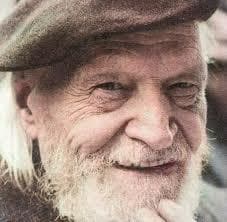
Giuseppe Ungaretti
We can say that we have seen them for seventy years! Greens and not greens, reds and not reds. Seventy years we have been drinking (as the primitives say) the blood, and we have been eating the flesh of so many unknown beasts. No, we were far too innocent, we had not asked for so many wars and occupations, so much abandonment and exile, so much History. Not to mention our own personal history, poor little pieces, poor little fibers, which continued with its slight pleasures and its strong pains, with its prides and its shames – ah! shame has not failed us –, with its deaths and more deaths. You, however, always in the first row, and of all one of the most exposed. And without fear.
Without fear, it would have been little: you replied. You responded to solitude, to the desert with The End of the First Time, to the war in the trenches with The Buried Port, to exile with The Sentiment of Time, to the death of your son with Il Dolore, to distresses and shipwrecks, with Allegria and The Promised Land. For the first time perhaps in history, we saw a great poet who was also a poet of occasions; and which grows with the years with each new opportunity.
Ungaretti, like all of us, has gone through humor and bitterness, through metaphysics and through passion. He knows that there is no valid image and poetry except that which brings distant objects into contact, the more distant they are. But I think he knew how to give full meaning to this old truth – old at least like us, men of seventy.
It is also the truth of the world. It is because a strange, incomprehensible space separates the act from the reverie, the thought from the language – and the flower picked (he says) from the flower offered. The fact is that at any moment our life could just as well stop – and everything would have to start again. Since there is no reasonable transition from one to the other. This is what the image warns us of, the more improbable it was; the gap that it manifests, however great it may be, is neither wider nor narrower than that which separates life from death, and the joyful navigation of this shipwreck of each moment from which we leave, like an old captain escaped from disaster. The dead make no more noise than happy grass. The eye of night watches our rest, the drops of stars. Death is the truest sleep. You said all this in your beautiful rough, hard, secret language, so quick to change the earthiness of chatter, the slightest stirrings of the mind, into idols.
I think on every page of Ungaretti, I venture to say, of Leopardi. But even closer to the Rimbaud of the seasons and the embers, to the Apollinaire of the fagnes. To the poems of the haijins:
Are they therefore dry
Sources
Remorse
Or
Each of my hours
I experienced it…
Another time
For there is no death which is not also rebirth, nor rebirth which does not proceed from a death, it is therefore that there exists near us, in the depths of beings and things, an innocent country, where time escapes us with space, and clarity arises at our side in beatitude. We simply need, on each new occasion in our history, to rediscover, perhaps recompose, this golden age. This too, Ungaretti wrote:
I burn the spaces and this time on the hill
Like a dream
Divine death
Jean Paulhan, 1960.
Resources
Giuseppe Ungaretti - A life, a work - France Culture 1988
Giuseppe Ungaretti Seminar - In Praise of Description - Collège de France
- Allegria di Naufragi: 1919-2019 - Carlo Ossola
- Ungaretti, Fautrier, and the living life of nature - Isabel Violante
- Ungaretti and its reception in Germany - Patrica Oster Stierle
- The poetry of Giuseppe Ungaretti: “indiscreet daughter of boredom”? - Olivier Chiquet
- Ungaretti and its classics - Carlo Ossola
Giuseppe Ungaretti legge "I fiumi"
Interview with Giuseppe Ungaretti (1961)
Interview with Giuseppe Ungaretti, 2 (1961)
Correspondance : Giuseppe Ungaretti & Jean Paulhan, 1921-1968
Bibliography of texts published in the NRF
The texts below, published in La Nouvelle Revue Française, are grouped into four main sets: texts by Giuseppe Ungaretti, notes and columns by the author, texts about the author, and, when available, translations by the author.
Texts by Giuseppe Ungaretti
- Hymnes, 1928-12-01
- Il me semble étrange et singulier qu'un homme mort depuis un siècle ait su exposer..., 1930-04-01
- Hymnes, 1931-10-01
- Poèmes, 1934-10-01
- Grandeur de Fautrier, 1959-12-01
- Le Paradis dès l'Enfer, 1966-01-01
- Sous le signe de Niobé, 1968-03-01
Notes by Giuseppe Ungaretti
These texts by Giuseppe Ungaretti may include reading notes, mood notes, performance reviews, miscellaneous pieces, or previously unpublished texts. They appeared in NRF sections such as Chronique des romans, L'air du mois, Le temps comme il passe, etc., or in tribute issues.
- Poèmes, 1962-04-01, Les revues, les journaux
Translations by Giuseppe Ungaretti
- Notes et Pensées, by Giacomo Leopardi, 1930-04-01
Texts about Giuseppe Ungaretti
These texts may include thematic studies about the author, correspondence, reading notes on works by or about the author, interviews conducted by the author, or works edited by the author.
- Histoire de Dada : lettres de Louis Aragon, Giuseppe Ungaretti, Paul Éluard, Tristan Tzara et Georges Ribemont-Dessaignes, by Collectifs, 1931-08-01, Notes et discussions
- Sentimento del Tempo, par Giuseppe Ungaretti (Vallecchi), by Benjamin Crémieux, 1933-11-01, Notes : lettres étrangères
- Les poèmes de Giuseppe Ungaretti passent pour être cérébraux..., by Armand Robin, 1953-07-01, Textes
- Les Cinq Livres, par Giuseppe Ungaretti (Éditions de Minuit), by Philippe Jaccottet, 1954-07-01, Notes : lettres étrangères
- Giuseppe Ungaretti, by Jean Guérin, André Pieyre de Mandiargues, 1954-11-01, Les revues, les journaux
Chronological distribution of texts published in the NRF (1908-1968)
This chart shows the chronological distribution of texts across the four categories defined above: Texts, Notes, Translations, and Texts about the author.
Bibliography of texts published in the journal Commerce
The texts below, published in the journal Commerce, are grouped into two sets: texts by Giuseppe Ungaretti and texts translated by the author.
Texts by Giuseppe Ungaretti
- Apunti per una poesia (p. 17-29), printemps 1925 [188 p.]
- Notes pour une poésie (p. 22-41), été 1927 [236 p.]
- Note sur Leopardi (p. 141-146), hiver 1927 [228 p.]
Translated texts by Giuseppe Ungaretti
- Leopardi, Pensées (p. 147-180), hiver 1927 [228 p.]
Bibliography of texts published in the journal Mesures
The texts below, published in the journal Mesures, are grouped into two sets: texts by Giuseppe Ungaretti and texts translated by the author.
Texts by Giuseppe Ungaretti
Translated texts by Giuseppe Ungaretti
- Marcello Gallian, Le monastère, 15 octobre 1935 [188 p.]
Bibliography of texts published in Les Cahiers de la Pleiade
The texts below, published in Les Cahiers de la Pleiade, are grouped into three sets: texts by Giuseppe Ungaretti, texts translated by the author, and texts about the author.