A young ancestor, Fautrier
Jean PaulhanJean FautrierThe enemies of modern art (like Mr. Berenson or Mr. Venturi) generally declare, in a solemn voice, that no one had ever made such a painting - apart from the wild centuries - and that our grandfathers Titian or Raphael would close their eyes in horror before Braque or Fautrier. To which the supporters of modern art (like Ms. Madeleine Rousseau or Mr. Mauduit) respond, in a weak but ardent voice, that on the contrary our ancestors have always done this for forty thousand years - apart from a few so-called civilized centuries - and that our Aurignacian or Bantu grandfathers would dance dances of joy in front of Picasso.
Thereupon they all rejoice. They think they have proven something. They didn't prove anything at all.
And why wouldn't modern art be new in every way, and admirable in every way! What is this terror, and this timidity? Of course, it is true that we are, in a sense, heirs and great-grandsons. But it is no less true that we are also ancestors — young ancestors, future great-grandfathers. This is what we always forget, and we are wrong to forget it. But I come to Fautrier.
Nothing is more deceptive than a table. The poem or novel warns the reader: we see all the space to cover, the pages to turn, we can guess the time it will take, what patience! Instead of a painting seeming to reveal itself entirely at once. He throws himself at your head, he throws himself at your eyes. At least he pretends.
And, of course, the opposite is true. A good painting never stops giving itself. It gives itself when we look at it, and even when we turn away from it. When we turn our backs on him. It’s wave upon wave, puff upon puff. It's like a secret spring that never stops gently stirring the grains of earth and sand. In any case, who is agitating them at Fautrier?
It is possible that not a single wish affecting art, and first of all painting, is entirely absurd. No, and not even the old dream of a moving painting. Painters are told repeatedly that they must rejoice in their limits, cherish the canvas with its two dimensions, resign themselves to their immobile characters and their stuffed apples. Yes, but sometimes the question gets turned around. It's not just the eggs, the pleated papers or the coffee grinders that we see here that are moving. It's not that they move in a still space. No, it is rather space itself which has set itself in motion, and moves through them, and from within transforms them.
And thank God! Otherwise there would be little left but to talk about colors, tones and values, it wouldn't be very joyful. But from one view to the next, everything is possible: relationships, confrontations, contrasts, in short, ideas.
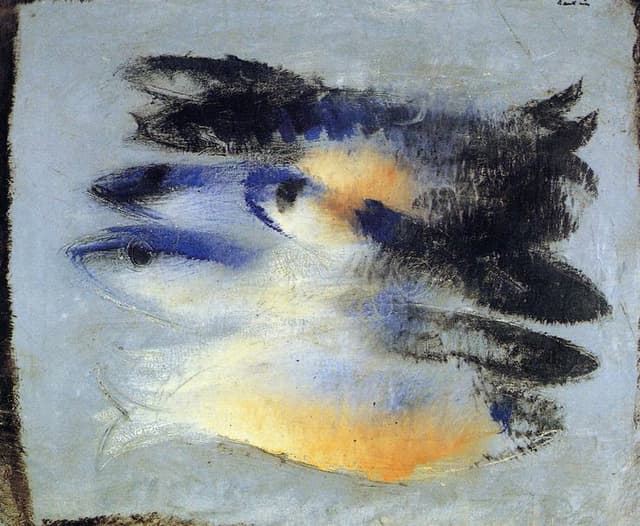
I can clearly see what can embarrass an honest critic - an honest amateur - in Fautrier's paintings: it is that they are both similar and not at all similar. We think we recognize a fortified castle, some knights' crack (seen through a wind of sand) - but it could just as well be a paper collar. A balloon glass, but isn’t it a forest of lianas? A locomotive is an inkwell. In short, there is not one that does not have, from one wave to the next, its dark passage and its tunnel (we find it transformed at the exit); if you prefer, its black plate, like the inspectors had their gridded window, and the Dutch paintings their white dot.
There have always been figurative painters (like Douanier Rousseau), who painted to measure, and abstract painters (like Wols), who painted in fantasy. They all also have their reason for being and their meaning: their clarity. But what can we say about a Braque or a Fautrier who, all at the same time, with the same movement show and do not show, invite and refuse, form clarity and extinguish it, give meaning - and it is another meaning which is the right one. What can we say, except that with them a painting begins and is founded, which should be called the painting of the dark side or of the contradiction.
I am not thinking of painters alone. The trait of a Fargue or a Michaux, a Lear or a Lewis Carroll, is that the misinterpretation in their works, for the first time, takes on its dignity - takes on, if I may say, its meaning. No doubt it is a misinterpretation which is due to a sentence, to a particular word (far from it separating, as in painting, one wave from another wave). But the difference comes from the nature of the Letters, which divide what the table confuses. For the rest, do we need to recall here what everyone knows?
This is because there is no clarity, in the order of the mind or sensations, which does not include an obscure aspect, nor any meaning which does not enclose its misinterpretation. If the flower, the man or the painting we are looking at were perfectly transparent, for us they would be neither green nor red, nor light nor dark. They would be to us as if they were not. And the ray of sunlight in the room reveals itself to the hundred thousand grains of dust that it does not penetrate. In short, it is only through darkness that we see light.
Philosophers observe, in the same sense, that it is not at all by reason that man trusts in reason, nor by thought in thought - but following that obscure adhesion which we still call faith. Thus, everything happens as if modern writers and painters had come a little closer than was common until them to the very sources of vision and the roots of thought.
But why, one might say, is it precisely these days?... Ah! that's another question. But we can, failing to resolve it, turn it around: and why wouldn't that be nowadays? Why wouldn't modern man have pushed a little further in this direction than men of all times? Why wouldn't our era be one of those heroic eras, which future eras will imitate at length? Why resign ourselves so quickly to being only descendants and great-grandsons? I appeal against such cowardice, against such humiliation, to all my young ancestors.
1955