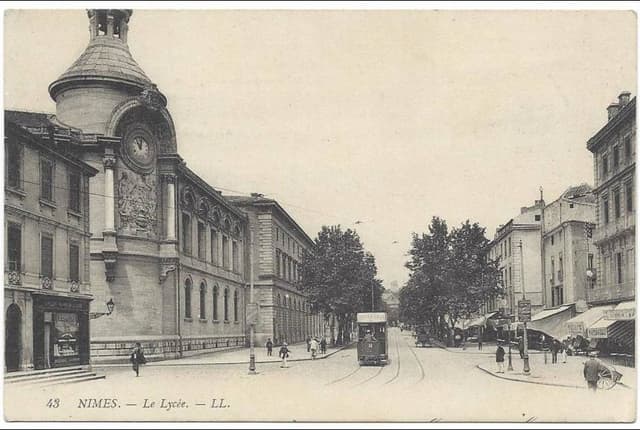
Memories of Nîmes high school
Jean Paulhan— Your childhood?
— It was only at the age of forty that I began to experience the daily surprises and wonder at the world that we generally attribute to childhood, which we even go so far as to call the gift of childhood. It’s a sense of wonder that grew stronger later, as I grew older. So I risk being unfair to my childhood memories in general, and high school in particular.
I don't think I'm exceptional at all. But I would readily believe that the poets who speak to us of the gift of childhood confuse the very legitimate joy they experience in writing their poems with a distant feeling that they would have once experienced. Their poems are a constant revelation to them. Naturally there are many childhood memories in their poems. And naturally also they write them with joy. They are very amazed to have written them. Life and the world when they discovered them were not. Or it was an unpleasant one.
I am not a rebel. I always felt like we had no choice. That if we wanted to live and lead a life that ended up being pleasant - which even ended up being delicious - we had to go through all kinds of tortures and constraints - the constraints that grown-ups had prepared for us.
So I always felt like I was being taken advantage of. Even today, I am amazed at the patience with which children agree to submit to the conventions of life in society, to the habits and manias of their parents, to play absurd games at command, to work up to eight and ten hours a day. I'm not saying they're wrong to do that. I say that when we also want to make them believe that they never stop being amazed by the sun, the grass and the animals, we are really making fun of them.
I was not exceptional. I wasn't raised by exceptional parents either. They were aware of the morals of their time. They were even a little early. I don't remember receiving a single slap in my childhood, nor a single kick, of course. In very serious cases - for example when I happened to set fire to the rags in our attic - I was given harsh remarks and put in the corner. Fifteen minutes around the corner, an hour around the corner. But the harsh remarks hurt me much more. I thought about it a lot more. A falling out with my parents seemed almost intolerable to me.
Yet when I think of the child's true condition it seems to me that it is a condition which would be more accurately expressed by slaps and kicks than by dignified reproaches and being put in the corner.
— But what memories do you have of school?
— I'm afraid these are mostly memories of great boredom. But I keep a pretty strong feeling about the local school, where I spent a few years. It was customary, as a welcome, to throw ten or twelve at the newbies, to beat them up a little, and then to drag them on their backs, pulling them by the legs all around the courtyard. It happened that during this operation their clothes were a little torn and soiled, they were not hurt that much.
In any case I remember that this little bullying scared me a lot in advance; and I was not without anguish seeing new people like me beaten up in this way. I was waiting for my turn. Then there was a minor accident — a boy's ankle was broken — and the bullying stopped abruptly. I'm still waiting for them.
— Don't you have any other memories?
— Yes. A rather humiliating memory. I couldn't have been more than five or six years old. I happened to forget myself in class. First my neighbors, then the professor, saw a small pond at my feet. I did ask permission to go out, but rather timidly, I'm afraid. And I didn't know how to snap my fingers. No one had noticed me. Strangely enough, the professor seemed even more confused than I by this little incident.
Stranger still, it earned me a reputation among my little comrades for indomitable will and tenacity. It was admitted at first glance that I had forgotten myself on purpose, in order to denounce the apathy and bad will of our professor - who in fact sometimes refused permission to go out. He never refused them again afterwards. I had made myself useful.
— Have you ever thought about writing?
— I was determined to do so. But a mishap happened to me. It seemed to me at that time that a story is made to amuse the people who read it, to distract them, to tell them stories of ghosts and savages. Ah, I've lost a lot since then, on that front. Never mind. So it seemed to me that the essential thing in a story is the subject. I invented topics; I invented them in piles. The problem was that I didn't go any further.
One day I had great hope. One of my comrades, Dubled, admitted to me that he too wanted to become a writer. He had everything he needed. Unfortunately - he confided to me - these are the subjects that I miss.
How lucky! I immediately entrusted him with four or five well-chosen subjects. Thereupon he avoided me for a few days and ended up telling me with an embarrassed look that no, these were not what he called subjects. I never collaborated with anyone again.
— But the Nîmes high school in all this?
— I'm very annoyed about it. No matter how hard I search, it doesn't remind me of anything.
Yet he taught me at least one thing. He taught me to waste my time. We lived in the suburbs of Nîmes, next to an artillery barracks, a sort of mazet. There was a large garden there, a sort of pine wood in the shelter of which I raised my frogs and toads, and I set traps for insects from the neighborhood. The trap was generally a bowl that I stuck in the ground. Ground beetles, ant-lions and other beasts fell into it and could not get out. I then applied myself to taming them. I don't know why I always thought it was possible to tame any animal. But after all, the road to my traps in high school was long. So every morning my mother gave me the four cents that would allow me to take the tram four times.
I didn't take the tram. In general, my four cents were spent on absurd purchases: cicada cages, perfected feathers with five beaks, surprises, roudoudous and sometimes (when I was able to save money) a white rat. But I had the pleasure of wandering, first in the countryside, then in working-class streets with their small grocery stores, then in bourgeois streets with their department stores. I arrived at school a little tired. I was resting during the lesson. Yes, I am left with a great feeling of calm and serenity from my lessons, and from my teachers.
Besides, I wasn't a bad student. I wasn't rowdy, I really needed rest. Even I had some antipathy for hecklers.
I wasn't selfish either. I would sometimes bring to my classmates the little cars or the marbles that I found in my surprises. And to my parents strange devices for cutting carrots or potatoes that I had bought from peddlers. My parents asked me where the money came from. I tell them. It seems to me that they were more surprised than irritated.
I'll come back to it. You might think, based on what I said, that I was a dreamy little boy. But no, I wasn't particularly dreamy. To tell the truth, it seems to me that something was missing from my childhood: something along the lines of punishment, torture, beatings. Deep down I vaguely suppose that there is in man, alongside a great desire for gentleness and love, a certain need for brutality, blows and beatings which also demands to be satisfied, which is satisfied at all risks; and that if we had received a little more beatings in our childhood from our teachers and our parents, we would have seen a little fewer wars later.
Date undetermined.