If words are signs (end)
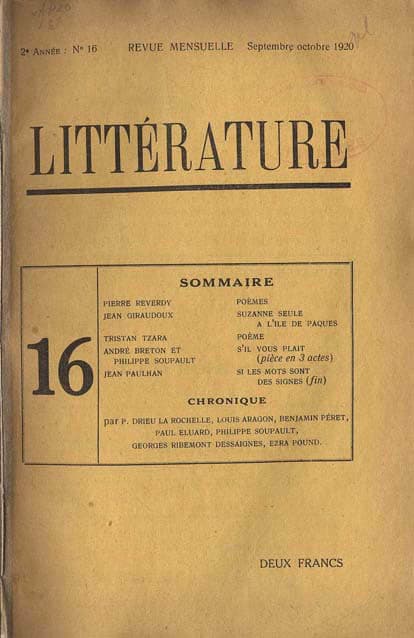
Jean Paulhanarticle original, Littérature n° 16, septembre 1920
If words are signs or Jacob Cow the Pirate (1)
(1) See nos. 14 and 15.
(END)
V. JACOB COW THE PIRATE.
Mac Orlan used to say that having fallen, with his sailors and his negroes, into the hands of Cow, this pirate had them ranged on the deck. He then moved from one to the other:
" What's your name ?
-Dick Smith, of Chicago.
- GOOD. To the sea! ”
We cast Dick Smith. When it's Mac Orlan's turn:
“My name is Jacob Cow,” he said.
Then, so great is the terror that this name inspires, Jacob Cow himself hastily returns to his privateer boat, lowers the sails and disappears.
We use words as if Jacob Cow had to run away every time. There are also forbidden terms, those which relate to devils and dangerous beasts. Weasel only offers one compliment: little beauty, the other name being misplaced. The old diseases that come back, it's under new words: censorship, last year, prohibited anyone from talking about the plague. And the young girls, to whom we speak for the first time, refuse to give us their names (dreading to give us some influence over them). “I never had the blues,” says Alcée, “before I knew the word.” A strange requirement, threatened at all times, maintained at all times: we would no longer bear to speak, one must believe, if words ceased for an instant to be the things themselves.
- Cow however, in reality does not run away. Béril does not allow himself to be seduced by the rhyme, nor by the advertising of sugar. “They’re buying us,” he thinks.
No doubt; and the reflection of Marcus Aurelius is not such that it cannot easily be refuted. The pun is little considered. By which we would notice that the cases, where we supposed to take in the fact this confusion of words with things, were also those where the confusion already threatened ruin: as if its defect alone, and already its crack, held our attention.
Our requirement as well, with this defect, takes on a new aspect.
VI. LANGUAGE FLATTERY.
Mire speaks, and lets himself be spoken. Effortlessly, he moves and brings cities closer together or apart, gold during the days or nights. The tongue, however, comes to twist him, and we ask: “Is this really the word he was looking for?” Some listener complains: “We don't understand each other,” replies Mire; understand my words better, I wanted to say...” Immediately the words appear, and like signs: this is where the meaning finds itself threatened, does not play, falls from its height, so that we can distinguish the thought on one side, the inert word on the other. Like a tennis player, who has just missed his shot, looks with astonishment at an arm, a racket, previously part of him, now foreign, and made of a difficult material.
The idea of the sign bears, alongside this failure and just on its occasion, the mark of confidence. It informs us that words, whatever they may seem - and even this one which has just disappointed - belong to ideas, that there is a natural agreement between them, that they will make sense again. Practical idea, of defense, and not the simple observation that one might have believed; she repeats: each idea has its word, each word its idea. A timid person thus says to himself: “How calm I am, is surprised how calm I am,” and encourages himself.
This brings together the facts that were initially opposed. It is precisely because they want to make it a sign, and on it to obtain this success, that Cilia and Atlys, starting from the word which baffles them, will imagine some thought, of which this word is no more than the appearance; such is their defense against language, dangerous or embarrassing, where it must be noted for such, to the point that it is appropriate to say that people speak and express themselves against this language - instead of through it.
A practical man believes that humanity, as a whole, is made up of scoundrels; he adds that every scoundrel is good for something, when you know how to handle it. Now our idea of the sign comes from a wisdom of the same order. I want her to save us from serious disappointments: all the same, too defiant, always concerned with imagining the worst, she neglects the first resource of words, their naive resource.
(These two men who meet, and say: "How are you? - Ah, Sadoul has been condemned to death", or this young woman to her friend: "Who are they calling me? - Georgette dear, Georgette in gold - The miser! No more?", we must admire what reality their language immediately achieves. Where literary works, which should claim a neighboring reality, or even more independent, nevertheless seem hesitant, and as if erased, we will insinuate that it is for having too easily accepted as ideal this state of the weakest language, where words at every moment signal to fail us,
and the only one taken into account by the doctrines according to which the writer expresses things, or expresses himself, sincerity is his master virtue and emotion his state of grace, the more intense it is, and, it is said, personal - a few others still...)
JEAN PAULHAN.