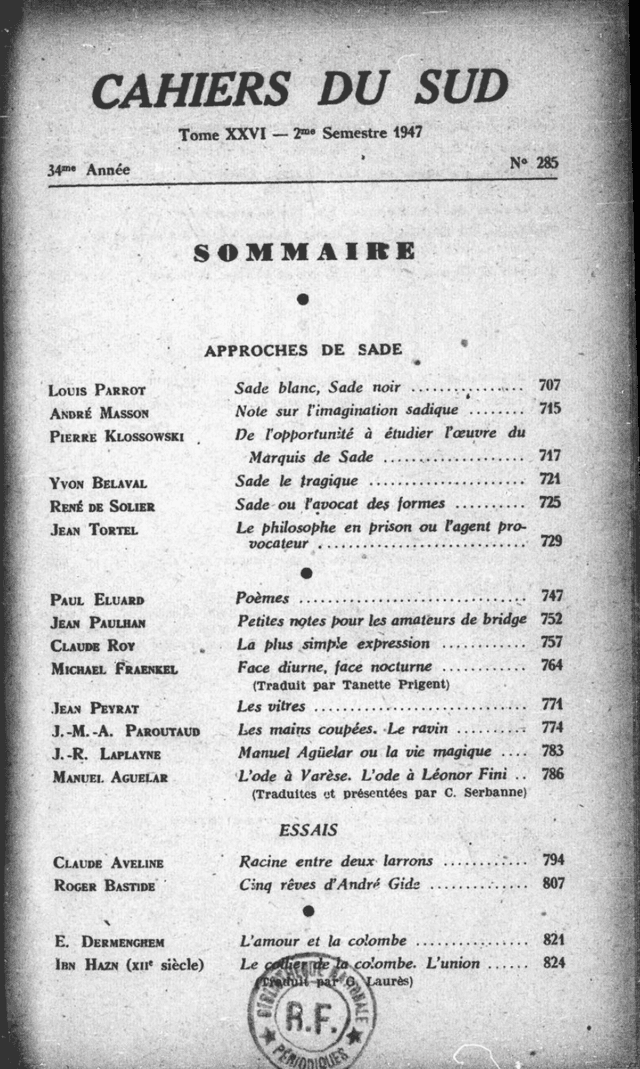
Little notes for bridge lovers
Jean PaulhanAbout morality
At this family tea party, where we are celebrating the fifteenth birthday of some cousin, an unknown relative approaches me, and makes lofty remarks to me: about the education of the children (whom we should warn a year in advance, he claims, of the plans we form regarding them); on the immorality that is, alas, rife these days; especially among boys; especially in the sixth grade class; in a very special way, in the sixth grade class of the Condorcet high school. I try to live up to it. Then we separate.
Information obtained, he is the only smuggler in a family - mine - on the whole rather honest and even, in places, delicate. You're going to tell me he's lying. Not at all: it is simply probable that he feels more keenly than others, and for good reason, the necessity of morality.
So do writers. I see that we commonly criticize this or that - let's say Sartre or Zola - for the filth and the mud bath, into which he begins by plunging his heroes. Personally, I would feel rather worried about all the moral weight he is going to use in dragging them back from such a base. L’Assommoir certainly has its grandeur; he also has his weaknesses, the worst of which is that he already calls the painful Work, the overwhelming Fecundity.
On the occasion of this little celebration, I took up bridge again. This was an opportunity to make two or three rather worrying remarks.
*
A language in progress
This is because the language of bridge, in passing from the ceiling to the contract, was perfected almost as much as he had played whist on the ceiling. A player can now declare, in four or five announcements, the details of his cards, to the point that it is becoming common to hear people ask for a small or a grand slam.
I want to. But be careful that every game is firstly based on an element of uncertainty and invention, of hypotheses, in short, of genius. The day your language is perfect, bridge will be replaced by precise calculation. All you have to do is put your cards on the table; and I already observe that the game of play, without having changed in the least, is, in the contract, more mechanical, less amusing than it was at the ceiling.
(Like international languages. You are surprised to see them one after the other, Esperanto, Ido and the rest, disappearing. The reason is very simple: not an inventor has yet thought of leaving out the defect - errors, baroqueries, confusions, false etymologies - which would make them amusing, and make them last).
The other remark is even more worrying. I will only say it with caution.
*
Another cause for concern
In the old bridge, happiness and misfortune had the same price: one trick better than the request was a hundred points won. One trick less, a hundred lost.
The Beaulieu brand had already come to change all that. Demerit became more serious, more sensational, than merit; fifty only for the unexpected lift, a hundred for the missed lift. This could be the effect of modern philosophy, which is dark.
But with the contract, the disappointment goes much further. The extra raise is hardly worth more than twenty or thirty, depending on the case. Sometimes nothing at all. The trick less is immediately one hundred, two hundred or three hundred points. In short, the language of the game has reached a point of perfection such that the player is no less guilty — and should not be less disappointed — for having expected too little from his game than for having hoped for too much. Where we see that perfect language is better suited to punishments than rewards.
No doubt this is also one of the reasons which makes us quickly abandon perfect languages: it is that we have the weakness of preferring rewards. And I'm not giving the contract five years of life.
As for returning to the ceiling, there is little chance. First we should start by forming more accurate ideas about language. Then the ceiling had its weaknesses: for example, a request for a clover (American) and a counter (no less American) which already meant too much.
The last remark is more general.
*
Curious chatter
Furthermore, the bridge contract (like the ceiling) seemed to me to be the site of a painful disagreement. As long as the players limit themselves to announcing (dryly): "a club - I pass - A no-trump..." there is nothing to say. The misfortune is that they hardly hold back from adding, for example:
I'll pass, for now.
I will modestly say a diamond.
I don't object, out of the goodness of my heart.
Bridge means silence (which is not true by the way).
You played as the late Bridge (or the late Pied, or the late Ballot, depending on the case).
Five thousand Englishmen drowned in the Thames (or twenty thousand or a hundred thousand).
There are two methods. (It seems a rule to add after a few moments: the good and the bad).
Of course, it happens that this is just a simple cheat, similar to the pouts, grimaces or smiles with which the player sometimes embellishes his declarations. (At least within the family, because the family, in these cases, has learned not to complain).
But I only concern myself with the case where these little jokes are made quite naively. Well, then here's what happens.
*
A horrible disagreement
It’s because the talker (myself, on occasion) is not happy. He said to himself, more or less: “Ah, ah, that’s not bad. That’s the end.” He has the delicious impression of talking to himself, without there being much need for words. He is ineffable and yet he gets along very well. What joy! He glides in his mind, he flies over vowels and consonants, words and sentences. Don't stop it!
GOOD. But the other player, who hears it, says to himself on the contrary: “So play, instead of talking. Don't be smart. Again with his words, his mannerisms, his chicness. You run after me. I was waiting for that one.” (That's the worst. Nothing seems more contemptible, nothing seems more sentence, than a sentence that one expected.)
“And then what?” you say. To me, it simply seems like an abyss. How! If you said chip and your neighbor understood elephant, river and he understood calf's head, you would cry misunderstanding! (Although there is still a certain connection between the flea and the elephant). But you speak thing, and he understands words! You speak nuances, intimate thoughts, delicate feelings, and he hears vowels and consonants, sentences, words. It's worse. It's worse than it is scary.
I prefer not to dwell on this painful subject.
*
The little family snack ended without further incident.
(Published in Les Cahiers du Sud n° xxx, September 1, 1947)