Letter to Jean Dubuffet, 1944
Jean PaulhanJean DubuffetTuesday
Dear Jean Dubuffet,
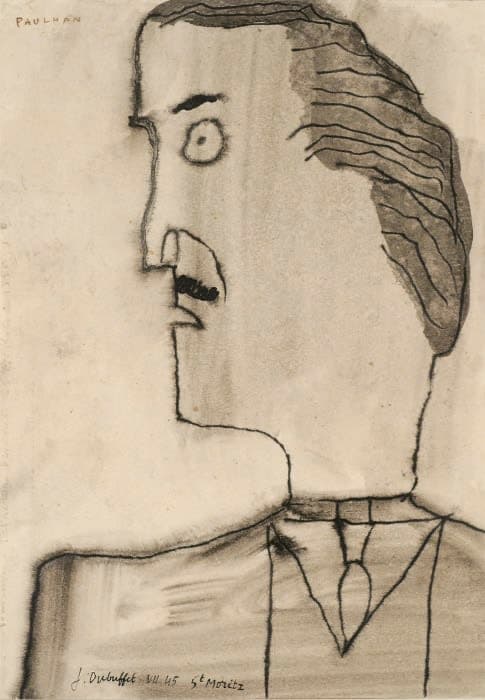
"Paint me?" said the painter Mi Fei, you're joking. I'm humming my little song. — Paint me ? said the painter Sou-Tong-Po, you want to laugh. I'm cooking my little pot. — What can I do about it? said Yu-k'o, as soon as I've drunk the wine, rocks and bamboo come out of my happy liver. They come out in a big way number, and I cannot stop them.” So out in large numbers the distraught town sergeants and the nostalgic metro travelers, the scarecrows, the cows and the wastelands of Jean Dubuffet. And, obviously, Jean Dubuffet can't stop them. But painting is made by the people who see it, as much as by the people who make it. And for us who see them, these little men and these shacks pose such serious questions that it is appropriate to do a little social history here.
When I started, I was very young, going to exhibitions of modern painting, I saw very quickly that we met two kinds of people, some of whom (in front of Carrière or Renoir, I suppose) laughed like little cows, slapped each other on the thigh and gave the signs, which I recognized very well, of the greatest joy. We would have said we were at the circus, in front of the hippopotamus or the tapir. I was for them, I found them friendly. It seemed to me that it was natural to have fun. That it is more natural than to keep (as people of the other species did) a morose face, and to speak of moral greatness - in front of Carrière -; or joy of living — in front of Renoir. Or even the golden section, and painting things more as we think of them than as we see them. Because what is fun, and even exciting, in life is seeing things and not at all thinking about them. No one in their right mind would ever imagine the hippopotamus, for example, with its vibrating ear and the drops of tar passing through its skin. But when you have seen one, you remain upset for a few days, unless you are insensitive. So, I was on the side of the people who were laughing. I later discovered something else.
This is because laughing people were dissatisfied with laughing, and somber people were satisfied with being somber. That was more serious. This seemed like a completely general error. When they had finished slapping each other on the thigh and bumping their elbows, the joyful people said: “We have been made fun of. I will never set foot there again. Poor France.” But the sad people said: "What a soul! You will have to bring your brother-in-law there. Ah! Jean Dolent was right to write..." Because their favorite critic, to top it off, was called Jean Dolent. He gave his name to a street. And I had the feeling that they were all wrong, that it should have been the opposite, that the happy people should have been satisfied, and the sad people discontented. Finally, that there would have been a sort of agreement to be established between them, a discovery to be made. But I didn't dare say it, of course, and it was only a few months ago that I was offered to write for the major newspapers. So I take advantage of it. I take advantage of this to defend myself. Because for me, in all this, ah! I'm ashamed to say it, or rather I was ashamed of it at the time, I knew that what I was doing wasn't very brilliant; the fact is that I found myself in agreement with the sad people (because finally I saw clearly that they had reasons, that they explained things, that they knew what painting was about). But that didn't stop me from having fun at first. Of laughing with people who were laughing: of a lady who looked like an elephant; of a horse that was mounted on a roof; of another lady who was seen both in front and in profile. Well! I was both in front and in profile, like this lady: I was laughing, but I found it very beautiful. I was having fun, but I was convinced. People will ask me how I did. Ah! I I don't know anything about it anymore, but I did it very well. And I was wrong, there's no doubt about it. And events seemed, with each new exposure, to prove me more wrong. Because good painters became more severe, more strict, masterful every day. Obviously they knew something. Sometimes it was enough for them to demonstrate this with a simple little line, a thread. I held on. In the end, I was rewarded for it. Because there ended up being painters who could be laughed at without making them angry, who were willing to be pleasant, and who were still wonderful. Whose paintings were not at all a ministry, nor a theorem, but a kind of rejoicing, something like a public festival, a great farce. It seems to me that this is the case for Klee, and perhaps for Campendonck (whom I know mainly by name). This is the case for Picasso (said with due admiration). This is particularly the case for Jean Dubuffet. What joy! Naturally, I was happy to be right. Or rather to have been right. There was something else still, more serious. It was because I saw clearly that I had been right with the whole world. It is normal, it is even, I would like to say, human that art and painting in particular are a sort of celebration or fraternity, and do not therefore cease to be admirable. There are secrets of this kind everywhere, and it is not always easy to discover them. For example, I believe that one day I will be able to look with joy at old paintings in a museum. But I haven't gotten there yet, there's no point in lying. On the contrary, I have known for some time how to visit a church without getting too bored. As soon as you enter, you must remain standing, without moving, and always look in the same direction. The whole price of a church lies in the grandeur of a space which strikes you all the more as you refrain from exploring it. It's like forests, you don't have to start crossing them straight away. There are secrets of this kind on all sides, and everyone keeps their own, otherwise they would not be able to live very well. Even a political article becomes interesting if it happens to be read in small offices, and even more interesting if it has lost its head and tail, which we must try to reinvent. But enough on that. What I meant was that Jean Dubuffet resembles these life-changing discoveries. We had been looking for a long time for a painting that would amuse you and yet be a great painting. Well! we found it, or rather Dubuffet found it for us, so clearly that there is no need to hesitate. But the secret goes further.
We were told, when we were children, that primitive painters, to tell the truth, did not understand much about painting, but that they loved religion so much that they persisted in painting anyway. Of course, quite the opposite is true. The Primitives didn't care much about religion. If they painted angels and virgins, it was because they had been ordered to do so. It was also to convey something else. Because they had made a somewhat difficult, somewhat shocking discovery. They had discovered that it is dangerous to paint too well; that blues and golds and pearls end up being too beautiful, too brilliant; that it crushes the painting, it takes away its reason for being and its dignity. In their time, we had just invented new colors, richer than the others; new ways of perspective. New sections more or less golden. They defended themselves as best they could. They pointed out, in their own way, that there is no painting that is worth it (nor any human work perhaps) without some fault. This is also what great men have always known, those who (as they say) marked their era. The inventors of ceremonies, and of water features and French gardens, for example, knew very well what everyone could have known: that a garden must be vast and majestic, that it must give both a feeling of ease and order, of independence and majesty. But they knew something else that is a thousand times more difficult to know (and, in any case, to apply): that a garden, and a water feature, and a ceremony, must be slightly ridiculous; of a light enough ridiculousness, to make everything else pass. What I'm saying is very obvious, and rather matter-of-fact. This is not that far from what Christians call original sin. And to take just one example, it is quite obvious that these houses (always rather warm and with a good smell) where, as soon as you enter, you find yourself greeted with smiles and kindly questioned about your personal tastes, and suddenly surrounded by graceful naked ladies who say nothing and stop moving so that you can look at them better, it is certain that these houses are of the order of enchanted gardens or paradises. From a distance, it could very well be confused. However, there is a difference, to which one is more sensitive than the other. But there are very few people, if they are not specially warned, who are capable of predicting it. Well! Dubuffet is one of them, he knows the man better than you and me.
My dear Jean, I started this letter as a letter. But I saw clearly that it was going wrong, that it was going through a study, as they say, or a trial. So too bad, I continued. After all, why not cite the Chinese (even in a study)? They are men like any other. And who are even a little more men - when they happen to be painters - than we are used to being back home. Who understood very well what European painters do not always know: that a painter must not abuse the situation. That he should not be too much of a painter, nor too proud of it. That this is a sort of singularity that he should rather try to forget. It's like art criticism. You see, I haven't yet said that art criticism is jokes, chatter and trampling. Bad literature, around a picture that is very self-sufficient. And that a work defends itself alone, and the rest. But if I didn't say it, it's not out of pride, it's the opposite: it's because all art critics these days start there; so that it has become a sort of sign, a somewhat pompous way of announcing that one is an art critic. But I try to avoid anything that looks like pomp.
Besides, I only had one word to say: it can happen one day that following some chaos or flood the worlds find themselves slightly confused. That day, we will be very happy to have Jean Dubuffet on hand to sort them out, but that is only a way of speaking. In truth, each of us gets confused all the time, and we are happy to find Jean Dubuffet, who knows us so well.
Goodbye, see you soon, dear Jean Dubuffet.
- (Jean Paulhan, O.C., Tchou)