
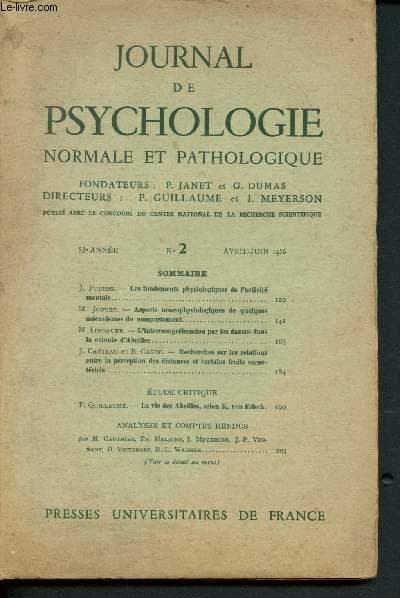
Substitutes for the soul in modern psychology, by N. Kostyleff, 1907
Jean PaulhanReading report published in the Journal of Normal and Pathological Psychology, Volume I, 1907, p. 48. See the original in Gallica
in: Studies on the nervous system (Anatomy and Physiology) (3) — Substitutes for the soul in modern psychology, by N. Kostyleff (Paris), Félix Alcan.
The notion of the psychic phenomenon has until now remained entirely heterogeneous fact to that of the physical substratum of life. When we we followed to the end, in all its details, a nervous process, we do not yet know where to place consciousness, mental images, ideas; we do not see any possible relationship between the cells or the nerve centers and the phenomena that introspection reveals to us.
Physiological units being too simple, therefore, to respond to the immense variety of psychic phenomena, the tests of psycho-physiology were followed by tests of psycho-chemistry and psycho-mechanics. We will study here the way in which phenomena are accounted for psychological, the chemical conception of life of Le Dantec, and the conception Zehnder mechanics.
I. The chemical conception of life.
K. sets out at length, in three chapters, the general theories of The Dantec. It is possible to reduce the increasing complexity of phenomena of biological life, new facts to the general laws of physics or chemistry; thus the specific property of nerve cells was found to be analogous to electric current, the facts of memory which fit into the complex structure of metazoans are only one case particular functional assimilation.
It remains to explain consciousness. Dantec considers it an epiphenomenon, otherwise everything would happen in exactly the same way. This epiphenomenon is not even particular to man, but it is common to all atoms. From then on x designating for example consciousness of a neuron, there will be a total x of our individual which will be the sum of all the x of the neurons and which we will call consciousness.
This hypothesis can be criticized from a design point of view. current state of the nervous system. Moreover, it is powerless to make us account of the psychological unity that we see in ourselves: we admit in fact that epiphenomena are, in the mathematical sense of the word, a function of vital phenomena. “Now, what do we see on the physical side of this parallelism? all the effort of Le Dantec tends to prove that the unity objective of life is a conventional notion, without scientific value. And what do we see on the other side, on the side of epiphenomena? a statement free mation of this same unit, which Le Dantec thus rejects from domain of physiology, but retains in the domain of psychic epiphenomena. The illogic here is quite obvious and the theory chemical remains powerless to account for the phenomenon of consciousness.
II. The mechanical conception of life.
K. shows how Zehnder can deduce from the movement of atoms in space the existence and differentiation of molecular aggregates. In a sufficiently differentiated molecular aggregate, the wires, conductors excitations, do not remain isolated, but converge at a central point which becomes a nerve center. All of the neurons thus constituted trains the nervous system; throughout the uterine period, the system nervous, in the embryonic state, maintains the correlation of all parts ties of the individual for nutrition and growth; but when the embryo detaches from the maternal uterus, the mode of nutrition, the conditions of existence, everything will change for him; a large part of the embryonic nervous system stops functioning: this transition corresponds exactly to what we call the beginning of life psychic.
“Let us observe a child who sees the flame of a candle for the first times. He touches this flame and burns his hand. The nerves that carry caloric excitement work at the same time as those that carry visual excitement: the former work even with more of intensity and this results in new pathways, perhaps a cell new, special. This cell has numerous extensions which touch the nerves of visual contact as well as those of caloric arousal It is by means of these new channels of communication that the notion a flame will enter the child's mind. Everywhere we find the same process: the creation of new fibers or cells which form a special nervous system, that of consciousness. In this diagram, every action, every state that becomes conscious, every abstraction is represented by a cell.
The mechanical theory is thus more lively and more flexible than the theory chemical. It can be objected that memory and forgetting remain like this unexplained. If the theory were strictly true, the consciousness of man would be filled with concrete and always present images; each mental image being represented by a brain cell must, in fact, be present as long as the system of consciousness remains intact.
III. Critique of psychological data.
The scientists who have attempted the objective synthesis of life neglect, in general, the eigenvalue of the data provided by introspection. Their thought becomes banal, imitative as soon as it applies to phenomena psychic. But other scientists have recognized that the method of science objectives are not enough to explain the problem of mental life and have sought to make a psychological critique of psychological data.
K. dwells the longest on the Mach theories he will adopt by perfecting them. The objective study of certain excitations in their relationship with the sensations they produce, allowed Mach to discover in the organism, no longer static data, but motor processes which correspond to the mobile groupings of sensations. Take the case of visual perceptions: two squares of the same dimensions never produce the same effect, when placed in places different; we must conclude that the definitive notion of the square is secondary, deduced and essentially different from the physiological impression.
The distinction between right and left also undoubtedly has a motor origin. The structure of the visual apparatus exhibits symmetry perfect and if we only took into account retinal excitations, the distinction between right and left would be unacceptable. It is therefore necessary admit that visual sensations are not localized in the retina, but are associated with the motor reflexes of the body, “which as a whole, and especially in the structure of the brain, presents a certain preponderance of the right side over the left side”.
Mach thus manages to show that the geometric notion of space extended in height, width, depth is purely subjective. He studies in the same way auditory perceptions, the perception of time. But when he approaches the higher forms of consciousness (abstraction, judgment), he lacks physical data to explain their increasing complexity.
IV. The coordination of psychological data with data from the objective science.
With Mach, we must replace psychological units with a grouping reflexes. And the hypothesis of the functional development of these reflexes will give us the explanation of the points which escaped Mach. If the repetition of refiexes creates and develops the organ, it must be said that the functioning of the visual apparatus is enough to extend the rudimentary perception of physical space, to coordinate the sensations of the top, bottom, near, far, and to derive the subjective unity of geometric space. In at the same time the hereditary heritage of the species is enriched, and the generations which follow find themselves endowed with an innovation more complex than than previous generations.
This hypothesis of the functional development of reflexes is thus strong useful. For having ignored it, Sollier, Ribot, James, even Dumas who sought a conciliation, only arrive at logical errors or contradictions, because they cannot give the objective definition accuracy of subjective phenomena.
The hypothesis is still necessary for introspective psychology: it gives a new meaning, by completing them, to the theories of Philippe and Ribot on images, and creative imagination, to the theories of Binet and Claparède on the association of ideas and judgment. K. exposes all these theories that he perfected.
What we call the soul will therefore objectively be the set of reflexes peripheral and internal which reach the cerebral centers. And it's a quite sufficient definition from a scientific point of view. We can still complete, from an introspective point of view, and say that the soul presents a set of reflexes which reveal themselves to our internal sense as a mosaic of sensations.
Above all, we will find, in K.'s work, many interesting quotations, mainly from Austrian psychologists.
Jean PAULHAN.