The Vieux-Colombier theater
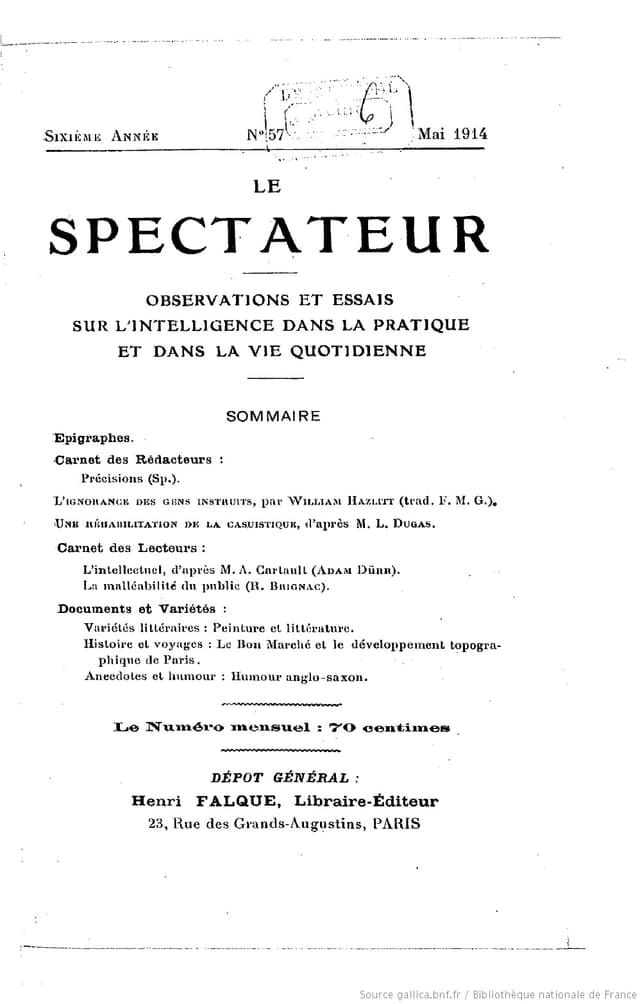
Jean PaulhanJacques CopeauArticle published in Le Spectateur, n° 50, October 1913, p. 389-390
Phocaste the gardener and Daisy, the Echange and the Pain de famille, the Maison Natale by Jacques Copeau, and the Fils Louverné by Jean Schlumberger, these are not, for those we know and those we want to guess, school works, relating to the same technique. And what new company should be founded on such disparate materials?
*
* *
This theater does not promise us any innovation in staging or decoration either. Thus distinguishing itself from the Théâtre des Arts of J. Rouché, as it already separated itself from the Théâtre libre of Antoine.
So there remains this, this very simple thing: an act of faith in the theater and the artistic value of the theatrical work.
*
* *
To understand the meaning and gravity of such an act of faith, we will use a comparison.
Mr. Hervé's theories, relating to the homeland, appeared at a time when our foreign policy, like our military preparation, seemed to expose us to some humiliation. Fashoda, Tangier, Agadir, and wasn't it a common opinion then among many that a war would leave us defeated? Now these theories wanted to eliminate the homeland which brought us such affronts. The reason for their success - or at least for the fact that we knew them, that they passed through us - was, to a large extent, that they made pride possible for us, placing it no longer in war, but in the fight against war.
The state of mind of many men, of young people who love art, is, with regard to the theater, what Hervé was with regard to the homeland. How can we suffer these humiliations: the failure of an Ibsen, of a Claudel, the triumph of a Pierre Wolff, of a de Caillavet, if not by thinking, by affirming that the theater is an inferior form of art, of the order of cinema and the circus? Resolutely negative attitude.
*
* *
An attitude of expectation which only prepares the way for a new confidence: let us welcome the act of faith of Mr. Jacques Copeau, parallel, if we want to follow the comparison, to such a new form of patriotism: "to raise a new theater on absolutely new foundations. May it be the rallying point of all those, authors, actors, spectators, tormented by the desire to restore the beauty of the stage spectacle" (1). Of the value and honesty of such an attempt, the diverse and strong work of the Nouvelle Revue française, of which the Vieux-Colombier theater is a logical continuation and extension, is a sure guarantor for us.
Jean Paulhan
1 - An attempt at dramatic renovation: the Vieux-Colombier theater. La Nouvelle revue Française, September 1, 1913. ↩