The Firefighters’ Hall
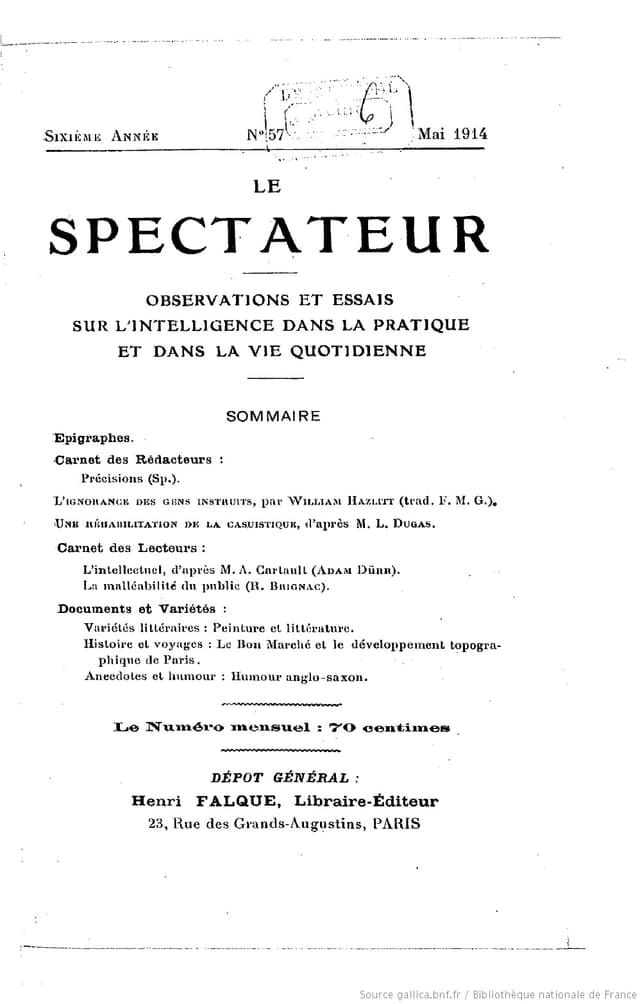
Jean PaulhanArticle published in Le Spectateur, n° 34, April 1912, p. 151-154
Barbey d'Aurevilly, having finished one of his works, wrote in the preface: "One will not fail to reproach me that this book is composed, and, so to speak, made up of parts and pieces", thereby implying that he had wanted it to be such, and that one wanted to seek other criticisms for it.
It is clever, to better ruin a reproach and remove all its significance, to address it openly to oneself in advance; or, if it has already been said, to accept it, without showing any shame. These are two sides of the same argument. A few sentences will evoke it precisely.
If the reproach is only expected:
"There was hardly any point in me coming to ask you for advice: I know in advance what you are going to tell me..."
“With your character, you will surely blame me for…”
"I'm sure you're going to say the opposite of me..."
"You think I'm a liar; but say it right away..."
All sentences which aim to refute in advance, or even to prevent the reproach, the dreaded criticism, from occurring. To admit to being guessed would show, in the interlocutor, a certain poverty of spirit: and on the other hand, what is the point of formulating a reproach, given that a long-prepared answer will undoubtedly immediately ruin things.
If the criticism has already been said:
"Well yes! I'm a cad, so what next?"
"Perfectly, I did...and if you think I regret it, you're wrong."
"La Ferté: Between you and those who believe in Providence, there is little interval."
"D'Arcy: there are few indeed." (Renan, The Abbess of Jouarre, p.8)
It seems that, by such arguments, the adversary must, at least, find himself surprised and, in some way, disconcerted. At least we are taking away from him the fighting ground that he had created for himself, to offer him a new one, perhaps full of pitfalls. He was ready to argue on this point: Is X a cad or not? And now he must discuss this other point: was X right or not, in such circumstances, to act like a cad? He must abandon the entire plan of attack already drawn up, and, without wasting time, imagine a new one. Which is not without some confusion.
*
Let us imagine the argument, no longer used at the chance of a passing dispute, but during a more general conflict, and by a social group against another group. It will become made of language, transforming for its own benefit the depreciative value of a given word into a laudatory value.
This was already very visible in the previous example: "You are a cad. — Yes, I am a cad; and then?" It is clear that mufle does not have the same meaning in the reproach and the response. It means first: one who acts indelicately, and is wrong to act thus; then: the one who acts indelicately and is right to act in this way. It is still necessary to distinguish in its meaning a part, of secondary importance, half unconscious: "the one who acts indelicately"; and a very clear, very apparent part: "the one who is wrong", in the criticism; "the one who is right", in the answer. And the semantic fact which is attempted here, desired, is therefore the transformation of the meaning of the word, into what it presents as essential.
The painters of the academic school have recently used the argument. The Salon des Pompiers opened in Paris on January 24; "Firefighter" was, until 1911, a mockery, and almost an insult: it designated, for what they readily represented Roman warriors wearing helmets, David's students and, more generally, the "school painters", Bouguereau or Luc-Olivier Merson.
Now they have picked up on the mockery: they accept it, they want to be firefighters, they believe that any self-respecting painter must be a firefighter. They strive to make the insult become a compliment: and it has indeed become so, by that very fact, for an entire social group which does not lack importance. Mr. Lavedan explains with complacency that there is no name more flattering than that of firefighter (L'Illustration, January 27, 1912).
We would cite many facts of the same order: the Sans-culottes of the French revolution, the English Tories – Tory originally means: brigand—, the Gueux de Hollande, the Jaunes — anti-socialist party founded by Biétry, and which had its official organ: the Yellow—, the Wolves — literary and artistic group —, the Camelots du Roi. For an identical reason, perhaps, and thanks to social theories, humble, poor, unhappy are almost flattering words today.
Sometimes we see, in these examples, the new meaning triumphing; sometimes the old sense has prevailed: and there are cases where we will hesitate, depending on our taste or our convictions. But in various forms, a single argument is revealed, the very one that we wanted to clarify here first of all, and which it would be possible to call: the argument of unexpected agreement.
Jean Paulhan