Rhetoric rises from its ashes
Jean PaulhanWe first see any problem of style as something mediocre or low — and we hasten to reject it. Who stops at my language, said Montaigne, I would prefer it to be silent. “I’m not a writer,” says the writer. Here we are joyfully returned to love, to strength and to fear, to the things of the world.
However, we cannot avoid the fact that they quickly send us back to language. Because the all-coming of the mind shows itself, in use, full of artifice and apparent falsity. Of the various events linked together in a novel, there is one that seems improbable to us: it is the one that happened; and characters, the truest; dialogues, the most exact. A sure way of not converting anyone is to expose our thoughts and our emotions as they come to us. Nothing says literary, in letters, like the authentic.
Whoever returns to the rhetorical problem realizes, to his surprise, that nothing is so rigorous or so serious; that he must commit himself entirely to it, if he only wants to understand it, and that there is hardly a solution here that does not have the appearance and nature of an oath. If he then recalls his first disgust, he recognizes the effect of his weakness, and of that common cowardice which distracts us from a task that is a little too difficult and shows us it to be chimerical or base. But he has nothing more in a hurry now than to bite into these sour grapes.
It goes, to begin with, to the heart of the problem.
I. THE LITERARY PARADOX.
The modern world has curiously renounced rhetoric for the same reason that made rhetoric. If rules and genres were ever imagined, it was to assure the human spirit its full freedom, to allow it cries, and surprise, and deep song; and it is also to ensure this song and these surprises that we today reject the rules and seek to confuse genres. If man invented the three-point speech or the five-act tragedy, it was to forever avoid artifice; and it is also to avoid artifice that today we avoid the three points or the five acts. In short, rhetoric, to understand it, has never intended anything other than to tear the writer away from conventions and sentences: to return him to the natural, to the truth. But it seems to us rather that it only ever formed sentence makers and word arrangers. From which follow here originality, revolt and Terror; there obedience, imitation, respect for the rules. The literary paradox is even stranger:
it is that the proofs and arguments of Terror are also those of Rhetoric. We think of some famous person, whom some would consider too thin, others too fat. It would be little: on the same portrait. Better yet: on the same features of this portrait, on the same line of the cheek, of the hip. Because Rhetoric claims to free the mind from the empire of language - and the best proof it gives of its success is the use it makes of rules and commonplaces. But an anti-rhetoric, in turn, only wants to free the mind from its chains of words. She names these chains: they are also the commonplaces and the rules.
But it cannot be both at the same time. If the cliché liberates the soul, it cannot at the same time enslave it; if the rule subjects language to thought, it cannot at the same time bend thought to language - unless it is of such a strange nature that it would then be necessary to leave aside all other concerns in order to penetrate it. It is sometimes said that it has happened to men, and to writers in particular, to change their tastes. But it seems rather that everything is changing in the world, apart from the taste of the man and the writer.
*
This is the central paradox of the Letters. We will note, before attacking its difficulty, what it offers at the base as naive and obvious. In truth, it only appeals to our banal experience, as if the Letters constantly drew their material and their reason from this experience, of which they would only be a purer, more precise state.
It could be said of current conversation and reflection that language is not entirely distinct from thought. But the two confuse their train; we speak our thoughts there, we think our language there. "How are you?... I don't like this cold. It's going to get even colder, the swallows have already left..." You only have to enter the flow of chatter to feel that it is not particularly about words, nor about thoughts. The two go hand in hand.
Not that departure remains possible at any time. All it takes is a hesitation, a return, a question that is never completely obscure: “The swallows, you mean the swifts?... Since you are interested in my health...” Or: “The word you used... if your words had gone beyond your intention?...” Immediately the confusion begins. dissipates, and we grant that there were, indeed, words and thought. From one to the other, all possible relationships: loyalty and betrayal, the vague and the narrow, the nonchalance and the precision. The commitment, the release that Terror and Rhetoric deal with are only one of these relationships, not the least familiar.
It happens at any moment that we miss a word, and we search for it, trying one after the other ten neighboring words, which are separated by some slight nuance of meaning: this one seems too heavy, that one too free, and that other pretentious. Sometimes it happens that the forgotten term finally comes back to us, and we recognize it; sometimes it seems that it does not exist, and we remain suspended - but all the more strongly thrown back towards our only thought - between several words, each of which seems unfair or crude to us. (Like dreams, when we try to tell them, without much success).
I only seek to patiently rediscover the banal environment where Terror and Rhetoric play: it seems to us, in such cases, that each word risks engaging us a little further than we would like. Master of the word you are going to say, slave of the word you said. We also have no shortage of excuses when it comes to escaping slavery: “The word went beyond my thoughts... don't understand it literally... it was only a way of speaking...” and the rest.
*
We will observe here that Terror and Rhetoric still agree on two points. One would be that the rules and commonplaces seem particularly likely to provoke this dissociation of the word and the idea: or at least to precipitate it - and as the catalysts of this analysis. Since it is, in any case, about them that the question arises, and the opposite answers are provided.
The second point would be that the answers are both inspired by the same principle; it is (to put it roughly) that thought is better than language: that we must rely on it as a last resort. But we call upon his choice, we solicit his decision, as if there were no worse humiliation than obeying language.
All in all, the bias is acceptable. It is reminiscent, through its authority and its evidence, of this other bias, purely moral, which traces the struggles of the body and the spirit, and finally demands the submission of the body. So with language, this body of thought.
It remains that such a bias can in turn be expressed by two doctrines, so contradictory. Here we come back to the paradox. It is simply necessary to observe that Terror offers a more favorable ground for its examination than Rhetoric.
Because this is limited to aligning its rules and principles, as if they were self-evident. Here is the metaphor and the hypallage, she says, here are the places. She adds (as if carelessly) that in this way the student arrives at the truth, at the purest of the spirit. But Terror, on the other hand, starts from a view of rhetoric: exactly, from the consideration of the defects of rhetoric, its errors, its traps. It would be an understatement to say that Terror knows Rhetoric: it proceeds from it and follows it step by step; she never stops knowing it, and refuting it. There is no piece of the trial that she does not display and discuss before us.
II. RHETORIC BREACHED.
So I imagine that here we are thrown into full rhetoric: subject to rules and genres, held to this and that figure of language, to this and that kind of sentences or words: the metaphor, the regular verse, the poetic word. All expressions themselves subject to the places that need to be rendered: the comparison, the end, the means, the brevity of the sunny days, the vulgarity of the crowd.
It is this submission that the Terror attacks. It is enough for him, to base his attack, on the confessions of Rhetoric.
Everything has been said about the harmful effects of rhyme or metaphor. What! Should the poet stop in full inspiration, to give in to a sound, a noise, a hollow form, and put three words where he thought of two? And how would his passion, his thoughts remain authentic there? Here they are twisted, counterfeited, and finally allowing only a forgery to come to us, where the ruse of the writer merges with the emotion of the man. Too happy if the humiliation remained secret and the false had the appearance of the true. But no one is mistaken; the drama has one act too many, the verse is full of stuffing:
Sire, I speak frankly and I hardly show off
Besides we don't have war machines 1
and the places of the speech follow one another in the parade:
_Virtue, placed at the _principle _of man, fortunately holds the middle _between extreme vices and prepares us by its soothing action for the_eternal_end... 2
And even if we are wrong, what shame remains for the poet or the orator, forced by I don't know what arbitrariness to cut and cut in his intoxication and his transport, or on the contrary inflate them to the extent of a premeditated language machine. But everything has been said about the struggle of the angel against the aesthete, of the liter against the amphora, of poetry against beauty. If you prefer, young romantic versus aged classic.
Because the objection is old. And the answer - at least if we do not want to abandon the poet to his lies and his falsehoods - is no less old. (However, both so natural that one hardly thinks about their age).
*
"I didn't want it," says the classic. It certainly happens that I grope around. It's not always to find the place, or the rhyme. And very often what seems to you, in my verses, artifice or labor, is what came to me from the gods. It is common for the rhyme to reach me before the idea, or at least completely confused with it, and the words to my emotion. Thought and language are all one to me. And like you talk about trees or sky all the time without having the slightest awareness of using the word tree, or sky, so it is for me with meter and assonance. Rhyme is my grammar, my syntax.
Thus speaks the rhetorician. To those who object to him that this is not a common experience, he can well reply that he would not be a poet, if he himself were completely common: that what's more, the terrorist also has his key words and his rhymes; and that he simply uses them, for having refused to recognize them, without any tact. Victor Hugo boasts, in more than one place, of having massacred rhetoric and made the hypallage shudder. But his poems abound in virtuous beaters, in generous sheaves, in candid linens, in faithful harrows; Delille was more discreet.
The terrorist has his response ready. "So be it," he said. Did I claim that we were perfect? Simply your slavery and sometimes ours go back so far that we no longer distinguish them. But are we any less a serf, for ignoring our servitude? You have been broken, from childhood, from these vain sound figures. You have learned, like another language, rules and places, tropes and mores. If they are natural today, were they less habitual? Were they less conventional? Your case is even more serious than I thought. Because technique and artifice would have left you at least some freedom of mind, and the feeling of your decline.
Thus we see each argument of rhetoric turned against it. Is the place manufactured because the mind agrees to bend to language; spontaneous is that he complied once and for all. And finally the presence of the rule or the place in any case only betrays servitude and submission.
*
These are the reasons for the Terror. It must be admitted that they seem urgent. Moreover, so easy, so easily evoked, that we should perhaps be surprised that Rhetoric has long survived them. (Because we did not wait for Victor Hugo to invent them. But Plato and Montaigne, but Pascal and Diderot never cease to oppose them to the clever of their time, and to the eloquent). We should simply ask ourselves if they are not a little too easy. It is one of these doctrines that nothing embarrasses: they are not always the safest, nor the best founded. Then, I see too far how far we should extend this: to the point of maintaining that all syntax betrays the mind, and all language lies to us; because if it is concerted, it is artifice; and servitude, if it is spontaneous. (But it may be after all, I don't know, that we will have to give up language). There's more.
This is because it is easy to reverse the reasons for the Terror, using the same source of argument to defend words, rules or places. If they are natural (one might say), it is therefore because the mind gives free play to them: it is because the rule has ceased to be opaque and linguistic to it; but he went beyond it to find his own laws. — It happens that you are looking for them. - Either. I only use them once I have gained my mind when their words are no longer perceptible to me, but only their face of thought...
It is all too easy to turn every argument of the Terror against it in this way: if the commonplace is spontaneous, it is as much a gain over language. Reflected, we witness the victory of the spirit.
We know this card trick where the subject is led to designate the card from which the illusionist has chosen. (It is, for example, the seven of diamonds). “Do you take the reds or the blacks? — The blacks. — Good. We still have the reds. Hearts or diamonds? — The diamonds. — Well, in the diamonds, the figures or the low cards? — The figures. — I'll give them back to you. And in our low cards...”
Sometimes the ruse succeeds. But the trick that concerns us is hardly more subtle. And it simply appears that the terrorist and the rhetorician, having first made a choice of language or thought, agree to understand any example that concerns them according to this bias. (Also, there is no expression that does not have its language and its thought). They must be sent back to back.
III. WHERE RHETORIC MAKES ITS FAULT A VIRTUE.
However hollow or mediocre the argument of Terror may be, however naive its pretension, it still occurs. That's not saying enough: it happens commonly. In the absence of proof, it is a state of mind. Who has not said to themselves, when faced with an electoral speech, a hawker's sales pitch: “These are just sentences that he is stringing together... does he think he has got me with his slogans?” Even if it means thinking, the next moment: “Well, he’s already said them often... It may well be that he ended up believing them... He doesn’t even see that they’re words anymore.” Carrying himself thus effortlessly from one position to the other of the argument, as if they were only a single thought of which he would successively discover the two sides.
Now we still know of this thought that it regularly plays against rhetoric; that it is the continuation, and like the second phase. It has been said of the Terror that it understood rhetoric. But when the rhetorician says, and repeats, that we must avoid leaving the compass in the circle, or the meter stick in the wall, and that true rhetoric begins with the disgust of rhetoric (like philosophy with the hatred of philosophy), what is he doing, what to foresee in turn, and already understand the Terror. If Montaigne knows Cicero, Cicero expects Montaigne.
Here we are imperceptibly carried to a new problem which would deal less with the value than with the nature of Terror. It would no longer be: “What does the terrorist want?” but: “What does he think?” Ni: “What can rhetoric be, to merit so many opposing grievances at the same time?” but: “What can the terrorist be so that these opposing grievances seem to him to be one? So that he uses them indiscriminately...”
I said that the Terror was banal. This is not to say simple, far from it. But to those who seek less what it is worth than what it is, two distinct features are immediately evident.
*
One would be that the terrorist oscillates between two sentences of a different nature - ready at any moment, on the slightest indication he receives, to pass from one to the other: the first, made up of parts and pieces, which have just been brought together, a clever assembly, the height of ruse and technique. And the second naive and naked, ready-made, spontaneous, without there being between its elements the slightest artificial junction, the slightest intention. It's the whole range from emerald to reinforced cement, from coal to brick. And certainly the apparent sentence has not changed. It’s always the “I don’t care much”, the virtuous thrashing, the pure spur. But the Terror here had no other care than to go beyond the appearance. The French word louer is also the common aspect of two words locare and laudare (like dé from datum and digitale). It is strictly speaking two words; he has two natures; but current consciousness is no more mistaken than the scientist. And simply the terrorist must more carefully investigate whether the virtuous battle is a constructed or spontaneous phrase, artifice or nature. As we have seen, he uses the slightest clue here. He leaves on the slightest trail. Now this research or this doubt, which his objection betrays, offers a second feature.
It is because he sees himself rejected, from doubt and oscillation, towards the purest thought of words. A thought before language, if ever there was one: since language is not yet assured to him. Since it is on this language that we hesitate.
Anyone who is torn between a silk dress and a wool dress, a felt or leather hat, is not without being led to question the use and reason for the hat or the dress. Thus going back to the intention. Thus, who hesitates between two words, even the thought. It usually seems to us that it is our fingers that touch a table, a banister, a hand. However, he who is surprised or confused by tact (as happens when a ball of bread appears double to our clenched fingers) immediately sees this tact slipping from his hand: it is his mind alone, he thinks, which has made a mistake. And neither the poet nor the critic wonders about the “virtuous beat”, whether it is concerted or given by the gods, only following the first revelation, the profound shock of thought that they receive from it.
Here is our complete terrorist: he is the one that the commonplace, the figure or the trope, at the same time as they give him hesitation over the sentence, refers to thought - and such in short as Rhetoric painted its writer to us. It's a bizarre discovery, not an inexplicable one. Because it can no longer suffice for us to recall that rhetoric depicted such a writer. That if Terror is at the same time the state into which Rhetoric throws us, but also the state that Rhetoric announced to us in advance, without doubt it is, more than its continuation or its effect, its intention.
*
It has been said that Rhetoric, too, probably understood the Terror. But it seems that she understands it in a more particular sense. When a hunter returns wet and cold, he will first, if he is wise, change his clothes. Then he lights his gas to cook his quails (because he is hungry). After which he turns the button on his T.S.F. to rejoice the heart a little. This is what the hunter does, if he is just wise. But if he has genius, he lights a big fire which at the same time dries him, roasts the quails and delights his eyes.
And perhaps we should also distinguish between a literature of great fire and a literature of gas and dry clothes. Because Terror is wise, which foresees the immediate objection to which every rule or every cliché comes up against in us. She runs as quickly as possible. She saves us from disappointment, which she accepts in advance. But Rhetoric foresees disappointment, and also foresees Terror. Terror knows that man needs to dry out; but Rhetoric knows that he also needs to eat and rejoice. The terrorist knows literature; but the rhetorician knows literature, and also knows the man who creates literature. He plans (as happens in a game of checkers) a move further than the terrorist. In short, the merit of Rhetoric could well be this: it permits Terror.
Thus we would now see between the two descriptions, the gap of which constitutes the literary paradox, less an opposition of meaning than a difference of scope. Simply one - the terrorist - relates to a two-dimensional spirit which raises the objection and leaves it there: a spirit entirely distinct from its works, and from which it is possible to abstract. But Rhetoric, on the other hand, retains the objection, and also retains the mind which made it - thus playing in another dimension, where the relationships of thought and words are renewed; because making the objection simply leads to rejecting the places and the rules, but being the objection leads, through a little more science, to rediscovering and reinventing them - with a force all the greater because we almost lost them forever. It is sometimes assumed that Rhetoric was addressed to simple minds. But undoubtedly it is we who have become a little too simple to understand Rhetoric. We sometimes say that poetry is a much more tragic and profound thing than those who want to reduce it to meter, to caesura, to rhyme imagine. But perhaps what made it possible to reduce it to meter and rhyme was that we already formed a deeper and more tragic awareness of it.
*
* *
We know, since Socrates, that philosophy has many merits, but a singular defect: that it is not philosophical. Any more than aesthetics is itself aesthetic; nor morality, morality. But each of these doctrines ends elsewhere, in the foreign and resistant matter that it exercises: made of madness and wisdom, of beauty and horror, of good and evil. (Thus understand the philosophers, who do not call themselves wise, but lovers of wisdom).
Let us imagine on this point what price would be on the contrary a morality which is sufficient to make the reader moral, an aesthetic which makes him beautiful; a philosophy, wise. This is not just a pipe dream.
Because Rhetoric (if at least our analysis is correct) is precisely that science which can only be understood at the cost of a rhetorical event. And perfectly obscure, to its fault. Where would come from, no doubt, the disgust, the hesitation, the weakness that we first noticed: it is that we have to commit to it, and take the risk.
I said weakness. And the various passions that accompany and mask it. We are sometimes surprised that Letters these days seek less coherence and rigor than emotion, violence, tremor, and head-over-heels. But undoubtedly there was a time, which it is up to us to recall, when they were sure enough to transform without trying so hard to move; too effective to need effect. From which we would barely see, in so many bursts and agitation, other than remorse for lost efficiency.
1 - Victor Hugo ↩
2 - Massillon ↩
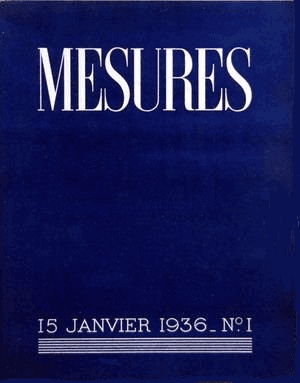
Text published in the magazine Mesures, January 15, 1938 - No. 1.