The genesis of aesthetic emotion, by A. Leclère, 1905
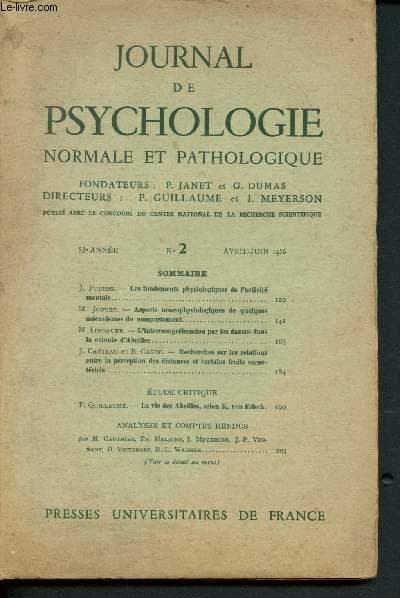
Jean PaulhanReading report published in the Journal of Normal and Pathological Psychology, Volume II, 1905, p. 470. See the original in Gallica
in: Psychology in its relationships with logic and aesthetics
(242) — The genesis of aesthetic emotion, by A. Leclère (Berne). Archives of psychology, t. IV, n° 14, November 1904, 50 pages.
L. makes an ingenious and fine attempt to resolve the question of beautiful, from a psychological point of view alone. Conclusions are based, for most of them, on observations of often subtle details, skillfully linked together. We will summarize them in their most general aspect.
L. first criticizes the realist theory of beauty. The subjectivity of aesthetic phenomenon is all the more obvious because it appears, not only as relating to sensations and ideas of a completely subjective nature, but also, and usually very clearly, as an effect of other emotional states. The physiological theory, on the other hand, obviously remains insufficient; the mass alone of the works of literary criticism and art critic proves that man realizes very clearly, for reasons of an entirely psychological nature, of a large part of his emotions aesthetic and the most important part of each of them. Here is therefore how it will be necessary to pose the genetic problem of the psychology of beautiful: “What is, in the non-aesthetic emotion, the modification which transformed into an aesthetic emotion?
Three theories have attempted to resolve the question of beauty: the intellectualist thesis, the materialist thesis, the moralist thesis. The intellectualists relate the pleasure of beauty to a pure judgment. To this L. counters that he It is easy for us, very often, to find the source of our admiration in our character, in our affections; they thus appear as the translation, in the language of aesthetic criticism, of tendencies which have not in itself nothing aesthetic. On the other hand, we do not demonstrate to others that something he does not admire is beautiful, but we try to appeal to his feelings, and ordinarily to his non-aesthetic feelings.
The materialist theory makes physical pleasantness the last resort of the feeling of beauty. And no doubt some physical pleasure is at the base of all admiration. But intimate analysis reveals here, as a fact, the distinction of a pleasant physique and a charm which can be joined to it, but not identify with him. And if the remark is already true for beautiful material, grasped with the help of the senses or the imagination, it is even more so, for the beautiful intangible which seems to be linked to our superior and ideal ego-altruistic tendencies.
Moralist theory relates all psycho-aesthetic activity to a certain property of our mental state which would consist in the faculty even to experience a pleasure sui generis in perceiving the various symbolizations of which ideas are susceptible in the world of facts. But this thesis, perhaps valid for certain orders of higher emotions, remains powerless to explain a host of aesthetic pleasures. Very often, we find noble or petty interests beneath the most undeniably aesthetic tastes. Besides, we hardly consider it ignorant or unintelligent he whose taste we blame; we are rather tempted to accuse his heart, his emotional dispositions.
The examination of intellectualist theory shows that the cause which transforms non-aesthetic emotion into aesthetic emotion is a properly intellectual element; we must concede, on the other hand, to the materialist theory that an element of pleasure is at the basis of all aesthetic admiration. And these two aspects of the question, developed at length by L., con- lead to the following conclusion: when enjoyment of any kind felt directly or by sympathy ceases to be properly enjoyed for being thought to some degree, it becomes the idea of this enjoyment. Like such, it maintains a pleasant tone, but attenuated; she is still capable liveliness, but no longer intensity. Like any other idea, it keeps the property of pushing the mind to an objectification which will be a judgment of beauty. Thus the aesthetic fact is joy which has become, through a sort of abstraction, an idea of itself.
L. applies this general conception to various genres of art and shows how it accounts for everyone. It summarizes and contains, on the other hand, what was true in the least inaccurate aesthetic doctrines. L. shows, in conclusion, what is its scope and its metaphysical value.
Jean PAULHAN.