Grace and atrocity of Fautrier
Jean PaulhanJean FautrierI sometimes wonder what the obvious, unusual greatness of Fautrier comes from. I also sometimes wonder about the place he holds in modern painting. As soon as I search in this direction, this is what I find.
First, let's clarify one point. This is because I have the right to speak of Fautrier — like Braque or Ben Nicholson — of “modern painting”. People will tell me that Raphael or Fra Angelico, too, were modern in their time. No doubt, but if I may say so, it wasn't on purpose. Time and space appeared to Angelico (as to the Egyptians or the Hindus), according to all we know of them, rather negligible things. Obviously, God had used it: he had to, one way or another, animate matter. But it was only to remind man of his perishable character: basically, to humiliate him. The man defended himself by thinking about it as little as possible.
On the contrary, the hero of our time is ready to say: “We Moderns...” And if he doesn't say it, he means it. It is because we have cultivated this curious science, history, to the point of no longer being able to simply say, of a painting or a moment: “I like it, it disgusts me, it enchants me…” No, we have to start with: “It’s Gothic, it comes from the Renaissance”, and the rest. So that with today's artists it is a question of a sort of redoubled modernity, of a modernity of the second power. It would be little if they were, in fact, modern. They still imagine that they are. They want to be, and nothing will make them stop. This is the first point, and here is the second.
This is because critics feel a curious uneasiness when faced with the work of modern painters. Not that they give up talking about it. Ah! certainly not. And they even talk about it willingly in a tone of enthusiasm and adoration: without making the slightest reservation; they hardly stop to evoke in their subject the human condition and cosmic rhythms, vital functions and the soul in its most intimate depths, in short, what is most profound in ethics, sciences and metaphysics. But they curiously refused to judge them. And, subsequently, to compare them with each other. Critics will readily observe that the roots of the art of Staël, or even of Dali, penetrate to the third layer (or the fifth, or the tenth) of the unconscious. But is Staël a better painter than Dali (or Miró than Hartung), is he even simply a great painter? and should the artist push to the tenth layer or be satisfied, for example, with the third? No one thinks to inform us about this. But that's the whole question.
That there is a new fact there - new, as modern art is new - is what I think will be easily granted. However questionable the old, respectable doctrines of autonomous art, model art or personal art may be - Croce, Berenson, Wölfflin, Venturi - they would at least allow us to decide, at first glance, that Rembrandt was a better painter than Raphael and Uccello than Vinci (or the opposite). But it seems that both models and values have been taken away from us.
Here is a final feature, which follows from the previous one: it is that painting today poses to criticism - and first of all to the painter himself - a moral problem rather than an aesthetic problem. Who would think of still talking about beauty, grace or ugliness? However, Picasso does not hesitate to say that Cézanne, if he had lived and thought like Jacques-Émile Blanche, would not interest him for an instant. What touches him, to hear him, in a Van Gogh painting, is not the chair or the shoe, it is not the fury of the lines or the bursts of color, no, it is simply the torment of the man. To which Mr. Julien Alvard, who also agrees with Picasso, very recently added that the modern painting is only worth - purity, frankness, passion, sensuality - through its ethical virtues. In short, the values would still be there. They would simply have changed meaning and nature.
However, it will be said, it is the painting alone that is given to us, and if they had not painted, who would know Van Gogh or Cézanne? No doubt. It remains that what we judge in the painting is no longer an object, an apple or a shoe, as it used to be - it is an operation: it is the spirit in which the artist painted the shoe or the apple, it is her concern or her torment, her personal approach with the obstacles she encountered.
It's time to return to Fautrier.
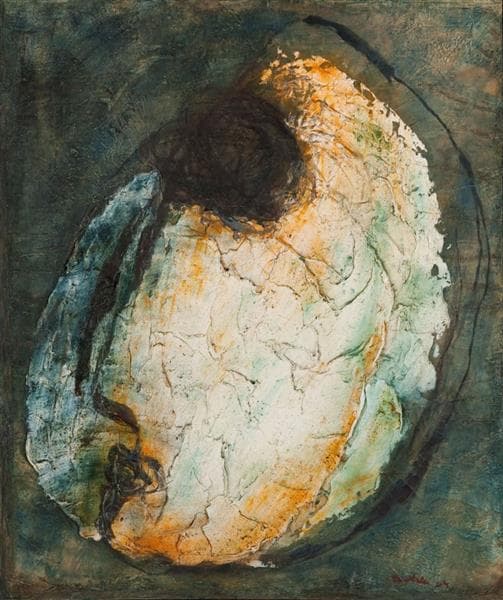
Who follows Fautrier patiently throughout his work first passes through moraines and dark glaciers, crumpled sheets, volcanic landscapes. What is striking in the paintings of this period is first of all the rage and the refusal. Certainly refusal of fashionable schools, from surrealism to cubism; also refusal of objects as they appear: an opened pear seems like a slice of ham. Is this glacier a real glacier? If we want (says Fautrier). It is also the mastery of colors, the extreme virtuosity: whitewashes, lumps, crushes seem to maintain, through metamorphosis or catastrophe, the prestige and the rich material of a Rubens or a Turner.
From Les Otages however, refusal and rage enter the picture. They are the meaning and the emotion itself: here are tortured and truncated bodies, swollen, swollen, stiffened faces. But there emerges from so many horrors a satisfying beauty which fills us: an atrociously flowery grace.
I'm going through some. This atrocious grace survives today in the Nudes, curious panting things, which are like a stump and a shred, yet shot through with shivers. However, the refusal has since become the framework and, if I may say so, the very design of the painting. Packaging, crates, collars, cardboard buckets, pleated papers, there is not one of these miserable objects, both transparent and solid, which does not offer at the last glance, before the trash, its tear and its flaw, in short, the same lack and the same contradiction which characterize modern painting.
However, it is with the greatest respect, despite the apparent negligence, that Fautrier treats all these discarded objects. The flaw and the refusal finally find their dignity - their serenity: as if they were entirely painted.
So whoever follows Fautrier patiently in his work, moving from Volcanoes to Hostages, and from Hostages to Objects, is led, I was going to say, to ask questions. The first of which would be approximately this: it seems that the operation of modern painting was carried out on Fautrier more than he did it. It is because he was discovered, much more than he discovered. And the second:
It is not enough to say that modern painting differs from classical painting. It takes another place in us. It calls forth new feelings: a voluptuousness, a disgust sometimes, unexpected; we don't know what love is a little desperate, into which stupor and mystery enter - in any case, enigmatic, elusive. Where does this undoubtedly come from that we feel deprived, in her presence, of principles and values? But what if values had become, like painting, historical? If the best painter was the one whose operation initiates us most innocently — I mean without calculations or reasons — to this new state of art and love? We can see that the whole place, the whole big place, would therefore have to be granted to Fautrier.
Here, everyone has their say. However, I do not believe that the answer raises serious difficulties. It is, in my opinion: yes, and it is still yes.