Fautrier in Italy
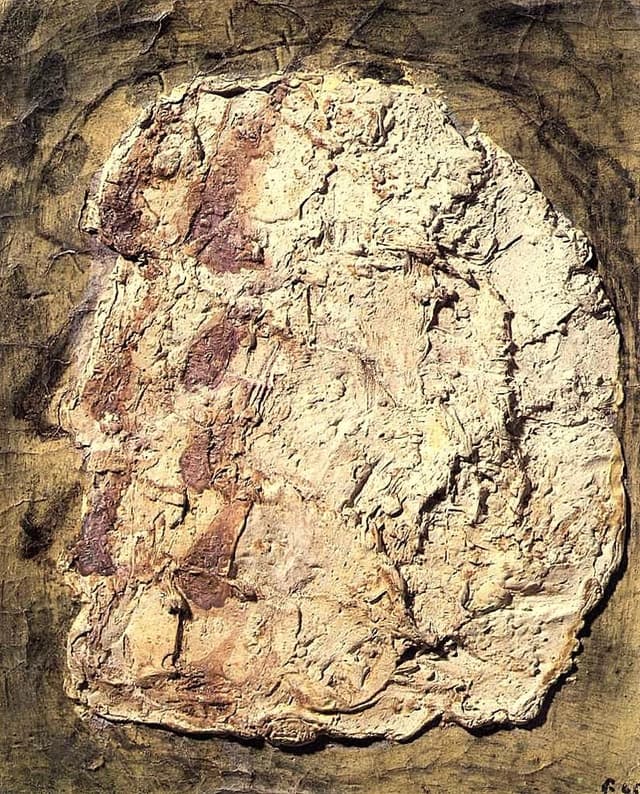
Jean PaulhanJean FautrierI don't think Fautrier will receive the success he deserves in France, far from it. Yet it has striking merit. Yet he was, if I may say so, called. It would be an understatement for him to be the first of the informal painters. He knew how to maintain in an art of fragments and debris the precious colors and the deep shadows, the warm drawing, in short all the resources of a Titian or a Veronese. That would still be little: he realized the old dream of painters which is to convey in a few lines, in the manner of Apelles and Protogenes, the elementary movements of men and beasts, rusty woods and waves, clouds and microbes. Hokusai knew how to draw a rooster's foot which the next moment became a river under dead leaves. Thus each of us pursues and completes the streaks, diagonals and fibrils as we wish: the cracked world of Fautrier. The painters who are criticized for not depicting anything at all are those who know how to evoke with a stroke, with a tear, with a simple breach, more things than we can imagine. However, what is there in Fautrier's paintings that is confident and almost insolent? Never has the fact of the painter, the fact of the prince, been imposed with more brilliance. It looks like he didn't even need to watch himself paint. There is no refusal in this blissful painting but pure enthusiasm, without the slightest demonstration, without the slightest refutation: and it is not his fault if more than one glorious painter, alongside him, takes on the appearance of a diligent student. Simply, here is something that needs to be said. And Fautrier lets him pass. It's not from him that the insolence comes. But of these great sacred signs that Novalis or Hölderlin sought in the eggshells and the folds of the rocks.
I said that Fautrier is little known among us. But it seems that Japan and Germany have been paying him a just tribute for several years. And Italy, which gave it, at the Biennale, the place that France refused it; Italy, where two works have just been published which are moving, just and precious in more than one respect.
G. C. Argan, in his Fautrier, material and memory, does not specifically claim that Fautrier was influenced by Bergson or even that he read this philosopher. It only holds that the philosopher and the painter had to confront the same problems, to which they gave almost the same solutions. This is what he tries to demonstrate with great skill and force. I won't follow him that far. It is enough that his metaphysical side makes him identify more than one feature in Fautrier's paintings that we do not see, or that we see poorly. For example:
_If Fautrier opposes his painting of pure objects to the pure space of Mondrian, and his informality to quintessential forms, it is because he feels that miseries and impurities, the released or repressed impulses, the good and evil of lived existence are better than the abstract purity of logic. He accepts the confusing obscurity of reality, without hoping for anything from the diaphanous clarity of utopia.
That Fautrier is given to live life without reservations is the constant theme of Argan's study. And how does a life “lived without reservations” show itself to us? Here Argan explains to us, according to Bergson:
Each attempt made to go beyond perception through conception, that is to say to follow an intellectual approach, leads to an impoverishment of perception.
But suppose that instead of rising above our perception of things, we only sought to sink into it, to deepen and widen it. Suppose we insert our will into it, and that this will, by expanding, dilates our vision, we will thus obtain a vision analogous to the vision of Fautrier; analogous also to more than one modern poem, which strives to grasp at once the totality of life. Thus with A Throw of the Dice, where for the first time the figure of a thought “is placed in our space”. It is true, adds Argan, that
this icy and resplendent light, this profound correspondence between the colorful qualities of painting and the metric quantities of poetry had already been glimpsed by Turner.
Argan concludes:
_Such a painting gives us for the first time a faithful cross-section of consciousness and its spatio-temporal figure in complexity and contradiction, but also in the depth of its motifs. The repertoire of signs and colors of which it is made offers us a new repertoire in the history of painting.
This “space-time figure” is not without embarrassing me. But let's leave it at that. This large album, Fautrier, material and memory, contains forty-three reproductions, most of them in color and about as faithful, without cheating, as a reproduction can be.
Palma Bucarelli, in his Jean Fautrier, Peinture et Matter, first attempted to draw up a complete catalog of the work. His work contains some eight hundred photographs, sixteen of which are in color; and a sort of film which shows us in a few pages Fautrier at work. Ms. Bucarelli also intends not to let anything escape from the work or the man. However, she does not appear at all overwhelmed by such a vast undertaking. It is in a natural and even cheerful tone that she tells us about Fautrier's life: bourgeois childhoods and games at Parc Monceau; the Catholic nurse, the first revolts; then the death of the father and the departure for London; the prizes at the Royal Academy, the discovery of Turner; English strolls. (“All good things, said Fautrier, are done in laziness.”)
It was the War of the Fourteenth which brought him back to France. He was gassed in Montdidier, and almost immediately reformed:
It was then that he began to draw and paint, also to read and to study with more ardor and avidity than ever: this same avidity which still shines in his eyes today. He threw himself headlong into Rimbaud and Lautréamont. However, he also shows himself to be more sensitive to the distinction of Modigliani, to the candor of Utrillo than to the technical rigor of Braque.
What remained of Fautrier's youthful admirations? From Utrillo, perhaps, a certain taste for the material. From Modigliani, some concern for elegance. From Rimbaud, the call to phantasmagoria. From Lautréamont, the anguish, the feeling of sin: who would not think, in front of the Hostages or the Nudes, of Maldoror: “This woman saw her bones hollow with wounds, her limbs merge into the unity of coagulation and her body present the monotonous appearance of a single homogeneous whole...”
Palma Bucarelli concludes:
_It is not his face, it is his life that Fautrier's paintings resemble. They are made of the same material, one would say of living flesh -, of a flesh throbbing and stubborn to live, as happens, it seems, to decapitated bodies... It still seems like a conscience lucid and suffering like a night of insomnia.
Either. But there are insomnia that are joyful or consoling and full of revelations. And the trait that we can least refuse in Fautrier's paintings is still a beauty that goes beyond the canvas and the painting itself, a beauty rediscovered by what means, at the cost of what sacrifices? Giuseppe Ungaretti very rightly said1: “The impression of happiness which seizes my eyes when faced with the poetry, I mean the painting, of Fautrier is such that I certainly do not think of reasons, of theories or of school concerns. If it comes to my mind later, it is again and always its singular power of consolation which surprises me.” But what is the consolation, and this rejoicing that springs from horror and torture?
I said that Fautrier's paintings gave almost the same impression as Rimbaud's poems: the feeling of a broken world, in debris, and as if struck in its course by some other world. Here Argan will answer us that such must in fact be the aspect of a pure world, deprived of the links and embellishments of all kinds with which doctrines and ideas overwhelmed it: in short, the effect of a dilated perception. I want it. But I don't understand why the effect of expansion is, in certain respects, impoverishment. Why would life without reservation be a life in fragments? Add that Fautrier is not the only one involved; that it belongs to an entire modern school which, from the Cubists to the Abstractists, and from Braque to Mondrian, does not seem to have in the least feared construction or the spirit of system. Add finally that Argan's explanation offers this first defect - from Argan's own point of view - that it is an explanation by philosophical theories (in fact, quite subtle) and by opinions - true and well-founded, Argan will tell me. Hey! no doubt, but which are no less opinions. So that Argan cannot speak here without contradicting himself: and the more plausible his interpretation, the more it also ruins his bias. We cannot avoid asking ourselves: what if it were the opposite? What if there existed some primitive thought, which could not be looked at head-on? Finally, such that we could only grasp fragments of it, but all the more evocative because they are more fragmentary and private. This would explain Fautrier's terror and his joy, his excess of horror and his jubilation quite well. No, I do not want to forge some new doctrine here, but simply to give substance to an absence of doctrine and intention which is immediately obvious.