Fautrier in Japan
Jean PaulhanJean FautrierAs soon as he has freed himself from the wonder in which the tender warmth of the welcome given to him throws him, the meaningful beauty of the flowers offered to him, the serious cordiality of the smiles dedicated to him, the traveler questions himself and wonders what is the expectation or the worry that Japan curiously fills within him.
And here is roughly what he answers:
For some four centuries, the West has based its knowledge and its conduct on the principle of evidence to which it is a question of progressively reducing all the events and all the facts that we are given to know. We follow this principle in everything and no one can say that the effects are very happy: we have come to the point where there is nothing, under the pressure of so much evidence, which is not close to evaporating - to disappearing and us at the same time. Yet we have had this extraordinary (and completely undeserved) chance that there has not yet been found a single scientist — among those on whom the fate of the world depended — who was of the opinion that in fact the world only deserved to disappear.
But it would be foolish to hope that this luck could last forever. I would not want for anything in the world to try to shed any light on what is by nature secret. However, we can clearly see in what sense Zen resembles the processes by which we sometimes resolve a conversation, by saying: “Enough reasons and objections, it is a fact that...” (for example, that Napoleon died on Saint Helena or that you are wearing a gray hat), or else the French mother slaps her little daughter who is grunting, and says to her: “Now you will know why you cry.”
Or the mystic detaches himself from appearances, refuses beauty, glory and wealth and replaces knowledge with non-knowledge. “How can we free ourselves from passions?” asked the student Ting to his teacher Mou-tcheou. To which Mou-tcheou replied, brandishing his stick: “I call this a cane, and what do you call it?”
What do so many and varied arguments imply? This is because clear thinking is not sufficient in itself. But it needs to be supported by obscurity. The grains of dust that we see dancing in the ray of sunlight passing through a dark room would not appear to us if each of them did not have its black face. But our science and our knowledge have always behaved as if throwing glass dust in place of grains of dust would embellish the spectacle. But this is simply removing it. This is what scientists and philosophers do. This is against which Zen and the wisdom of each day raise frail defenses, fortifications of twigs. But it is this wisdom, with the help of Japan, which must prevail. Or our world will disappear.
However, as I advanced towards the heart of Japan, I thought I would find everywhere the appearance and the sign of these great joys. Because the most striking feature of the Japanese landscape is that not a place, even the smallest, remains inactive; the fields are partitioned like stained glass windows: sometimes rectilinear, sometimes tortuous following the desire of the earth and passing from one to the other without the slightest apparent discomfort. And I even thought I saw, from my plane, a rice field slowly climbing step by step a mountain of shale. But cities are in no way inferior to valleys in terms of boldness and complexity: there is not a space that a house cannot reach, even if it extends its tentacles like an octopus, slides its spirals like a sea snail. However, so many forks and dead ends also have their blind faces. How to find the friend you are looking for? It happens that the streets do not have names or the houses have numbers and it is in vain that the driver calls on passers-by, walkers, even children. He quickly despairs, and it seems that cities were invented to hide men even more than to avoid them. “I live,” said the friend whom we finally discovered, “in a house so well hidden that, to find it, you have to have known me since my childhood.”
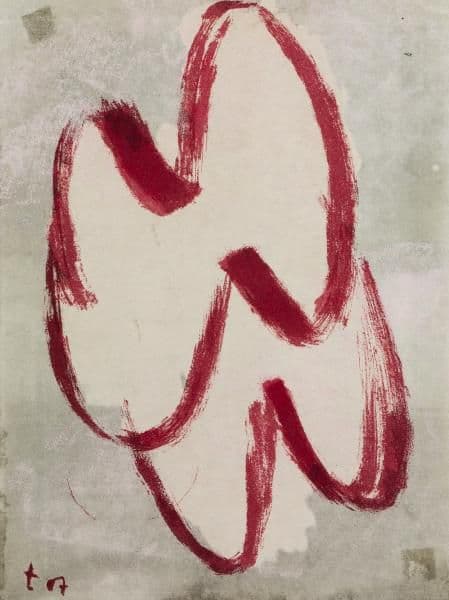
What is Japanese art? It is the slight defect or lack in extreme perfection (as if nature in turn were speaking, and the roles were reversed). The asymmetry of the constructions gives the walker a vivid feeling of space, a screen half-blocks the entrance to the house; the garden which turns and hides itself seems likely to mislead the visitor: yet there we encounter — rocks, lakes, bridges and trees — nature in its entirety, but arranged in such a way that we can never see it all in one glance. The contemporaries of Saint-Pierre in Rome admired that this immense church looked like a miniature. But the traveler admires that in Japan each miniature—hai-ku, bouquet, calligraphy—resembles the whole of nature, better: reveals it and, in a way, lets it pass. “I let the harp,” said Peiwoh, “sing for me.” I am pleased that the opportunity was given to me to write these few words on the occasion of an exhibition in Tokyo of the paintings of Jean Fautrier, who is not only the first of the modern painters and the Informels: who is among all modern painters the only one who has been able to maintain, in the perfection of his canvases, all the resources and the infinite charms of old painting.
Yet he knows how to put so many qualities at the service no longer of abstract ideas and combinations of human reflection - as ancient painting did - but, one would say, of some mysterious object with multiple faces that he surrounds and tries to retain. And it is not, in his paintings, the pure spirit which assimilates an obvious nourishment but in the depths of the soul a communication and our thought suddenly displaced into its most secret region, made of shadow and clarity - well, to put it in a word - the most Japanese of our painters or - it's all one - the most truthful: the one who best resembles the world whole, and thereby protects him and helps him to continue.