Essay on the interpretation of some dreams, by A. Maeder, 1907
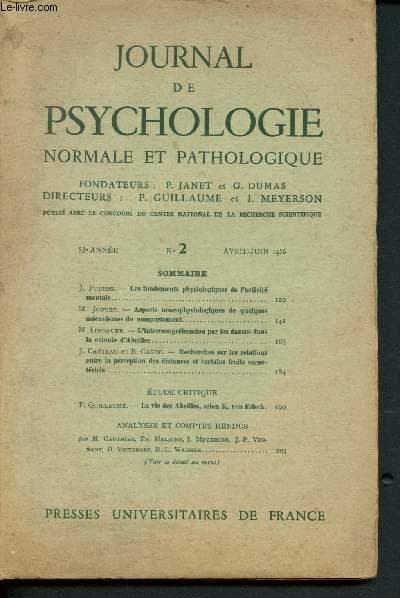
Jean PaulhanReading report published in the Journal of Normal and Pathological Psychology, Volume II, 1907, p. 48. See the original in Gallica
in: Memory, Imagination and Intellectual Operations (210) — Essay on the interpretation of some dreams, by A. Maeder (Zürich), Archives of Psychology, vol. VI, No. 24, April 1907.
I. M... accepts, in broad terms, Freud's theory of dreams. The dream results from two antagonistic forces: a desire, repressed in the waking state, which tends to come true and a censorship which stops it in passing and distorts it. The processes used for this deformation are: 1° condensation, or the fusion of foreign elements into one; 2° the displacement or transfer, which is “the decentering of the interest of ideas with an emotional coefficient on those which are insignificant, hence the common idea that we dream of trifles which could not attract our attention during the day”; 3° dramatization, or concrete, symbolic representation of ideas.
As for the repressed desire which seeks to be realized in the dream, it “rises from the depths of the subconscious”; he is generally the most selfish and without any regard for anyone other than self. From there comes forgetting the dream, because our attention, in normal life, is only focused on those of our desires capable of social use. From the point of view of desire, we can distinguish three kinds of dreams: 1° those which are the manifest realization of an unrepressed desire (we refused chocolate to baby. In a dream, the following night, he received a packet); 2° those who are the veiled realization of a latent and repressed desire (see the dream of the snake below); 3° those which represent the thinly veiled realization of a repressed desire (a Romanian lady, who does not get along well enough with her husband, dreams that she is raped by a big dog).
II. The process followed by M... to analyze new dreams was the next: the chosen subject recounts the dream when he wakes up. M... asks him, about each element of this dream: “What is happening to you now? mind on this point? The subject must respond completely sincerely and without exercising any critical faculty. M... observes at the same time his facial expression, the accent of his voice and his alterations; he must demonstrate here a lot of finesse, like the subject of a lot of sincerity.
III. M...'s observations relate to four dreams. Here is the one who is undoubtedly the most important.
Dream of Ida, a young girl of twenty years old: (A), _I am in E... and crosses a large meadow, to pick beautiful daisies; a dog comes barking and I run away on the path, frightened... I lie down on the side of the path; a snake is applied to my neck, on the left, I am very afraid; impossible to get rid of it... the Dl R... arrives, applies something very funny which frees me. This method surprises me, but I say nothing.
(B). I arrive in a large shaded garden, where a gardener is watering.
(C). _I'm in front of the door and I have to draw a picture; I make the sky, three crosses which are the stars, I am very bored and I don't know what to do. P... arrives and helps me out by drawing a large boat from Lake Geneva. I am very happy...
Here is now the information obtained by Mr... and the conclusions that he gets from it.
(HAS). “The snake and the dog.” Ida says: “The serpent is the punishment for taking the flowers, I deserved it. At E... (country house) I didn't dare not tread on the grass, the farmer would send the dog at passers-by who were picking flowers. I have often picked daisies to ask them: “Love me, a little, a lot...” Ida said again: “I am very afraid of snakes. The serpent, Eve and the apple. The snake in the dream is small, applied to the side of the neck. I am slowly trying to get rid of it, without success; besides, he doesn't bite and doesn't hurt, but it's unpleasant; in trying to push it away, I feel like I'm touching a little dog; it's hairy.”
Dr. R... is his family's doctor; Ida recounts some memories on him: “One day in the presence of my family he said that the Tsarina had just given birth to a girl. We were kids of seven or eight years old and we were both very intrigued and very proud: we had been told about maternity and childbirth.” Ida tells again, not without resistance moreover, that at the religion lesson, the kids smiled knowingly when we told them about the snake. She still remembers a few conversations with girls of his age on clearly erotic subjects. She saw several times, notably at E..., scenes of dogs “which climbed on their backs.”
That’s enough, concludes M..., to say that the entire dream is a “fantasy sexual”. The snake and the dog are common symbols to denote the man. (Cf. Gubernalis: Zoological mythology. In Tuti-Namé, the coitus is called a game of snakes. Id. the serpent's promises to Eve.) The dog that pounces on Ida, the snake that is attached to her neck is the husband who comes and who takes it. The snake changes into a little dog when touched; he touches Ida's neck, and Ida later says that in the same place she two years before, had received a kiss from a good friend.
“At the time I had this dream,” said Ida, “I was in a state of nervousness. and particular tension. Very in love with Samuel, I impatiently awaited his promised visit.
We find in all young girls of this age, concludes M..., dreams of similar content.
(B). The garden.
Ida says: “The gardener at Dover, where Samuel lived, looked mysterious. He reminded me of Putois (from a tale by A. France, Putois, the father of the village's illegitimate children). He was holding a spear and watering. M..., a young man I know gets up every day at five o'clock to water the garden. (The answer on watering is evasive. Ida seems to be fleeing the word.) Le Paradou (in La Faute de l'abbé Mouret, by Zola) is a magnificent garden. “The day before, I risked being sprayed by passing near a garden.”
For M..., the dream is still a “sexual fantasy”; in each association, except the last, there are more or less direct allusions to sexual facts: Putois, the spear (symbol in the same way as the sword or the dagger, or any penetrating object), water (urinate), Paradou, the great shady garden that Ida spoke of when recounting her dream.
About this garden, M... notices that, in general, the forest, the garden represent the pubis, in legends and tales (Cf. Lefèvre and of Gubernatis).
(C). The drawn landscape.
Ida says she can't draw and it bores her. The stars she drawn are crosses — poetry — an earthworm in love with a star. — N... invited him to take a trip in a sailing boat, she refused, because he still wants to court her. He often recites verses where it's about stars.
Pierre, his childhood friend, wrote him a beautiful letter a year ago, which made a strong impression on him, in which he described the profile of sails of Lake Geneva.
Dream interpretation: the shape of the sail is reminiscent of a dagger or a sharp object. Moreover, it is drawn by a young man, who is not indifferent to Ida. This sail is undoubtedly a sex symbol.
The sail is directed towards the star. But the star often designates the woman (a brilliant actress, a worm in love with a star). A lover, in Switzerland, “calls his beloved a star”. In some towns in French Switzerland, young girls call their genitals “the star”. The Dream stars are drawn by the girl. When the drawing is When finished, it is “a pretty landscape,” says Ida, “and everything is very good.”
It is therefore still and always according to M..., a sexual fantasy, about the same theme, with a different and very refined staging.
JEAN PAULHAN.