Happiness in slavery
Jean PaulhanA revolt in Barbados.
A singular revolt bloodied the peaceful island of Barbados in the year 1838. Some two hundred Black men and women, all newly raised to freedom by the March Ordinances, came one morning to ask their former master, a certain Glenelg, to take them back as slaves. Their book of grievances, written by an Anabaptist pastor, was read aloud. Then discussion began. But Glenelg, whether from timidity, scruple, or simple fear of the law, refused to be persuaded. Whereupon he was first jostled, then massacred with his family by the same people, who returned that very evening to their huts, their palavers, their accustomed labor and rites. Governor Mac Gregor quickly hushed up the affair, and emancipation continued on its way. As for the list of grievances, it was never found.
Sometimes one thinks of that notebook. It likely contained, alongside legitimate complaints about the organization of workhouses, the replacement of the lash by the cell, and the ban on "apprentices" (as the new free laborers were called) from falling ill, at least the outline of an apology for slavery. For instance: that the only freedoms we truly feel are those that place someone else under an equivalent servitude. No one delights in breathing freely in the abstract. But if I choose to play the banjo cheerfully until two in the morning, my neighbor loses the freedom not to hear it. If I succeed in doing nothing, someone else must work for two. And we also know that an unconditional passion for freedom swiftly leads, in this world, to conflicts and wars that are no less unconditional.
Add that since the slave, by the good offices of dialectics, is destined to become master in turn, one would surely be wrong to rush the laws of nature. Add, finally, that there is both grandeur and joy in yielding oneself to another's will (as lovers and mystics do), and in finding oneself at last freed from personal pleasures, interests, and complexes. In short, that little notebook would appear today, even more than one hundred and twenty years ago, as heresy: a dangerous book.
Here is another sort of dangerous book: an erotic one.
I. - Decisive like a letter.
And why call such books dangerous? At the very least, it is imprudent. One does it, no doubt, with the easy courage that makes readers want to test themselves against danger. Geographical societies, when sending travelers abroad, advise them not to dwell on dangers either: not from modesty, but so as not to tempt anyone (war gives us enough examples of that). But what dangers? There is at least one I can clearly see from where I stand, a modest danger. The Story of O is one of those books that leave a mark on their reader, and do not leave that reader exactly as they found them. Over the years such books themselves change, curiously mixed with the influence they exert. Very quickly, the first critics begin to look somewhat foolish. No matter: a critic should never hesitate to make a fool of himself. The simplest thing is to admit that I know little.
I move through O as one moves through a fairy tale (fairy tales are children's erotic novels), as one moves through those fairy castles that seem abandoned and yet where armchairs under dust-covers, ottomans, and spinning beds are all impeccably kept, and where whips and riding crops are already in place, as if by nature. No rust on the chains, no tarnish on the colored tiles. The first word that comes to mind when I think of O is decency. A difficult word to justify. Let us move on. And this wind, always running, crossing all the rooms. In O too there blows some spirit, one does not quite know what, always pure and violent, unceasing, unmixed: a decisive spirit, unhindered, moving from sighs to horror and from ecstasy to nausea.
And if I must confess it again, my tastes usually lie elsewhere: I like works in which the author hesitated, where some visible embarrassment shows that the subject first intimidated him, that he doubted he could carry it through. Yet the Story of O, from first line to last, is conducted like a brilliant action. It resembles a speech rather than an effusion, a letter rather than a diary. But to whom is that letter addressed? Whom does that speech wish to persuade? Whom does it ask? I do not even know who you are.
That you are a woman, I have little doubt. It's not so much about the detail, where you like it, green satin dresses, basques, and skirts pulled up in several turns (like a curl of hair in a curler). But here it is: the day René abandons her to new tortures, O retains enough presence of mind to observe that her lover's slippers are threadbare, she will have to buy others. This seems almost unimaginable to me. This is what a man would never have found, in any case would not have dared to say.
And yet O expresses, in his own way, a virile ideal. Manly, or at least masculine. Finally a woman who confesses! Who confesses what? What women have always defended themselves from (but never more than today). What men have always reproached them with: that they do not cease to obey their blood; that everything is sex in them, even the mind. That we would have to constantly feed them, constantly wash and paint them, constantly beat them. That they simply need a good master, and one who distrusts his goodness: because they use to make themselves loved by others all the enthusiasm, the joy, the naturalness which comes to them from our tenderness, as soon as it is declared. In short, you have to take a whip when you go to see them. There are few men who have not dreamed of owning a Justine. But not a woman, that I know of, had ever dreamed of being Justine. In any case, dreamed aloud, with this pride of complaint and tears, this conquering violence, with this rapacity of suffering and this will, tense to the point of tearing and bursting. A woman, perhaps, but one who resembles a knight and a crusader. As if you carried both natures within you, or that the recipient of the letter was so present to you at every moment that you borrowed his tastes and his voice. But what woman, and who are you?
In any case, O's story comes from far away. One first feels that repose, those spaces a story receives from having been long carried by its author, long made familiar to her. Who is Pauline Reage? A mere dreamer? (They say you need only listen to your heart - hers is a heart nothing stops.) Or a worldly, experienced woman, surprised that an adventure begun so well, or at least so seriously, in asceticism and punishment, ends in dubious satisfaction, since O remains, after all, in the sort of brothel where love has brought her, and remains there not altogether unhappy. Yet on that point:
II. — Ruthless decency.
This ending surprises me too. You will not take away from me the idea that it is not the true end. That in reality (so to speak) your heroine gets Sir Stephen to put her to death. He will only undo his irons once she is dead. But obviously not everything is said, and this bee — it’s Pauline Réage I’m talking about — kept a part of her honey for herself. Who knows, perhaps she was taken, this one time, by a writer's desire: to one day tell the rest of O's adventures. Then this ending is so obvious that there was no point in writing it. We discover it on our own, without the slightest effort. We discover it and it obsesses us a little. But how did you invent it — and what is the word for this adventure? I come back to it, as I am sure that once found, the poufs and the distaff beds and the very chains would explain themselves, would let this great obscure figure come and go between them, this ghost full of intention, these foreign breaths.
I have to think here about what is precisely foreign in male desire: what is unbearable. We see these stones, where the winds blow, which suddenly move or begin to sigh, to play like a mandolin. People come to see them from quite a distance. However, we would first like to save ourselves, no matter how much we love music. By the way, what if the role of erotica (dangerous books if you like) was to keep us informed? To reassure us on this, like a confessor. I know you get used to it, in general. And men aren't embarrassed for that long either. They take their side, they say that it was they who started it. They lie, and, so to speak, the facts are there: obvious, too obvious.
Women too, I will be told. No doubt, but with them the event is not visible. They can always say no. What decency! Where does the opinion undoubtedly come from which are the more beautiful of the two, that beauty is feminine. More beautiful, I'm not sure. But more discreet in any case, less apparent, it's a way of beauty. Twice I have thought about decency, in connection with a book where there is hardly any question of it...
But is it true that there is hardly any question of it? I don't think about decency, a little bland and false, which is content to conceal; who runs away from the stone and denies having seen it move. There is another kind of decency, it is irreducible and quick to punish; which humiliates the flesh sharply enough to restore it to its first integrity and sends it back by force to the days when desire had not yet declared itself and the rock had not sung. A decency into whose hands it is dangerous to fall. For it takes nothing less to satisfy her than hands tied behind the back and knees disjointed, bodies torn apart, and sweat and tears.
I seem to be saying terrible things. Perhaps. But fear is our daily bread, and perhaps dangerous books are simply those that return us to our native danger. What lover would not tremble if, for one instant, he measured the scope of the oath he makes, not lightly, to bind himself for life? What lover, if she weighed for a second what "I did not know love before you... I had never been moved before knowing you" truly means? Or again, more wisely - wisely? - "I would like to punish myself for having been happy before you." Here she is taken at her word. Here she is, if I may put it so, served.
So, there is no shortage of torture in O's story. There is no shortage of whippings or even branding, not to mention the straitjacket and the exposure on the full terrace. Almost as many tortures as there are prayers in the life of desert ascetics. No less carefully distinguished and as if numbered - each separated from the other by small stones. It’s not always joyful torture — I mean joyfully inflicted. René refuses; and Sir Stephen, if he consents to it, it is in the manner of a duty. Clearly, they're not having fun. There's nothing sadistic about them. Everything finally happens as if it was O alone, from the beginning, who demanded to be punished, forced into her retreats.
At this point some fool will speak of masochism. Very well: that merely adds a false mystery of language to the true mystery. What does masochism mean? That pain is also pleasure, and suffering also joy? Perhaps. Metaphysicians live on such affirmations - all presence is absence, every word a silence - and I do not deny (though I do not always grasp them) that they may have meaning, at least utility. But that utility does not arise from simple observation; so it is not the physician's business, nor the mere psychologist's, and still less the fool's. "No," they say, "it is indeed pain, but pain the masochist knows how to transmute into pleasure, suffering from which he distills, by some secret chemistry, pure joy."
What a revelation! Men would then have found what they sought so assiduously in medicine, morality, philosophy, religion: a way to avoid pain - or at least to overcome it, to understand it (even as punishment for our stupidity or faults). And they would have had it forever, since masochists are nothing new. One wonders why they have not been honored more, why their secret has not been spied out, why they have not been gathered in palaces and observed in cages. Perhaps men only ask questions to which they have already, in secret, supplied the answer. Perhaps it would suffice to bring them together and tear them from their solitude (as if that were not the most chimerical of human wishes). At least, here is the cage, and here is a young woman inside it. We need only listen.
III. - Curious love letter.
She said: “You are wrong to be surprised. Consider your love better. He would be terrified if he understood for a moment that I am a woman, and alive. And it is not by forgetting the burning sources of blood that you will dry them up.
“Your jealousy does not deceive you. It is true that you make me happy and healthy and a thousand times more alive. Yet I cannot prevent this happiness from immediately turning against you. The stone also sings louder, when the blood is at ease and the body rested. Instead, keep me in this cage and barely feed me, if you dare. Everything that brings me closer to illness and death makes me faithful. And it's only when you make me suffer that I'm safe. You shouldn't agree to be a god if the duties of the gods scare you, and everyone knows that they are not so tender. You've seen me cry before. You still have to taste my tears. Isn't my neck charming, when it chokes and moves in spite of me, with a cry that I hold back? It is too true that you have to take a whip when someone comes to see us. And even, with more than one, it would take the cat of nine tails.
She immediately adds: “What a stupid joke! But also you don't understand anything. And if I didn't love you with a crazy love, do you think I would dare speak to you like that? and betray my peers?
She said again: “It’s my imagination, it’s my vague dreams that betray you at every moment. Exhaust me. Rid me of these dreams. Deliver me. Take the lead so that I don't even have time to think that I'm unfaithful to you. (And the reality is in any case less worrying.) But take care to mark me with your figure first. If I bear the trace of your whip or your chains, or these rings still in my lips, let it be obvious to all that I belong to you. As long as I am hit, or raped by you, I am only thought of you, desire of you, obsession of you. That's what you wanted, I think. What, I love you, and that's what I want too.
“If I have once and for all ceased to be me, if my mouth and my stomach and my breasts no longer belong to me, I become a creature from another world, where everything has changed meaning. One day perhaps I will no longer know anything about myself. What pleasure gives me now, what do the caresses of so many men do to me, your envoys, whom I cannot distinguish - who I cannot compare to you?
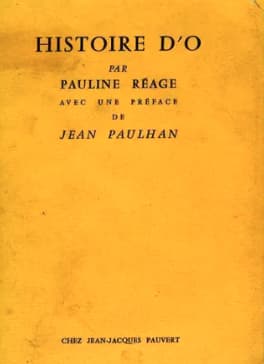
This is how she speaks. I listen to her and I see clearly that she is not lying. I try to follow her (it's prostitution that embarrassed me for a long time). It may be, after all, that the fiery tunic of mythologies is not a simple allegory; nor sacred prostitution, a curiosity of history. It may be that the strings of naive songs and “I love him to death” are not a simple metaphor. Nor what the rangers say to their lover of the heart: “I have you under my skin, do with me what you want.” (It's curious that to get rid of a feeling that confuses us, we decide to lend it to the Apaches, to the prostitutes.) It may be that Héloise, when she wrote to Abelard: "I will be your daughter of joy", did not simply want to make a pretty sentence. Without doubt the Histoire d'O is the fiercest love letter that a man has ever received.
I remember this Dutchman who must fly across the oceans until he finds a girl who is willing to lose her life to save him; and the knight Guiguemar who waits to heal from his wounds a woman who suffers for him “what no woman has ever suffered”. Certainly, O's story is longer than a lay, and much more detailed than a simple letter. Perhaps it was also necessary to come back from further afield. Perhaps it has never been more difficult than today to simply understand what the boys and girls on the street are saying — what, I suppose, the slaves of Barbados were saying. We live in a time where the simplest truths only have the resource of returning to us naked (as O is) under the mask of an owl.
Because we hear perfectly sensible people talk quite willingly of love as a light feeling, without consequence. We are told it offers many pleasures, that the contact of two skins is not without charm. We are told, too, that charm and pleasure reach their fullest only for those who preserve in love its fantasy, its caprice, precisely its "natural freedom." Very well: if people of different sexes (or the same sex) can so easily give each other joy, good for them; they would be wrong to hinder one another. But one or two words in all this still trouble me: the word love, and the word freedom. The truth is almost the opposite.
Love is dependence - not only in pleasure, not only in existence, but in what comes before existence, in the very desire to exist - on fifty baroque details: two lips (and their smile or grimace), a shoulder (in the way it rises or falls), two eyes (a little moister, a little drier), finally an entire foreign body with the soul or spirit it carries, a body that may at any instant become more dazzling than sun, more chilling than snowfields. To undergo this is no joke; your tortures make me laugh. One trembles when that body stoops to fasten the tongue of a shoe, and one feels all eyes are watching one tremble. Better the whip, better rings in the flesh.
And freedom? Any man or woman who has been there will sooner cry out against it, heap curses and horrors upon it. No, there is no shortage of horrors in The Story of O. Yet at times it seems to me that what is being tortured there is less a young woman than an idea, a fashion of ideas, an opinion.
The truth about the revolt.
Strangely, happiness in slavery now passes for a new idea. There is scarcely any right of life and death left in families, in schools of corporal punishment, in households of marital correction; and the same men whom earlier centuries proudly decapitated in public squares are now left to rot in cellars. We no longer inflict anonymous and undeserved torture. Instead, far more atrociously, war roasts entire cities in one stroke. The excessive gentleness of father, teacher, lover is paid for in carpet bombs, napalm, and atomic blasts. Everything happens as though there were in the world some mysterious balance of violence whose taste - and meaning - we have lost.
And I am not disturbed that a woman should rediscover this balance. I am not even surprised. To tell the truth, I have fewer fixed ideas about women than men usually do. I am surprised that there are women at all - more than surprised: faintly amazed. Perhaps because they seem marvelous to me, and I cannot stop envying them. But what exactly do I envy?
I sometimes regret my childhood. But what I regret is not at all the surprises and the revelation that the poets talk about. No. It reminds me of a time when I found myself responsible for the entire earth. In turn boxing champion or cook, political orator (yes), general, thief, and even Redskin, tree or rock. People will tell me that it was a game. Yes, good for you, grown-ups, but for me no, not at all. It was then that I held the world in my hands, with the worries and dangers that follow: it was then that I was universal. Here's where I'm going with this.
This is because at least women are given to resemble, throughout their lives, the children we were. A woman understands very well a thousand things that escape me. In general, she knows how to sew. She knows how to cook. She knows how to arrange an apartment, and what styles go well together (I'm not saying she does all of this to perfection, but I wasn't a blameless Redskin either). She knows much more. She is comfortable with dogs and cats; she speaks to these half-crazy children that we admit among us: she teaches them cosmology and good behavior, hygiene and fairy tales, and this can even include the piano. In short, we never stop dreaming, since our childhood, of a man who would be all men at the same time. But it seems that it is given to every woman to be all women (and all men) at the same time. There is something even more curious.
We hear it said these days that it is enough to understand everything to forgive everything. Well! it always seemed to me that for women — however universal they may be — it was quite the opposite. I've had quite a few friends who took me for what I am, and I in turn took them for what they were — without the slightest desire to transform each other. Even I rejoiced - and they rejoiced for their part - that each of us was so similar to ourselves. But there is not a woman who does not seek to change the man she loves, and change herself at the same time. As if the proverb lied, and it is enough to understand everything to forgive nothing at all.
No, Pauline Reage does not forgive herself much. And to be frank, I even wonder whether she does not exaggerate a little, whether women like her are truly as much like her as she assumes. Yet more than one man grants her this all too readily.
Should we regret the Barbados slave notebook? I fear, to tell the truth, that the excellent Anabaptist who wrote it has filled it, in the apologetic part, with rather flat commonplaces: for example, that there will always be slaves (that is in any case what we see); that they will always be the same (this is debatable); that we must resign ourselves to our state and not waste time in recriminations that could be given to games, meditation, the pleasures of habit. And the rest. But I suppose he didn't tell the truth: it was that the slaves of Glenelg were in love with their master, they couldn't do without him or their slavery. The same truth, after all, from which the History of O comes its decision, its inconceivable decency and this great fanatical wind that never stops blowing.
Jean PAULHAN.