Balls
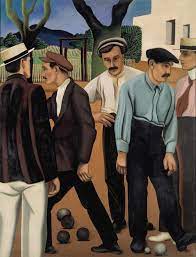
Jean PaulhanI asked my grandfather: “and who will be at the game next Sunday?” He replied: “There will be everyone.” This everyone was the big players, the big guns as they said, those from Quissac and Nîmes, Toulon, Hyères and Marseille. Finally, everything that mattered in the game of bowls, all those whose hands we would have enjoyed shaking; for example, Mr. Périer or Mr. Chassan, or even Mr. Clarond the elder.
My grandfather wasn't in all the parties, no. But he was part of all the shows: this long double tail whose all the members followed each ball with their eyes, oscillating their heads, wiggling their legs, twisting their torsos, breathing heavily. How many were there? There were well – in my opinion – five or six hundred, who were training at the time for the Olympiads. I was betting, of course, for my grandfather. But it was a Monegasque player, Mr. Rengo, who won the gold medal. In the years that followed, we even removed the balls from the program: it was the foreign countries, it seems, that had betrayed us: there were only 12 to claim the game. At least 17 would have been needed.
Why is it so nice to see a ball, hold it, caress it? I don't really know anything about it. Perhaps it is because she is a strange object: she carries to perfection all the curves that delight us in a fruit, in a cheek, in a flower or in a breast. We can't do better. There is even stranger: a ball remains, until the end of its race, full of surprises; This is because the good player, by throwing it, gave it two opposing movements. She flies towards the goal, that's the most obvious. But once it hits the ground, it can return (slightly) towards the player who threw it, or lean to the right or left. It all depends on the effect you have on it by rolling it under your hand. In short, she is agitated by two movements at the same time, the first of which carries her forward, the other backward; hence his hesitations and, if I may say so, his intelligence. Goethe admits that all reflection begins in a contradiction. Pasteur maintains that we find a dissymmetry at the basis of each phenomenon. These are great truths, which the game of boules reminds us at all times. Where does its gravity come from, in a way religious.
I am talking, of course, about the real game of boules, not about pétanque or the Lyon game: the Provençal game.
What life did we lead in the times I spoke about? This is what has become difficult for us to imagine. It was at the age of 28 that my grandfather gave up the grocery store where he excelled and, in general, any kind of work. But not bowls where he practiced every morning in his mazet with a few neighbors who – in my opinion – were not worth it.