Assassin for twenty francs
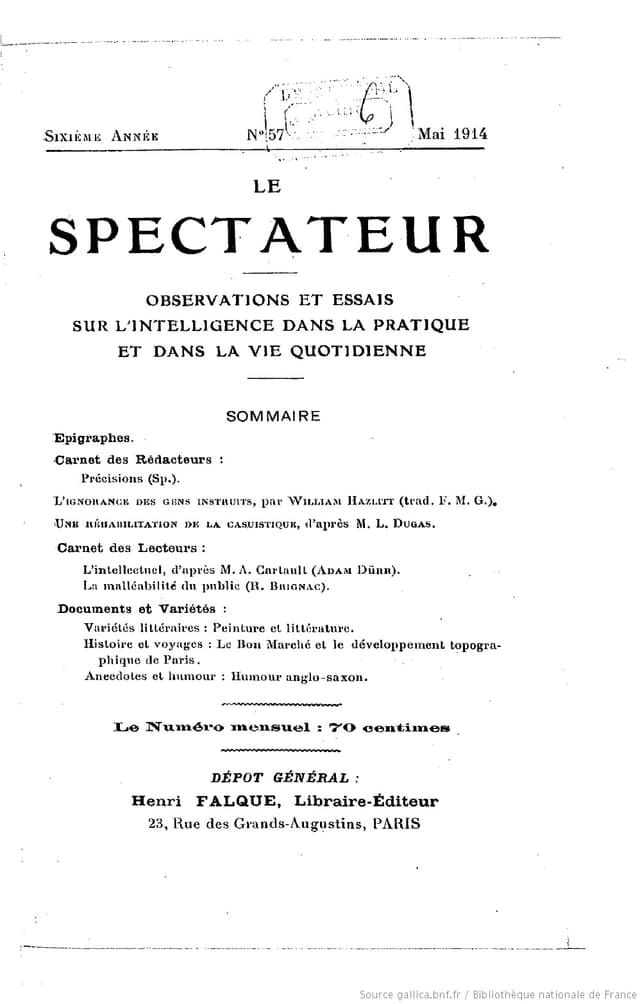
Jean PaulhanArticle published in Le Spectateur, n° 42, January 1913, p. 6-8
“Here,” says the Presse, “the crime which led Bour to the guillotine.” Bour killed, for fear of being surprised and as she called for help, a lady Schmidt whose home he was robbing; “When she no longer breathed, Bour started stealing again: he only found twenty francs and a watch.”
The title is in large letters: “Assassin for twenty francs”. By which we mean that Bour was naturally inclined to crime, and must have taken particular pleasure in it, — to consent to commit it for such poor results.
And this aggravates his fault, takes away all human feeling. “It is right,” said the Presse, “that Bour was not pardoned.”
Is he so sure that Bour wanted these twenty francs? And, had he found them, would he not have been satisfied with a hundred or a thousand? We do not seek it, through the effect of the illusion that René-Martin Guelliot rightly calls: the prediction of the past (1). And since the author of the crime took twenty francs, it means that he wanted them from the start.
*
* *
The word for is suspect here, and the care with which he wants to hide his ruse. Because the title cited above could very well have this meaning: "Assassin for twenty francs, he was an assassin (first moment), and he gained twenty francs (second moment)".
Yes, it would be possible that for had such a meaning. But he doesn't have it; it had, for the journalist and for his readers, this other meaning: with the intention of having twenty francs. This is very clearly accentuated in such an assessment heard: "Must one have fallen low to murder for twenty francs..."
What is suspicious? For ready both ways, nothing more. — It’s true; I only blame him because it seems to have, in the case of Bour, a real meaning that is all the stronger because its grammatical meaning is vague and imprecise.
V. Figger noticed that in the rapid and partly erroneous perception of the inscription on a poster - read: JOUETS ETRENNES, for example, instead of 10 DAYS AT THE SEA - it is the letters which do not appear on the poster which most strongly give us the feeling of their reality. Isn’t something similar happening here? Very innocent-looking propositions and conjunctions play an important role in any argument: it is undoubtedly that having by nature a very vague meaning, they are filled and, so to speak, swelled with the new meaning that we wish to give them.
Jean Paulhan
1 - Paradoxes of the notion of danger, in the Spectateur of May 1912. Two notes from Henri Gervaiseau: Judgments after the fact (June 1912) and Cause and fault (October 1912) specify and illuminate the same illusion. ↩