The argument of identicals
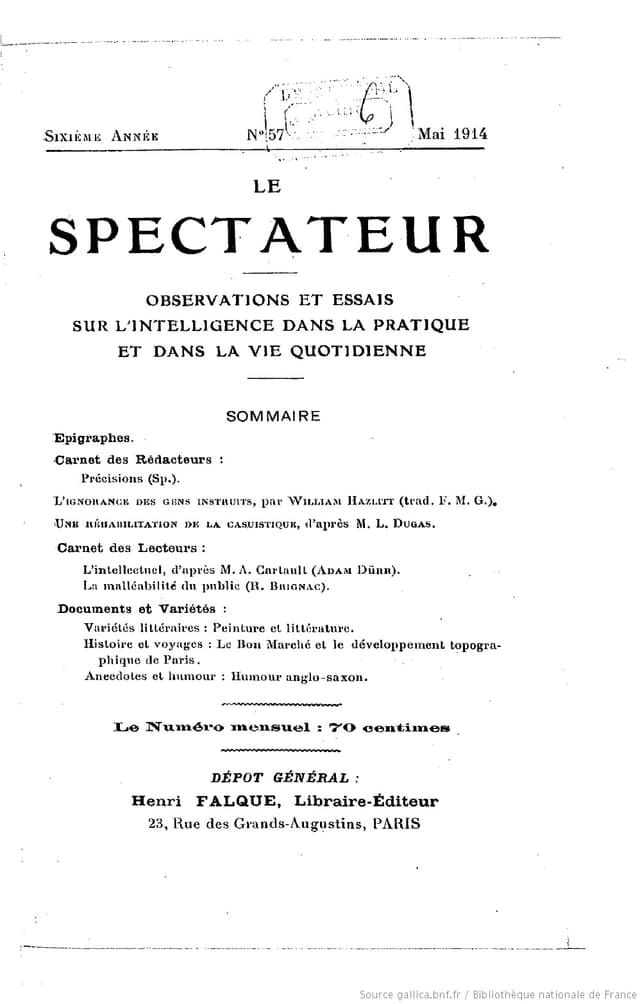
Jean PaulhanArticle published in Le Spectateur, volume three, n° 29, November 1911, p. 430-456
This socialist speaker said: "Your prejudices against socialism come from the fact that you do not know it well: I will make it known to you; or else from the fact that you have inaccurate ideas about the functioning of a modern society: I want to rectify them."
And this other: "You wrongly believe that you have prejudices against socialism: I will show you that they are only an illusion. Your condition, your desires, your feelings make you a socialist as we ourselves are."
The first speaker admits that those who listen to him have an opinion different from his; he will seek to convince them, to bring them to him through slow transitions. But the second speaker first asserts that those to whom he addresses are the same as him; he will then prove it to them, in detail. One follows an absorption method. We will call the method used by the other: the argument of identicals.
*
* *
I. — THE VARIOUS ASPECTS OF THE ARGUMENT FROM IDENTICS.
A. — An example.
A revolutionary propaganda pamphlet, the Letter to a Peasant (1) by Loquier, is nothing but a long argument of the identical. We will cite the essential passages. The author addresses a young soldier sent to Paris to suppress a strike:
"Those whom you are called to slash wanted a very simple thing; to live better and toil less. Their masters, idle, became afraid, and the government then brought you, you children of the people, to keep these people in slavery. Because the rich have always acted like this: to keep the slave in respect through the slave himself." (2)
So here is a first argument: you are of the people, like us, revolutionaries, and therefore a slave like us. And what we want is so simple, so legitimate that, undoubtedly, you want it too. Who doesn’t want to live better?
"As progress progresses, the people become educated. We are arriving at a time when many young people from the cities, by the ease they have in learning the history of social struggles, refuse to shoot at the people: our young friends are taking possession of their consciousness as workers." (3)
You too, through the march of progress, are called to educate yourself, to take possession of your slave consciousness.
"Only one hope remains for the privileged classes: the countryside! the peasants! You have noticed, in fact, that city people have a more alert, more subtle mind than our peasants, which even makes them laugh at them. This is ridiculous, because most city dwellers should remember that they are the peasants of yesterday." (4)
So perhaps you are, peasant, a city dweller of tomorrow. There is, between the revolutionaries and you, no deep separation: yesterday they were the same as you.
"Newspapers, books, conferences are the cause of the intellectual development of the workers. But the peasants are also starting to stir up a little. In the countryside of the South, masses of peasants have grouped together and told the exploiters that they no longer wanted to be their niggers or their mercenaries."
The peasants, through their own effort, also know how to become revolutionaries. You therefore cannot fail to be one day, even if you do not become a worker.
"I now ask you this question: do you, the victims, want to still serve your enemies and ours? If you have understood correctly, I have no doubt of your answer. You will have a great task to accomplish when you soon leave the regiment, that of having my letter read by everyone you know. You will be able to jointly buy brochures, books..." (5)
And you are now convinced. How could you not be? So here's what you need to do...
Thus the reasoning became more pressing in each place: "You are in the same condition as us, you have the same desires, you will have the same knowledge tomorrow; those who were similar to you are now the same as us; those who are similar to you become like us; you yourself, by reading this letter, have become revolutionary."
From an argument which consists of repeating to the person you wish to convince: "But you will be convinced! You are already convinced!", one might think that it is an accidental and clumsy process to avoid asking the essential question. The universality of the argument from identicals denies such a hypothesis.
B. — Simple forms of the argument of identicals in discussions, advice, advertisements.
There is a trick that parents happily use to get their children to accept a gift that may displease them. It is to say: "I guessed what you wanted, without daring to say it: here is a drum, or a cake." And children, usually, allow themselves to be convinced.
"I had a constant principle in my conduct with students," said a teacher: "never believe them capable of a bad action, and tell them so, until the evidence forced me. A child had stolen a pencil: he denied it forcefully. I said to him: "I believe you incapable of a lie. You didn't steal this pencil." This same child, touched by the good opinion that I seemed to have of him, subsequently demonstrated great sincerity."
“I believe you incapable of a lie”, here in all its simplicity, is the argument which supposes the moral identity of the two interlocutors, and that the result which had to be achieved has already been obtained. Authors who have written educational works note the strength of such an argument: a child to whom one day had been said: "How you want to wash your hands! How nice it is to be so clean!" without having in the least the desire that was attributed to him, subsequently became very careful of his person.
Thus the use of the argument of identicals supposes that one knows, better than oneself, the desires, the opinions, the tastes of the person to whom one is addressing. “I only want to be your representative,” the candidate said to his voters. — “I am only your spokesperson,” said Mr. Hervé to the peasants of Yonne. “My antimilitarist theories are not mine; it is you who entrusted them to me, giving me the task of defending them.” Thus, a speaker on tour, introducing himself to new listeners, sometimes congratulates them for being more deeply attached to the Republic, or to the socialist doctrine than himself, and for having proven it.
“So,” they might respond, “what’s the point of giving a speech? — It’s because a few details still need to be clarified.” He doesn't always dare to say: "I know what you think much better than you." But he can believe it.
An advertisement is an argument. It is addressed to a supposedly hostile or indifferent person; she asks him for a very simple thing: to buy a soap of a certain brand, a suit from a particular tailor rather than any other. But advertising readily proceeds with the argument of identicals. A daily newspaper offers those of its readers who subscribe before a fixed date reimbursement, in various items, of the money paid by them. Two days, three days before this date, notices appear in this newspaper. “Remember that you only have three days, two days, to subscribe to Excelsior”. Thus, whether the reader wanted to take out a subscription, we did not want to doubt it: only he could make a mistake on the day, do it too late, and we would give him simple advice.
Who doesn't remember announcements such as: "By popular demand, Mr.
MM. Jaurès or Maurras say to their worker or "French" readers (6): "You were socialists, royalists, without knowing it: but our doctrine, by revealing to yourselves your deep will, brings you today the tranquility of reason. You were waiting for us. With what joy you will now welcome us!".
We read in le Petit Méridional of February 12, 1911 "The herniated inhabitants of Saint-Hippolyte-du-Fort were impatiently awaiting the arrival in our walls of the representative of the house
There is no irony in such comparisons. Persuasive reasoning has its laws which are binding on a trader as well as on a political writer. The argument from identicals is undoubtedly one of these laws. Reduced to its skeleton, but still retaining part of its strength, we would find it in familiar discussions:
“You behaved badly towards me.
— No.
— What's the point of denying it? Think for a minute and you’ll see that I’m right.”
Or:
“You lied to me.
— No.
— Yes, you lied to me; and then you know very well yourself that you lied to me.”
C. — Complex forms of the argument of identicals.
Common places of propaganda.
A doctrine does not live without affirming its existence and its vitality, and that it knows how to impose itself today on those who rejected it yesterday, and that it will impose itself tomorrow on those who reject it today. The reader of Action française believes in the incessant progress of the royalist cause, the reader of Humanité in the near triumph of socialism, and the reader of Temps believes that the number of moderate republicans is increasing every day; this on the basis of their mutual journals. Now the very contradiction which arises between the assertions of these newspapers shows that they are not exact and disinterested information, but arguments: a single argument rather, the argument of the identical. Different doctrines know how to adapt it to different listeners, to different readers. They can't do without him. Has an orator ever implied, has he ever said to those who listened to him: "None of you approve of me and doubtless, when I have spoken, none of you will think that I could be right"?
Every socialist admits that a worker—by the very fact that he is a worker—is already half-socialist, independently of all study, of all reflection. Mr. Guesde, presenting himself for the deputation, wrote on the walls of Roubaix: "I neither want nor can represent the two classes in struggle. I only want and can only be the man of one against the other. Let no boss vote for me. Let no capitalist vote for me." Which means: “Let every worker, every proletarian, vote for me.” And maybe: “All the workers will vote for me.” The expression "the conscious proletariat" means: "the proletariat which is socialist", and more precisely: "the proletariat is socialist". We cannot imagine that a worker, aware of his quality as a worker, would be radical, for example, or moderate republican. It is a commonplace easy to extract from any socialist propaganda speech that only the worker to whom the speech was addressed was not yet entirely convinced, all those of his condition having been so for a long time.
However, Mr. Maurras, a royalist writer, readily repeats that every Frenchman “who thinks and to the very extent that he thinks” is with him. "Our ideas," he adds, "are the sum of all the feelings and all the real needs scattered throughout the country. It is little to be right; we are right with everyone (7)." We could smile at the all-too-obvious illusion. We must give the sentence its role as an argument, and read: “Since you are French, I ask you to be with me”.
The skill of Christian missionaries, among the slaves of Rome in the past, among the Negro or yellow peoples today, was, without doubt, to say: "You are the same as us; you have, like us, a divine soul; you are also children of God. And, thus participating in the Christian religion by your very nature, you are already half converted." It is implied, in the ordinary way: "Besides, all men have already become Christians. Only you remain." A Malagasy, a recently converted Chinese remains surprised and incredulous if we want to tell him that certain Europeans are not Christians.
Thus, in each of these three beliefs: the Christian religion, the royalist doctrine, socialism, the presence of the argument of identicals is betrayed by the adoption of a propaganda commonplace: the "Christian man", the "royalist Frenchman", the "socialist worker". It would be possible to analyze, from this point of view, other doctrines, to distinguish what is, in them, argument, and what is made of belief: these are the two faces of all doctrine; this commonplace: "the Christian man" is a form of this dogma: "the existence of the soul in every man". This commonplace: “the socialist worker” is a form of belief in the social value of the worker. However, for each believer, depending on the extent, the more or less disinterested form of his culture, one or the other facet will be more apparent: in the mind of this scholar, socialism is an abstract formula resembling the organization of an ideal society; and in the mind of this worker it is this: “Everything for the proletarians and by the proletarians”. Thus, one of the two only retains from the socialist doctrine its active face and the system of ideas by which it seeks to gain new adherents. And the argument of the odentics can thus profoundly modify, by very reason of its success, the belief which it serves.
A belief owes even more to the argument of identicals; it owes to it its aspect of impartial teaching - a paradoxical aspect if we want to think that the only interest of a belief is to quickly find new followers, and by all means. But the argument of identicals, and the commonplaces which are its expression, affirm precisely that these followers are already found, that they come in crowds, that they are ready to accept without restriction the doctrine offered - either for their half-divine nature, or for their condition as workers, or for their nationality as French. All that remains is to clarify, through simple teaching, their unconscious beliefs. The speaker, the apostle, duped by the argument he uses, believes he can show himself, without danger, just and tolerant. Christian charity could perhaps be explained this way. “Leave them, they don’t know what they are doing, says Jesus Christ.” That is to say: “They are, deep down, Christians like us. They are only mistaken about their nature: they do not yet know themselves.”
*
* *
II. — FORM AND LOGICAL CHARACTER OF THE ARGUMENT OF IDENTICS.
A. — Definition of the argument: its logical process.
Let A B C D E F G H I be the series of possible forms that a political belief can take. Two adversaries find themselves placed, one in B, the other in F. Now the first can seek to gradually bring the second closer to position B which he himself occupies, leading him through E, D, C. He will use the absorption method; B, a socialist, will thus show F, a conservative republican, through methodical teaching, that radicals, better than conservatives, and collectivists better than radicals, can achieve, in a republic, a lasting and just balance.
B can use a completely different method which was definitively analyzed by V. Muselli, and called the argument of extremes (8). He can criticize F for calling himself a republican and not frankly admitting to being "reactionary". It thus pushes F to a more distant position H or I.
Or B will say to F: "You are, like me, a socialist. If you call yourself a conservative republican, it is because you still have difficulty distinguishing the principles that guide you and their logical consequences. Or perhaps it is the fear of displeasing those close to you, or the superficial fear of social change?" B thus asserts that C, D, E have no valid existence; he first of all locates F in B. And this is properly the argument of identicals.
It may seem that Jesus Christ, during the interviews which have been reported to us, proceeded mainly by the method of absorption; and this is the case with all teaching. However, when he said, already triumphantly: "All those who are not with me are against me", that is to say: "All those who have not deliberately sided with me are my enemies", he was using the argument of extremes. At the beginning of his apostolate, he only said: "All those who are not against me are with me." He thus used, vis-à-vis all those who had not yet expressed their opinion on the truth of his doctrine, the argument of identicals.
We can now define this argument as follows: the argument of identicals asserts, before any discussion, that there is deep agreement between the two adversaries or that one of the two realizes the ideal that the other has formed. It remains for us to show what its logical structure is.
A polemicist, M. U. Gohier (9), is being prosecuted in the Assize Court for "insulting the army". He defends himself, telling the jurors: "I have already been prosecuted several times. Each prosecution was met with a reform along the lines of my criticisms. I was prosecuted for having said that the barracks is a school of alcoholism: at the same time, General de Gallifet launched a circular to curb the scourge. I was prosecuted for saying that the barracks is a hotbed of syphillis; at the same time the military governor of Paris posted health regulations and advice for young soldiers in the barracks..."
Here is the meaning of the argument: "Those who have me prosecuted share my opinions on the army: you yourselves, who have to judge me, must recognize with them the accuracy of my criticisms. Therefore you cannot condemn me since you think like me."
Which could be expressed thus:
I. Army leaders took measures against alcoholism in the barracks. It is therefore generally accepted that the barracks are a school for alcoholism.
II. So you cannot condemn me, who only said that the barracks is a school for alcoholism, which is what you all think.
We would easily find similar reasoning in any argument of identicals. It appeared in Loquier's letter, in this form: "I: Your condition, the march of progress, makes you a socialist. II: Being a socialist, you must refuse obedience to your leaders if they want to send you against striking workers." And in such a simpler argument: "You have behaved badly, and moreover you know it very well", it would be: "I. Your intelligence, your moral sense, or simply the fact that I have drawn your attention to this point mean that you judge your action bad II. Since you judge your action bad, you have the duty to recognize it and to show regret."
Such reasoning thus appears to be the logical process essential to any argument of identicals. It can be summed up like this:
I. That we perform such an act (10) presupposes that we have such and such a belief;
II. That we have such a belief leads to performing such a new act.
B. — Logical criticism of the reasoning contained in any argument of identicals.
In the first part of the reasoning which is the basis of any argument of identicals, appeal is made to a belief of a very special order: it is a belief which does not yet exist, which has no life of its own as a belief. It is the junction point of various desires, feelings, and actions: it may be unconscious, but it nonetheless exists. And it is curious to find here in its vulgar, primitive form perhaps, this paradoxical notion of an unconscious belief, to which philosophers often appeal. Mr. Maurras must interpret with great ingenuity the conduct of the French today to assert that they are royalists to the exact extent that they think. However, Mr. Jaurès affirms with similar conviction that, at all times, workers have been socialists. “Boulangism,” he wrote, “was only a movement of confused socialism.” (11) And again: "In the first third of the 19th century, the working force exercised itself, deployed itself, fought against the power of capital; it did not know that in the communist form of property was the completion of its effort". (12)
What an immense field opens up here for the argument of identicals! Any fact may seem to him to be a symbol of belief. The game is easy. Let us be given ten acts, ten words of a person: we will be able to prove to him, as he wishes, that he is "deep down" selfish or generous, proud or modest, and even republican, anarchist or royalist: it is enough to know how to choose, and interpret a little. Moreover, party leaders simplify everything: they usually attack people who are almost identical in conditions, tastes, desires, and can thus constantly repeat the same interpretations to them.
However, having proven to a particular worker that he is in reality a socialist, the argument of the identical will want to go further and say to him (II): "Now, be completely socialist; and, for example, vote for our candidate, register among the members of our party." To which the worker might respond: "But since you discovered that I was a socialist, it was good that I thought and acted like one. And I was only a socialist, in fact, only to that extent. Why do you want me to act differently, now that I simply know myself better?"
Here we see the “dangerous passage” of the argument. The belief referred to in the second part of the reasoning is a clear and considered belief, principle and source of new acts; and, therefore, completely different from the unconscious belief of the beginning. If the expression were not taken in the wrong way, one could say that the argument is based on a play on words; rather on a game of ideas: why must the idea of belief account for such distinct psychic realities? We can imagine the listener not playing the game, refusing to understand. The young peasant to whom Mr. Loquier addresses would respond: "Indeed, I see very clearly that I am a socialist. This is very curious. Since this is currently my job, I will soon have to charge the strikers and I can't wait to know how you will interpret this new act on my part."
It is because we refuse to obey our leaders, or we even vote for a particular candidate or we join a particular political party, or we act in general, for active, social considerations, for feelings quite different from simple intellectual knowledge. This rich man said: "I know myself; if I started to give once to the poor, my good heart would carry me too far." So, fearing the goodness he discovered in himself, he was in reality indifferent or evil. And this worker, who knew himself to be a socialist, nevertheless considered socialism as a currently useless reverie, from which only the leaders of the party could benefit: and he refused to act as it is agreed that a good socialist acts.
There is a simpler case: that of people who know themselves and who accept to be socialists, royalists, Christians, without imagining that their conviction could lead them to ever perform one act rather than another. “Active believers” call them indifferent or traitors. They are simply minds in whom belief exists in a pure state of belief: and, perhaps, is thus preserved more intact and uncompromised. The Christian who distributes all his fortune to the poor, we do not know if he will not one day regret being a Christian: at least he will be led to choose, in the system of ideas which constitutes his religion, certain precepts, to the detriment of certain others, and thereby to modify, to transform this religion within himself, to the extent that he wishes to live it.
Nor does it follow from being a royalist that one must necessarily risk one's peace to hasten the advent of a king. Some kings in exile are royalists, and yet do not wish to return from exile. From this observation: “You have this belief” to this command: “Act therefore believing” there is an abyss to cross. The argument from identicals supposes this to be crossed. And more precisely than just now, we could now explain it like this:
I. (A belief can be unconscious; it is expressed by words, actions, feelings: such a social condition is necessarily accompanied by such and such a belief.)
You act in such and such a way.
So you have such a belief.
II. (A belief is an active thought which knows itself and wants to impose itself: it is a principle of action.)
You have such and such a belief.
So act in such and such a new way.
C. — Psychological foundation of the reasoning contained in any argument of identicals.
It is important, to better understand that the logical transition from belief I to belief II can be accomplished without surprise and without disturbance, to think of the illusion of knowledge that we could call the feeling of mental realities.
When we experience a new emotion, it seems to us that this emotion could not have suddenly been created from scratch, but that, for a long time, it had existed in us in an unconscious state: it was at least a faculty of emotion, a "tendency", a latent emotion. “I feel now that I have always loved you,” said this hero of the novel to his lady; “I just didn’t know for a long time that it was you.” Consciousness appears to us as a light which arises successively on the various desires, thoughts, feelings formed in our soul: it only illuminates them, but the ideas and desires and feelings have been there for a long time. This man who sits down at the table says, to explain to himself that he immediately eats with such appetite: “How hungry I was, all the same!” But he admits very well that his hunger was unconscious: it is only now that he knows it, and, to tell the truth, he only imagines it: "Since I eat with pleasure, it is therefore that I was very hungry."
Now the same remark can be applied to any fact of judgment or belief. The proof is that we readily speak of opinion, of unconscious belief; the words are contradictory: what is an idea that we do not think, an opinion that we do not know? This is because the idea and the belief, once known to the mind, were rejected in the past, conceived as existing for a long time. We refuse to admit that an instant was enough to create them: the only resource is to believe that they were already within us. “I was revolutionary,” said Vallès, “before knowing the meaning of the word revolution.”
The worker, to whom the socialist speaker was addressing, is now convinced. Because he wants to improve his situation, to have fewer working hours and a higher salary, he concludes that he is a socialist. “You always have been,” he was told. And he agrees: in fact he always wanted to achieve a better situation. Only, he does not realize that, from the moment he gives meaning and dignity to this very simple desire, from the moment he translates it into socialist language, something new has appeared. It is very different, although we little realize it, to have a feeling and know that one has that feeling, from being "naturally" a socialist and knowing that one is a socialist. In the mind of this worker, the desire for a more comfortable life takes on a new form: it is associated with other desires, with ideas about society, with feelings of generosity or hatred. It is, in mental life, an active synthesis and no longer an independent element. It tends to translate into new actions.
Now this is precisely what the transition from belief I to belief II consists of. And when the worker recognizes that he has always been a socialist, it is belief II that he projects into his past life, unable to suppose that it appears to him at the moment. Thus the ruse, the artifice of the argument of identicals, from the psychological point of view, is no longer in the passage from one sense to another sense of the idea of belief. It consists in this that the listener is deceived about the true transition from reasoning I to reasoning II, and that he believes in the anteriority of unconscious belief I, while this anteriority is only an illusion. Between the moment when the desires, the ideas to which the argument appeals, lived an independent life in his mind, and the moment when they were united in an active synthesis, a decisive event occurred: the very fact of their union; but this meeting is more and something other than the various emotions and the ideas it contains, just as a crowd is different from the individuals who compose it. However, it is this meeting that the argument of identicals does not want to take into account. “You feel, it is said, such and such feelings: you have always felt them: but they necessarily lead you to perform such and such an act.” The listener thinks and finds this to be true. He does not think that it is because these two feelings have just been presented to him side by side that they seem to him to have such a consequence, and that, presented differently, associated with new ideas, their meaning and their value would be completely different.
Thus, thanks to the illusion of mental realities, which neglects the fact of conscious association and only takes into account the elements, the one who used the argument of identicals fades away: it is no longer his opinion on himself that he wants to impose; all it seems to have done is bring to light the profound beliefs of those who listen to it.
And, from this point of view, we would thus expose the reasoning included in any argument of identicals:
I. You thought or acted in such a way.
(Transition: you now reflect on these thoughts, on these actions; and from then on they take on for you, because of their reunion, a new meaning. They are a belief that you imagine to have always belonged to you, and which must now lead you to new actions and new thoughts).
II. You will act and think about the future in such and such a way.
*
* *
III. — THE VALUE AND THE INTER-PSYCHOLOGICAL ROLE OF THE ARGUMENT FROM IDENTICS.
A. — That a belief does not command one act rather than another; and how the argument avoids this difficulty.
It was noted above that a belief is not always accompanied by actions; such a Christian hardly differs in his conduct from such an atheist. We must now add that a precise belief, even recognized and accepted as a principle of action, does not necessarily lead to performing one act rather than another: the mystic and the warrior monk are both Christians: only each of them is with his own imagination, his particular will.
To what rule of life can the socialist belief that I recognize in myself oblige me? It depends on my character, on the ideal that I can have. I will be able to seek, if I judge it useful to my life, everything which will favor my belief: and everything which will surely destroy it otherwise. Let us imagine that the peasant, to whom Mr. Loquier was speaking, has allowed himself to be convinced: he now knows himself to be a socialist: thus he may also be led to refuse to fire on the workers on strike, out of a duty of solidarity, or to shoot them with joy in order to better overcome a belief in himself which he considers dangerous and likely to create trouble for him.
It is accepted today that the first duty of members of the Socialist Party is to buy the party's official newspaper. This again is highly debatable: being a socialist myself, I already know the angle from which any new event will be perceived by this newspaper: it has nothing more to teach me. And on the other hand, in order to better know how to fight the adversaries of socialism, I must know their feelings, their methods, their arguments: but I can only achieve this by reading their newspapers. It has often been said that in order to maintain its purity and strength, a doctrine needs bitter enemies: must I not, in the well-understood interest of socialism, be such an enemy (13)?
It will be said that, to act in this way, one would have to have very exceptional feelings and paradoxical ideas. The objection only shows that all the efforts of the parties went, in general, even more than to impose their doctrine, to avoid any deviation within this doctrine itself, to impose on their believers a whole series of acts, moreover arbitrarily linked together, and to affirm to them that outside of these acts there was only exception and paradox.
"Are you a socialist? If you are, buy the Party newspaper every day." The reasoning seems simple to us; He's asking the question wrongly. It seems to hear him that only one point is doubtful - are we, are we not socialists? - and that, once this point is fixed, the rest necessarily follows. Thus an advert says: "Would you like to win two hundred thousand francs? Take part in the Nos Loisirs competitions." But the real question is much less to know if I want to win two hundred thousand francs, than to establish that I have some chance of doing so by taking part in the announced competitions - and less to know if I am a socialist, than to establish that regular reading of the newspaper will bring about intellectual or practical advantages for me, or will hasten the advent of a collectivist society.
The skill of the argument is therefore to consider that there is a close union between the belief and the act that we demand from the believer, and not even to imagine that we can distinguish them, the act being nothing more than another side, a second aspect of the belief. "I am a socialist," said this speaker, "that is to say_ that I adhere to the socialist party...". He can speak thus with complete simplicity of mind (and this could also be a condition of his success: the ruse is often guessed, sometimes by its very exaggeration, and sometimes because it avoids all exaggeration.): a belief is a block where we are unable to distinguish, ordinarily, what is an essential element and what is a secondary element. Or rather the relationships between these elements vary with each of us. For a socialist, forgetting an annual contribution is more serious than having little understood and misapplied the principle of class struggle in a discussion. And for another socialist, the essence of his belief is to join the United Party.
Now, to the ruse, spontaneous or deliberate, of the orator, responds the naivety of the listener and his desire to immediately connect new facts to his new belief: the first ones presented to him will be welcome - just as the possessor of a sudden fortune seeks on all sides the means to spend or invest his wealth, ready to hear all suggestions; too much money delights and embarrasses him: he will only find peace of mind when he has established his life as a rich man on solid foundations. A new belief is also a fortune, which we usually spend or invest with less care and more haste.
B. — The affirmation of the identity of the interlocutors and its role.
The ruse, unconscious or deliberate, which consists of drawing attention to a secondary point to better gain acceptance of the essential point, can fail: the listener sometimes knows how to make the distinction between the belief that he recognizes as his and the particular act that is required of him - when this act would only be to confess his belief. — We must anticipate his late reflection, and show him that in fact, necessarily, belief is accompanied by action. And it is here that the appeal to the identity of the two interlocutors will mainly come into play.
From this interpsychological point of view, following Tarde's words, the argument of identicals takes on a new dimension. The reasoning that we first studied did not exhaust its material: this reasoning would have easily been found, in fact, in any argument by which we intend to dictate to others the conduct to follow and this by basing ourselves, not on moral rules, but on the character, on the acquired ideas of the person to whom we are speaking - in the argument of extremes for example.
Now it may seem, first of all, that this reasoning was accompanied by a more or less clear affirmation of full or partial identity. This argument from the extremes itself: “Why not admit to being frankly conservative?” means: “if I were in your place, I would recognize that I am conservative”. This is because all moral advice presupposes this postulate: “I am not asking you anything that I myself am not prepared to do under certain conditions, or that I have not already done”.
A point here lends itself to criticism: "under certain conditions... if I were in your place..." The answer is: "You talk about it at your leisure. You would see the situation in a completely different light, you would act very differently if you were in my place." And the reply does not lack a certain scope: the argument of identicals foresees it and cancels it, in advance. He presents the act, not as the logical consequence of the belief, but as its real and immediate effect. "Being a worker, like you," said this speaker, "I felt that it was appropriate to join the socialist party..." The argument of the identical, in such circumstances, seems necessary today: we know the distrust of workers for bourgeois "activists", rich or suspected of being so: this is because they can only invoke a narrow and elusive identity. But the worker orator has himself accomplished the act, the set of acts, which he demands of his listeners; and no doubt he had no reason to regret it since he boasts of it today and asks us to follow him. He is the man sent on reconnaissance and who returns, without injuries, to announce that the road is clear and that he will guide us.
How could we refuse to go with him? We must move forward: our ideas must “lead us somewhere”. This is a commonplace: "If we followed our ideas to the end..." But this speaker teaches us how far our ideas can take us without danger; and, alone, he has the experience of the actions he proposes to us.
Furthermore, we admit that he is "logical", that is to say that he knows the exact meaning of ideas and their legitimate consequences. A dictionary which would give the real meaning of words, and not the meaning that grammarians assign to them, would define the politician, the deputy: "the man who speaks", just as the doctor is "the man who heals". The error, if we want to call it that, is that the work of the offices, of the commissions, escapes all publicity. The job of the party leader, of the deputy, is to speak and, thereby, to think, since the two words, in common opinion, are synonymous. And, therefore, how could he not think more justly and better than we, who listen to him? A worker, leaving an electoral meeting, said to another worker who wanted to raise an objection to the candidate: “Well, he put you in your place — Naturally, that’s all he does!” This means: "I'm still studying, I'm taking lessons: with a little practice, I could do like him." So an apprentice carpenter would apologize for a poorly executed table.
The orator still has this advantage over us, which adds force to any argument: it is that he speaks and we listen to him; thus, within the very limits of his speech, we depend on him: in hearing him, we obey him. But all the superiority that seemed giving him his situation as an orator, his habit of thought, and his very experience, he puts it, through the argument of identicals, at our disposal. He sees it in us, even more than in himself. He seems to be telling us: "As well as I, you could have delivered this speech; of yourselves you were on the point of thinking of performing the act that I advise you." And through this, at the same time as he shows us the path, he gives us the confidence and pride necessary to walk it without hesitation.
But his success also comes, undoubtedly, from the fact that he leads us, by an unknown path, where we have only him as a guide. And how, once committed, would we dare to leave it? This socialist doctrine which teaches me what the State and property should be, I accept all the more willingly since these words: State, property, represent nothing for me, or very little. This financial theory indicates to me that it is necessary to reorganize the budget that I wanted, without realizing it. How would I contradict her? I hardly know what a budget is; and if I have a fairly precise idea of what a franc is and perhaps of what a thousand francs are, a million is nothing more than a word to which no image is associated in me. No personal experience therefore seems to me to oppose such use that is proposed to me being made of these millions and of this State: "You tell me that the society must be communist; I cannot contradict you; you were kind enough to reveal to me the existence of the society: it is simple politeness that I let you use it as you wish. You add that I have long wished for the establishment of such a society: it may be. You rightly noticed that I was unhappy with my current position, that I wanted to earn more and work less. I cannot hide anything from you, and this time again, you are undoubtedly right.
C. — Of some sentiments which favor the success of the argument of identicals.
Would we like to object that political discussions usually take place between more informed people, and who already have "their opinion made up" on society, the State and a few other abstract words? Mais l'argument des identiques jouera aussi un rôle, d'autant plus restreint que ceux à qui il s'adresse seront plus renseignés et d'opinions plus complexes. He reaches new minds, still ignorant of the doctrine he wants to propagate, the guiding ideas and the words themselves. The arguments of the identical are very numerous in the Gospel; they are almost absent from a contemporary Christian apologetic treatise.
And, what's more, the most informed people in political matters often remain very ignorant of their nature and their desires. There is there, in each of us, a new ground where the argument of identicals imposes its authority. Philosophers have always noted, with sadness, that men know themselves little: and even those who have wanted to observe themselves with patience, if they believe at first to have grasped the essential traits of their personality, are then surprised by all the contradictions that a longer analysis reveals in them. It seems, upon arrival in a new country, that we already know precisely the general features of its cities and its plains, the character of its inhabitants; then, little by little, this precise science fades and becomes confused: we learn that further away are mountains where other trees grow, and the gesture of a man reveals to us a different character. For us, we are a very old country, and, if we tried, we have long since given up knowing each other. We leave this task to dedicated people - moralists, politicians, inquisitors - to all those who "want our good", even in spite of us. The essential purpose of moral or political systems is not so much to teach us what we “should” feel or want, as what we feel or want. By this, they appeal to the argument of identicals and it is necessary that they appeal to it: the morality which would simply tell us: "Act as you please" would throw us into a painful hesitation: for we would then have to know what we please.
The argument of identicals takes advantage here of our uncertainty: all the better because it appeals, at the same time, to powerful feelings within us. No doubt it is helping someone to teach them what they think; it is also to flatter him: because he is proud to think something, and that a professional thinker is willing to recognize it, and tell him so. Attaching importance to the feelings of another person, and admitting it, also means recognizing one's inferiority: "I can do nothing without you, I expect everything from your decision". Through such modesty, the speaker who uses the argument becomes sympathetic. The worker who says, after a meeting: “All the same, how well he said everything I was thinking!” is grateful to the speaker who so aptly expressed his ideas: but first of all he wishes himself well for having had ideas lending to such beautiful developments. And through this, he is already willing to accept any new idea that will be affirmed as his own. It would cost him too much, after such a joy of self-love, to have to admit to being ignorant.
We read in the presentation of a medical treatment: "You all know, Ladies, the laws which govern the influence of the environment on the formation of cells: there is therefore no doubt that..." (14) This is the argument in all its naivety. How can you not be flattered that the author assumes such knowledge to you, and not read the rest favorably? And the argument here again takes advantage of the sort of shame that we feel in bullying someone who is interested in us, and flatters us, and undoubtedly wants our good. Moreover, should the argument fail, the person who used it can withdraw without humiliation. He did not “burn his ships.” This candidate for deputy, who brings together his voters, speaks to them in argument of the same: "I only want to be the interpreter of your wishes". However, voters reject it. "I put myself at your service," the unfortunate candidate may respond; "I put all my effort into knowing your desires; perhaps I had too high an opinion of you, perhaps you do not know yourself well..." It is a great thing to know how not to be apparently affected by the failure of one's argument.
The essential strength of the argument of identicals undoubtedly remains that the one who uses it does not appeal to obedience or docility, but in some way to the invention of the person to whom it is addressed, and that, while claiming to only want to develop the personality of the listener, it allows him to slavishly imitate the model which has been offered.
Jean Paulhan
1 - Nancy, Imprimerie Ouvrière, 1906 ↩
2 - Pages 1-2 ↩
3 - P. 3 ↩
4 - Pages 3-4 ↩
5 - P. 4 ↩
6 - This word, as we know, has a restricted meaning for M. Maurras. ↩
7 - L'Action Française, 29.4.1911 ↩
8 - The Spectator. I, n° 2. ↩
9 - U. Gohier. Antimilitarism and peace, p. 10-11 ↩
10 - Or: that one has such and such a character trait, that such and such an event has occurred, etc. ↩
11 - Action Socialiste (1905), pp. 384-385 ↩
12 - Socialist studies. (Cahiers de la Quinzaine, 1901), p. xliii ↩
13 - Thus, in the interest of their children, they say, parents who punish or scold them take on the attitude of enemies towards them. ↩
14 - Facial aesthetics. I know everything (ads), July 1909. ↩