Abnormal and degenerate, by Étienne Rabaud, 1904
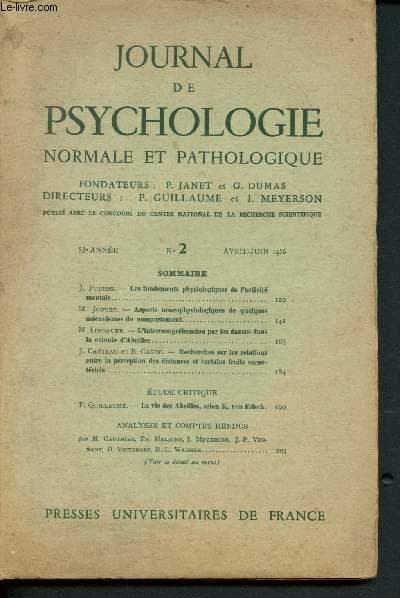
Jean PaulhanReading report published in the Journal of Normal and Pathological Psychology, Volume I, 1904, p. 98-99. See the original in Gallica
in: III. Clinical studies on mental degeneration
(70) — “Abnormals and degenerates”, by Étienne Rabaud (Paris), Revue de Psychiatrie et de psychology experimentale, t. XIV, No. 9, September 1903.
The term degenerate seems to have currently lost any precise meaning. It designates the most diverse mental forms, the most opposite. How then can we define it? By means of which distinctions? and what will result from the new conception of the degenerate in what concerns the study of mental disorders? This is the question that asks the author.
Disturbances to the constitution of the ambient environment, reactions interested cells, can result in two radically different processes. Either the disturbance will be purely harmful and the cellular element, incapable of adapting, will tend to become disorganized: there will be illness. Or on the contrary, the disturbance will cause, on the part of the elements embryonic, an adaptation: new tissues will form, different, no doubt, normal tissues, but healthy and not showing any trace of disintegration: there will be an anomaly. And we are thus led to distinguish, in congenital states, the abnormal, clearly characterized by the complete integrity of their tissues, and the sick who alone are the degenerates, the word degenerate carrying with it an idea of organic decay, in potential or in act. Let us now apply this distinction to the study mental tissue.
I. Anomalies. —In the group of abnormal people will fit, for example,
microcephali. We find, in their case, a slowdown in growth affecting either the whole brain or only (microcephaly
“incomplete”) certain parts of the brain: but the tissue remained healthy;
there is therefore no degeneration. In other abnormals a whole region
more or less extent of the brain, followed a different mode of evolution
normal mode; their constitution therefore belongs to a special type,
biologically equivalent to the specific type. Such will be certain persecuted, the originals of all kinds, the geniuses. And there is thus, between the
brilliant and the unbalanced simple, that a difference of degree and not of nature,
but neither one nor the other can be considered degenerate, that is to say, sick. Talk about superior degenerate for
to define the man of genius is to express nonsense. In decline,
in illness. there are no higher degrees.
He. The degenerates. — The degenerate is in fact characterized above all by his morbid state. The disease can be reduced to the initial processes at him of disintegration. It nonetheless remains: on occasion it will manifest itself and any degenerate can thus be regarded as potentially insane: but its mental manifestations, far from being a variation in the growth of the brain, in the arrangement of the fibers, will come of the poor quality of the substance of these fibers and of this brain. Their Characteristics will be the poverty of ideas, the vulgarity of associations.
Let us move on to the case where there is superposition of the abnormal state with the degenerative state. The notion of sick abnormality will allow us to understand how could give birth to the contradictory idea of “superior degenerate”. If a man of genius was struck by mental disorders, we will consider him as a abnormal degeneration to its lowest degree. To a degree higher the disease would in fact cause serious damage to mental activity. We must therefore not say that genius is a form of degeneration: degeneration can be superimposed on genius, but far from it. constitute the essence, it can only alter its manifestations.
J. PAULHAN.