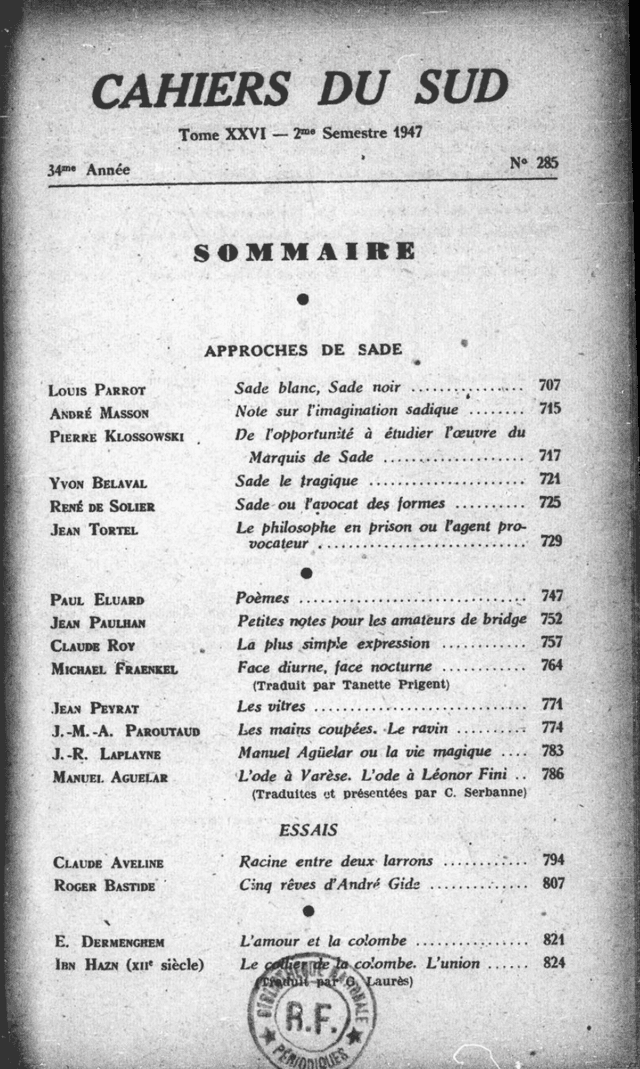
Les Cahiers du Sud - Reflections on Jean Paulhan and rhetoric
Aimé Blanc-DufourThrough a sort of spectrography of the written thing, Jean Paulhan, for seven or eight years, has been building a singular and penetrating philosophy of literature. Starting from Fleurs de Tarbes and leading provisionally to the essay published in Temps Modernes 1 under the title “Rhetoric was a secret society”, the progression of the analysis is uninterrupted and the propositions come together more and more solidly supported and convincing.
I do not claim to want to address all of Jean Paulhan's work here; the material is too extensive. To do this it will be necessary to have recourse to a certain distance, as well as to a parallel examination of the significant literary works of the ten or fifteen years to come, because there is no doubt that the form and style of these works, faced with the influence of the author of Les Fleurs de Tarbes, will be either a tribute or a revolt. It is possible, moreover, that this influence is already curbing the intention of writing for many. Jean Paulhan has perfectly succeeded in awakening the guilty conscience of the greatest number of people. You have to be grateful to him.
Paulhan writes: “Rhetoric was rather an art of asceticism and sacrifice”. At first glance this statement is surprising. We thought, without going any further, that on the contrary, Rhetoric was a technique which tended to embellish speech through the systematic use of “figures”. These carvings, these additions, the balancing of periods, the practice of metaphors and synecdoques softened by use and civilized in the exact sense of the term, all this created in our mind a sort of confusion with plastic art and, for many of us, with baroque art which experienced its flowering at the very moment when Rhetoric was drying up and was no longer sustained except by the use of recipes already foreign to the flow. which led the Society. If Paulhan's thesis is surprising, it is because we are stuffed with false notions, that we lack historical perspective 2 and that we have difficulty situating ourselves within the conditions which made Rhetoric an irreplaceable instrument of civilization. In fact, Rhetoric did not add ornament to the speech; on the contrary, it pruned what common language could provide in cumbersome riches. Those who have studied the formation of new expressions and figures through spoken language have always been astonished by the abundant inventions it secretes, inventions generally with no future, whether it concerns the domain of figures (from slang language to the so-called “humorous” style) or that of syntax. The writer, who, out of so-called originality, photographs indiscriminately these popular flowers that wilt as soon as they are picked, is doing a vain, lasting work. The role of Rhetoric was precisely to choose wisely, to renew without deviating from the rules, and above all to create these “common places”, necessary both for communicability and for the intelligence of the discourse. We will see later some objections that an amateur of our contemporary literature invaded by subjectivism cannot fail to raise (whether this be expressionism, impressionism, interior monologue or any other process which aims above all to put the reader under the brutal influence of the author's own feelings, rejecting logic and intelligence in favor of a disordered affectivity).
Rhetoric requires an objectification of the world of things and feelings, that is to say, ultimately, the possibility of giving an explanation. Aristotle and Lucretius said it. Malebranche 3 demonstrated this in turn, indirectly, when he said that we cannot claim to directly measure sensations as subjective phenomena by one another, and that any comparison between them presupposes a reduction to causes having an existence outside of us and therefore subject to the conditions of time and space. In the field of language, Rhetoric, at its origins and in its heyday, walked parallel to the philosophy of science, which is fundamentally a search for methods of exposition and explanation. Jean Paulhan incidentally recalls this aspect of the rhetorician problem in a short note - which I would like to see him develop - when he says, relying on the opinion of Aristole and Plato "that dialectic is the rhetoric of science, and rhetoric, the dialectic of opinion".
If Rhetoric has suffered an eclipse, it owes it to the impotence in which it found itself at a moment to match its technique to knowledge of the objective world. Having been unable to progress, or rather its certified representatives having, by breaking with the Encyclopedists, refused to submit to the disciplines imposed by scientific conquest, it lived on outdated recipes, while its adversaries filled the literary scene with their passionate confessions, mixing genres in a variety show which had at least the merit of novelty. I said progress knowing well the danger that such a word entails, its contradictions and its ambiguity, when it comes to an aesthetic problem. But is Rhetoric just an art? I don't believe it. It participates in social evolution, as a medium term, as a human tool intended to expose, explain and convince. This is why the progress of Rhetoric is linked both to epistemology and to certain methods detached from philosophical currents and updated by the needs of the century. From Kant to Marx via Hegel, we discern a dialectical current from which today derives a Rhetoric, still in its infancy, but which, through an awareness of its antecedents, can brilliantly and solidly revive the humanist tradition. Jean Paulhan does not seem to neglect this aspect when he writes that:...“Revolutions, Renaissances, Reforms, are the work of rhetoricians”.
So Rhetoric, set of rules and recipes techniques which require hard learning, training of the taste and the reduction of uncontrollable sensation to a common term, tends to make the world intelligible and rational. It is an auxiliary of man to the extent that he expresses a desire for domination over things.
We will say, and Jean Paulhan asked the question: does Rhetoric make conservatives (social or literary)? No, certainly; if we can cite recent cases of confusion between Rhetoric and political conservatism, this can only be through the projection, in today's world, of a Rhetoric arbitrarily detached from a past century. It would never occur to anyone to claim that the Conventionalists, the greatest of whom were great rhetoricians, were retrograde or conservative minds. Against any reproach of social conformism, Rhetoric can easily respond by saying that technical tools disdain morality. His art of persuasion applies to both pros and cons. Jean Paulhan, on this point, cites Quintilian and Aristotle. I will in turn quote Saint-Augustine 4: “I then taught Rhetoric and I sold the art of vanquishing others through the power of speech, being myself vanquished by my passions.”
Rhetoric presupposes a conceptualist philosophy. This is how it approaches Science, or, if you prefer, Knowledge in general. The object conceived comes from the real support of the sentence. To move away from it, to indulge in the mystagogies of anti-rhetoric is to accept all the constraints of a base witchcraft. In this regard, I remember having Céline's novel, “Voyage au bout de la nuit”, read in 1933 to a trade union activist, then around thirty years old and whose schooling had not exceeded the second year of upper primary education. Céline was not yet politically marked; if Léon Daudet said good things about it, the far-left newspapers did not bargain for compliments. My reader's reaction surprised me then as much as it seems justified to me today. It was in terms of disgust that he described Céline's novel and what surprised me, less for the substance of the story and the exhibitionist crudeness of certain passages than for the intended vulgarity of the expression: "We have no right," he told me, "to damage the French language to this extent."
Jean Paulhan points out that Rhetoric constrains thought. This is indeed the most beautiful tribute that we can pay him.
Delivered without a prescription, torrential and contradictory, thoughts can please on the spot, but, as soon as they are expressed, nothing remains but material that must be implemented and most of which is unusable. This is unfortunately all too demonstrated by these illegible works twenty years after their initial noisy success. Likewise, the winks and passwords specific to a generation are intransmissible, untranslatable and downright antisocial. There is no excess of freedom here, because Rhetoric allows all freedoms and even all licenses of thought, but on the contrary a withdrawal into formulas of the initiatory kind, an esotericism of expression at the very antipodes of freedom.
It must be repeated, the Rhetoricist is progressive, at the same time as attached to tradition. Can we see proof of this in the efforts made in France by a Rethoric in the process of being reconstituted, but still at the stage of drawing up the rules? The important thing will be to connect these renovated rules to the great humanist tradition. It's a problem of patience and honesty. The Rhetoricist is progressive because he is intimately commanded to participate in encyclopedic knowledge: An Encyclopedia cannot be conceived without a Rhetoric. It is necessary for new commonplaces that have acquired the right to assert their legitimacy by going beyond the generation that established them. The divorce between written language and spoken language is only conceivable at times when Rhetoric abdicates or ages. But it is enough for a truly human culture - historically necessary - to replace aesthetic schools for a current of exchange to once again be established between Rhetoric and spoken language. About twenty years ago, I listened to a winegrower from Beaujolais, an octogenarian nourished by the materialist philosophy of the 18th century, over the ideology of the forty-eight, speak. His sentences flowed like the prose of great authors and in his mouth the most abstract terms, embedded as in a chapter of Mably or Helvetius, took on a familiar and convincing air. And no one around him, in his village, found the nobility of the expressions that naturally flourished in his speech ridiculous. This old man was the witness of an outdated tradition, but his listeners beyond this very anachronism, nostalgically reconnected with a greatness towards which they vaguely aspired.
Eloquence is not easily dismissed. With a corpse on our knees we are always embarrassed and what's more it gives a stupid look that we try in vain to mask under an affectation of simplicity. Certainly, anti-rhetoric, at its starting point, is filled with excellent intentions, but it can only progress or affirm its aesthetic content by invoking at each step "the angel of the bizarre", a character who also turns into a "demon of perversity". In one or other of his roles, he manifests an insatiable appetite for domination. The only limits to the sacrifices it demands from writers who abandon themselves to its charms are silence or death.
Rhetoric is also the movement of expression arranging value judgments 5. This is in line with Jean Paulhan's remark, recalled previously, according to which Rhetoric is dialectic. of opinion. However, an honestly made value judgment is inseparable from a prior and explained position with regard to major human problems. Independently of the background to which Rhetoric is not necessarily linked, there is the whole technical aspect of the exposition, the indictment, the plea, the developed reasoning and the conclusions. All this literary instrumentation is properly eloquence, in the etymological sense of the term. Abuses of a practice cannot legitimately claim to prohibit its use. Rimbaud is terribly, frighteningly eloquent, Lautréamont is superb: “Old ocean. you are the symbol of identity always equal to yourself. You do not vary in an essential way, etc. 6 ”. What disturbs the Judgment that we pass on Les Chants de Maldoror, is due less to the composition, to the development, to the symmetry of the periods where we find all the elements of a Renaissance Rhetoric, than to the novelty of the images, than to the incongruous rapprochement of certain curiously paired nouns. It is also amusing to note that most of Lautréamont's admirers prefer to focus on the fortuitous and very secondary aspect of the “Songs”, and neglect what gives them lasting merit: the virile rhetorical thrust.
It is not even Verlaine whose poetic technique, when analyzed without bias, reveals a discourse 7, which voluntarily “parviloquent” is no less open to criticism than the grandiloquence of Agrippa d'Aubigné. Verlainian hypocrisy is a tribute to Rhetoric.
Jean Paulhan says: “Rhetoric was a secret society”. This is correct in the sense that a third religious order or Freemasonry are said to be secret societies. I would like to clarify that these are closed companies, with limited recruitment or surrounded by strict guarantees, but known to the majority and whose access routes, although difficult, are open to merit and patience. Like Freemasonry, Rhetoric was a democratic society recruited by co-optation. To be received there, social rank did not matter; only a love of literature, intelligence and talent counted. But all these conditions were rewarded by the accomplishment of an apprenticeship, this apprenticeship which contemporary letters consider to be embarrassing, an apprenticeship which moreover has nothing in common with the university mandarinship, which is even the exact opposite.
It is under the cover of anti-rhetoric that many writers, novelists, short story writers or poets refuse to submit to the rigors of an often discouraging apprenticeship and thus approach without “working class consciousness” a field where the slightest initial success becomes in their eyes a professional patent. There is better. The systematization of anti-rhetoric leads the most radical among writers 8 to the constitution of terrorist gangs whose leaders exercise a totalitarian dictatorship over their followers, although of fairly short duration. These gangs, when a historical break occurs between two eras, unwittingly play the role of an abscess of fixation within the superstructural elements of society. Depending on one's point of view, this role is judged differently. For a conservative it is good for young people full of dynamism to use their strength with junk weapons and damp squibs, rather than tackling the essential problems that superficial agitation makes us forget. On the contrary, a progressive will consider this activity regrettable, which, under the easy alibi of "the liberation of the spirit", for example, leads young men full of possibilities, onto the paths of a helpless and dopey old age.
Have I strayed during these reflections from the concerns that Jean Paulhan brought to the forefront of “Rhetoric was a secret society”? Apparently, yes, deep down, I doubt it because the irony of the author of “Fleurs de Tarbes” can only deceive inattentive readers, as well as those whose bad conscience pays for bad reasons. Jean Paulhan's passion, making language his object, goes beyond it to reach regions where the problems meet on the level of a new humanism. With much less skill, I didn't want to do anything else.
A. BLANC-DUFOUR.
Les Cahiers du Sud, September 1, 1946
1 - March 1946 issue. ↩
2 - From this point of view, I point out in passing that erudition hides the big picture of history and that in the 20th century, we have a notion of the Middle Ages (of the Gothic ages, we have of the Gothic) which is much more false than Boileau and Voltaire had. This needs to be developed. ↩
3 - The search for truth. ↩
4 - Confessions IV • 2 - Trad. Arnauld d'Andilly. ↩
5 - We could say to a certain extent that existentialism makes judgments of reality predominate in its literature; which results in a sort of phenomenology of the chosen trait that is systematically absurd or shocking. ↩
6 - First song.. ↩
7 - See in particular the sonnets of Wisdom. ↩
8 - We should recall the influence of painters on writers and the feeling of envy that the former inspire in the latter, regarding freedom of expression and invention. This shows that the writer generally ignores the conditions which govern the visual arts, and that he cultivates the illusion that his sentence can, depending on his talent, be pictorial, architectural or even musical. ↩