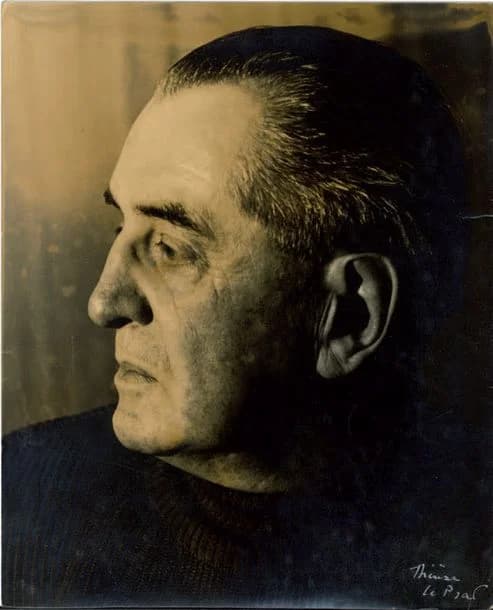
Let's not forget Jean Paulhan
Frédéric BadréWhat is a French writer in the 20th century? A provincial neurotic sitting on ruins, who sings about his painful and depressive times. In the increasingly generalized indifference. Do you want to be read, at least heard? In this case, don't say anything. Be reassuring, caressing, entertaining. Don't exist. Paulhan apparently advised anyone who absolutely wanted to publish a book: “become famous first.”
Of Charles-Albert Cingria, Paulhan found that he gave the impression "of a madman whose fury would never break out", which seemed to him to be the potential required for great literature. “We don’t write to be elegant or witty,” he said again. We don't write to have reasons. Nor even to be right; nor to give a plausible aspect to obviously false theses. We write to know the truth, and to keep it when we know it. We write to be saved.” Reflections of a writer of this century. The truth? Today we find yesterday's ideas absurd, just as ours will be tomorrow. The great adventures of the 20th century teach us to be wary of progress, of politics, of religion, of everything. “We write to be saved”... It’s all there.
Troubled times breed resilient moralists. The Montaigne Wars of Religion. Our Paulhan century. Judge then – long quote, but how else?: “Events are happening which should arouse our curiosity to the highest degree, and yet leave us indifferent. For example, habit bores us: but it should be the opposite. Every day I have a better use of this friend that I have chosen, of this garden where I walk, of this apartment where I have my room. I now know all the details, I go through them in my mind as I wish, I see myself going through them. What, this spirit must therefore be afflicted with some defect, that it carries who knows what poison, which acts in the long run, and imperceptibly spoils the object of my choice.
Yet at the same time we have the impression that this should not be so; and that it might not be so; and it happens that it is not so: for example, in Paradise, the golden age, the gift of childhood.
Funny Paradise, funny childhood. Scholars tell us today, with supporting evidence, that we passed through the caves with bears and lions around, in anguish and terror; and childhood, as we well know, is the age of complexes and hatred: the child, wild and oppressed, overwhelmed with orders and prohibitions, defenseless in broad daylight against work, in the middle of the night against nightmares. No, rapture, if there is one, must come with old age.
There is no doubt, despite everything, that something happened, which we fail to surprise. As it spoils what it possesses, the mind cannot help but distort what it would like to see.
The man is lost, lost, a Robinson. He is alone. But he can be saved. Through language, which contains a fragile secret, the key to rapture. This secret is around us, the common man holds it, it is in objects (the painters Braque, Fautrier, Dubuffet saw it), landscapes, animals, passers-by, novels. It is at the center of all poetry.
Half a century and more of research, of reflection and Paulhan tries to prove - read it, the proofs are in his stories, pamphlets and works of criticism - that man finds his unity - his paradise - in a language where opposites become one. In what world is the thing idea, the idea word and the word thing? In what thought? Paulhan, indefatigable reader, observer, talent scout for the Gallimard house, but also: resistant, intellectual committed against the corporalization of literary life, certain patriot, this man plays his role as éminence grise, “Pope of Literature” it was said, modulating in all the tones, in all its letters, by its own example sometimes: be free, do not be afraid, do not be anxious, and perhaps you will see. No wonder that once he died in 1968, he moved away at full speed.
Because he is a difficult writer to read. No doubt his great reflection on Terror and Rhetoric fails ultimately to give a satisfactory answer. This discourse on method applied to literature seems apparently intended only for writers who are interested in these questions. A writer carries the world on his shoulders. He manipulates an instrument fertile in illusions which must be distrusted. Everyone must find their own voice if they want to touch a truth. To read Paulhan is to be forced, then, to forget him, if we want the secret he suggests to become an ineffective commonplace. There remains, particularly effective, a method of cheerful and generous doubt, served by an admirable language.
It is with this in mind that we developed this delivery of L'Infini. The correspondence that we present, the texts that we republish, the testimonies and comments that we have requested, aim to draw attention to a character behind the scenes of French literary life, certainly, but not only. The questions asked are those of our traumatic history: political commitment, metaphysics, the anxiety of illness, etc. It also shows that his speech is always active, for whom the pleasure of reading is not an empty expression. “And all in all it is a little ridiculous to understand the people of a hundred or a thousand or ten thousand years ago so well, but those of today so poorly. “It’s not just ridiculous, it’s disturbing.” Paulhan remains a French writer today. Let's not forget it.
Frédéric Badré.