Interview with Pierre Oster, on Jean Paulhan
Pierre OsterITW: Pierre Oster, I remind our readers you were born in 1933, you are above all a poet. Thank you for agreeing to talk to us about Jean Paulhan today. For poetry lovers, I would like to point out that you are in the Poésie Gallimard collection, with an anthological volume, the title of which is “Landscape of everything”. You made your debut in poetry in the collection “Métamorphoses”, directed by Jean Paulhan, with a collection entitled “Le Champ de Mai”, published in 1955.
The first question I would like to ask you about Jean Paulhan, who was your friend, is: how did you meet him, and when?
P.O.: Well, the answer is a bit like it happened eight days ago. I had sent quatrains, gnomic quatrains to the NRF, because Maurice Nadeau had told me “Go to the other side of the street”. Well, and it is the word gnomic, basically, which had required the attention of Jean Paulhan, because gnomic poetry, since Bernardin de Saint-Pierre, the poetry of science, in some way, the exploration of the entire scientific field, this poetry, since romanticism, has been condemned. Moreover, it is reprehensible, there is no reason to say in a poem that "the melon is divided into slices to be eaten with the family", for example. I say that because it's a pretty funny example, but gnomic poetry is much more interesting.
And Jean Paulhan, deep down, was quite touched that a bird which had barely fallen from the nest used in a visible, lively way, a word which, in some way, was marked with a negative index. That's it, that's how I unwittingly caught his attention, because I barely knew he existed.
The address of the Gallimard house was something completely legendary... So I sent the texts to Marcel Arland, and then Marcel Arland, having received me at the moment when I was postponing the tests, someone entered the office, which I can see very clearly, square, large, amusing, from the start, because every unfamiliar face was important to him. We can say that, that is to say that he was insatiably curious.
So Marcel Arland said to me, “Pierre Oster, I need to introduce you to Jean Paulhan,” and from the outset, he set a trap for me. He said to me, “Yes, I read your little proof pages, but there is a place where the relative which is placed in such a way that we don’t know where the antecedent is.” It was still, for someone who could barely stand on his feet, because it is completely normal to be intimidated in front of great writers like Marcel Arland and Jean Paulhan. In short, he was a guru, that is to say he gave me a little “slap” there, here [behind the neck], to see how I would react.
ITW: He was showing you at the same time that he had read you carefully.
P.O.: Yes, it was nice, there was kindness in that negative remark.
ITW: And how did he appear to you from that first meeting? It's important the first moments...
P.O.: He appeared to be the very example of everything one could desire to encounter in human beings, that is to say the capacity to amaze you in the moment. What he constantly strived for and what he almost always succeeded in. I have never met anyone who was able to declare that in front of Jean Paulhan, he felt completely himself. We were... not terrorized, although he often expressed the desire to terrorize this or that writer, and not just writers, but what he wanted was to arouse reactions in others that might interest him, it seems.
And then there it was, he had the feeling that from his power he could learn something and that this lesson he could share with someone else.
ITW: How did your relationships develop afterwards?
P.O.: Well, it was absolutely, these gnomic quatrains appeared in the NRF in November 1954, a date I easily remember because it was my second publication. And from the outset, and Marcel Arland and Jean Paulhan, when they had somehow recruited a new collaborator, presented him with some works, which were there on the surface of their desk, and asked them to make notes.
This was also a way of probing the personality of the people who in some way had access to the light of the summary, and who were asked to kindly participate in the common enterprise. The joint enterprise was the "new new French review", where not only texts, poems, extracts from novels were published, but also notes, notules, chronicles. I found myself engaged, in a few quarters of an hour, I found myself, yes, engaged, in the strong sense of the word, in a collective enterprise to which I remain attached after half a century of reflection.
ITW: Since you're on the topic of grades, this is something that has interested a lot of readers. They say that there was a tone in the note, that there was something very particular. A lot of people say they preferred the grades in the NRF, how do you explain that?
P.O.: Ah we read the notes first, yes.
ITW: Why?
P.O.: Firstly because we read the notes of Jean Paulhan himself, under his name, under a pseudonym, which was a collective pseudonym, I never really understood what it was about, what it was about. But in fact, we could skip the summary, since these were the texts which were destined to appear in volume a few months later. But the notes remained in some way an object of mystery, since we never knew who we were talking about. Often, reading a note about a writer you haven't read is still interesting, it's even very interesting, it's perhaps more interesting than reading a note about a writer you know. And then, the very trick that Jean-Paulhan liked his collaborators - Marcel Arland perhaps a little less - but Jean-Paulhan liked it when people were lively, incisive, mocking, and he let a lot of things slide. That is to say, he granted us an astonishing freedom.
ITW: Have you had any conversations about this?
P.O.: Once, however, I must remember that in a note concerning Étiemble, I had treated it as a bird name which could not be included in the NRF. He said to me, “Listen, we already have a lot of problems with Étiemble, please, we’ll cross out an epithet.” Étiemble supported the thesis according to which, a thesis which was completely controversial and stupid - I did not call it stupid, I had used an even stronger word - he supported the thesis according to which only the poems in regular verse of Supervielle were good. Now, there are admirable poems by Supervielle in perfectly free verse. I thought it was a good idea, despite my young age, to say something stupid.
But we could go very far. One day he asked me, I also remember, it was in 1956, he asked me to report on two publications by René Char. And, how can I put it, my natural insolence (which diminishes with age) was fully expressed and I practically insulted René Char.
Who in return, in a letter to Jean Paulhan, insulted me by calling me a brain of white thread. So I hear Jean Paulhan telling me, ah Pierre Oster, brain of white thread, but what does that mean? White thread brain, I said to him, “listen Jean, it’s certainly a Provençal expression”. Well now I know the explanation. In fact, white thread brain is the thread that has not yet been coated with tar before sewing the sails. That is to say, a white-wire brain is someone who doesn't have much interest because we're going to use it, but we can't use it yet. Because he hasn't bathed in a solution that protects him from rain, the elements, sea spray and perhaps salt.
So Paulhan told me, ah very good, you see, René Char is threatening me not to give me any more texts for a year. That will make room for us! On the insurance front, one day, I said to Gaston, obviously, Jean Paulhan is one, ah there you go, I forgot the word. It was quite strong. In short, we had fun at the time.
ITW: And your relationships continued?
P.O.: A kid, I told him, there you go, dear Gaston, Jean Paulhan is a bit of a kid.
Fifteen days later, I entered the office, Paulhan asked me, it seems to me that you told Gaston that I was a kid. I told him, look, Jean, yes, you made me work for two years on a big project about which you had said nothing to the publisher. And one day you asked me to come and deposit the volume Honneur à Saint-John-Perse, of which I had kept the file, to deposit it on the desk of Gaston Gallimard, who seeing the thickness of the document said to me, "ah, it's a novel, you want to buy a car".
ITW: That's Gaston Gallimard's reaction. But here we are, because there is an important moment....
P.O.: It's still amusing, that an old man worked, in some way, to... oppose himself by going through an obscure route.
ITW: Roger Grenier told us the other day that, precisely, when they were at odds, it was he, Roger Grenier, who served as a little telegraph operator between Jean Paulhan and Gaston.
P.O.: Ah yes, the quarrels were severe, but they were quarrels which really had a purpose. Because Gaston was a man of great quality, of great intelligence, but in fact, he did not pursue the same goal as Jean Paulhan. Puisque la revue, c'était sa chose. And he thought that through the literature that he published in the journal, he could access, and that's another subject, he could access this world not governed by the principle of identity. He thought that literature was a filter that allowed us to climb a little higher than where we are.
ITW: Before coming to the work of Jean Paulhan, I would like to continue talking about the man and his personality. It is he who introduced you to Saint-John Perse, since you are talking about him just now.
P.O.: No one has ever met Saint-John Perse. We met a gentleman named Alexis Léger. Saint-John Perse was invisible. If you had met him in the street, if you had said to him "it's you Mr. Saint-John Perse", I think he would not have answered you... No, I'm joking, I am very sensitive to the need to preserve the distinction between Alexis Léger, the man, and the truly mythical character that he had forged, who was a poet by the name of Saint-John Perse.
ITW: Who was a mythical character...
P.O.: Ah yes, he was a legendary character. No one would ever have thought to say hello to him, Saint-John Perse, for example. It would have been a casus belli, he would have turned away.
ITW: Who wrote fictitious letters, exactly?
P.O.: Sorry?
ITW: Who wrote fake letters?
P.O.: You are not going to drag me into this field. No, because here I have an assassination to go back to, I have to assassinate the person who was the first to be able to show that the letters to the mother were pages which had been composed in approximately 1960-65.
So her name is Catherine Maillaux, and yes I conceived the grand plan of assassinating her first of all. The damage is done. The harm is done because you yourself are infected by this evil. What greater gift can you give your mother than to write for her, 50 years late, letters as sublime as those you can read in La Pléiade.
ITW: Seen like that, it's different.
P.O.: It's different. Say it (laughs...).
ITW: Tell me, do you think that Jean Paulhan, who arranged this meeting for you with Alexis Léger, therefore...
P.O.: ...he didn't spare me a meeting, he said to me, are you free at coffee time tomorrow, without saying anything to me, because that was his way of being. He didn't tell me, you want to have coffee, we'll have coffee with Jacqueline Paulhan, with Frédéric, with the children, and with him.
Yes, I thought there was a little surprise with him, but I didn't think at all that I would find myself in front of someone who represented for me an almost mythological element in the poetry literature that one could read in the 1950s.
ITW: That's because he knew, from the conversations he had with you, that he was someone you would have liked to meet.
P.O.: Who wouldn't have wanted to meet Alexis Léger? Among the writer friends I already had at that time, I don't see anyone who would have said, no, that doesn't interest me at all.
That is to say already, the kind of vindictiveness which is exercised against him today was almost already at work, because he is someone who aroused envy, jealousy. For example, Francis Ponge, whom I knew quite well, couldn't even bear the idea that I, a tiny person, could maintain work or friendship relationships... friendship, no, because you can't have friendship for someone so big.
But I had friendship for Francis Ponge, who was tall, but of a different size. And he said to me, why do you hang out with this character? I'm going to say bad things to you once again about this awful Saint-John Perse [pronounced "Peurse"], he said. And then his wife, one day, told me, and told him, at the same time told us, but anyway, why do you say so much bad about Saint-John Perse to Pierre Oster, who really likes Alexis Léger, who works for, in a way, the glory of this character. Because Honor to Saint-John Perse is a file that I kept, that's okay. And then I had a moment of grace. Madame Francis Ponge was a very pretty woman, very elegant, very discreet, very gentle. And Madame Alexis Léger was a very beautiful woman, very tall, very beautiful, very attractive. And I had this moment of grace. I made a response to Joan of Arc, I said, listen Francis, I'll tell you, Madame Léger was almost as beautiful as Madame Ponge.
ITW: A little flashback...
P.O.: We experience these things, because having approached such kind, so amusing, so great characters, in the purely literary field, it is still a grace that I owe deep down to Marcel Arland and Jean Paulhan, since they are the ones who half-opened the door of the NRF. I was not alone in wanting to, in trying to publish thanks to them.
ITW: A little flashback, before Perse and before Francis Ponge. It's a question from [inaudible] that makes me think of that. This is a subject that is generally not discussed much. Do you consider that Paulhan was an intuitive being?
P.O.: Intuitive?
ITW: Yes, did he have intuition? About this meeting.
P.O.: Have you ever met a guru who was not intuitive?
ITW: Yes, but in its human relationships.
P.O.: It was human relationships. Wanting to throw someone into the situation of walking out the door because they're upset, right? Having the intuition that one word too many... I have seen, I remember circumstances where, with one word, he managed to make someone leave. Even bowls, even playing bowls. He had the ability to destabilize people he considered his friends. And his friends, he wanted to teach them how to keep their balance. Isn't that the guru's job? Music guru, for example.
I say music guru because I can clearly see a friend in India, Bhopal, who stooped down in the morning, put two fingers to his mouth and placed his fingers on the guru's feet. Basically, I never did it. But I regret, in some way, not having embraced Jean Paulhan in that way.
Because, intuitively, I don't know, I didn't answer. He was neither more nor less than you, and me, and that Monsieur too. But he was.
ITW: So these relationships that began in 1955, if you look back...
P.O.: In 57, 55...
ITW: 55? September 55?
P.O.: In September, 54.
ITW: So you are a very young man, you are 21 years old.
P.O.: [inaudible].
ITW: And if you take a retrospective look at your entire relationship, so from 1954 to 1968, when Paulhan died, what was the fluctuation of these relationships? Have they always been narrow, less narrow? Was the conversation always the same, the exchanges? Was there a common ground in these conversations?
P.O.: The answer I will give will perhaps seem a little strange to you, but Jean Paulhan was very alone.
He was very alone in his work of elucidating precisely what he was aiming for. What I was alluding to earlier was that he thought that literature was like a prism which allowed access to another universe than the universe governed by the principle of identity or the principle of contradiction or non-contradiction, it's the same thing.
So, if we look carefully at the published correspondence, we see that even among philosophers, Jean Grenier or..., few people questioned him about the very nature of this research that he carried out to the end. This shows... it can even be demonstrated, to the extent that he wrote letters which were in some way small summaries of his work and by sending these letters, obviously, he was seeking contact with people who could have embarked on the same path as him. Difficult route.
Well then, because basically, its authors were Master Eckardt, it was Li-Tseu, it was Novalis, it was what he called the Chinese sophists, I talk about it in the little article. Basically, he was trying to tie himself to several traditions at the same time and in this way he was trying to counter the imperialism of the proponents of the principle of identity. “A is A.” What he wanted to demonstrate was that A is A, [and] not A. He wrote it. There was still Stéphane Lupasco who was in some ways the philosopher who had gone furthest in an attempt to demonstrate this universe which is not subject to the principle of identity.
ITW: If you want, we'll get into that later.
P.O.: This is a question that we will not decide, because we are not philosophers.
ITW: But it's very pleasant to read that in your latest book Practice of Praise and it's very interesting above all.
P.O.: There is something I can say, but there is a trace in the edition of the works of the choice of letters made by Bernard Leuilliot in three volumes, if I am not mistaken, in the white collection. There is a reproduction of a tire that he sent me where he expressed his despair. “I almost killed myself, here begins my despair”, as a writer (that's a quote from Borges in fact, I discovered it a long time later). But he was led to a state of emptiness, of disaffection even with regard to the authors in whom he thought he could find support. He thought about committing suicide, because the demonstration he was trying to achieve, he did not succeed.
I say this in a way, but it was a wonderful world where tires circulated in strange little underground canals. It was a tire that I must have found on a Friday or Saturday and which had the effect on me that you can imagine. When an old gentleman tells you “I almost killed myself because I fail to show what is for me the very heart of my thoughts, of the thoughts of the greatest people that I can gather around me, if I may say so, from the Chinese sophists and then the great masters of mystical reflection and then some scholars too”.
When someone says such harsh language to you, we are still inclined to listen to them. And there, the guru suddenly falls over, the guru goes pshitt. Basically, it's the first time I've used that word about Jean Paulhan. But when the guru feels that he is failing to demonstrate what he wants to rally as many close people as possible, we are still inclined to listen to him, to say to ourselves if this thought is not demonstrable, is it of such a nature that we must commit suicide when we fail to support it? What to do? It's serious.
It is true that Jean Paulhan had certainly gone through moments of great difficulty to the extent that he was alone in this research. We are wrong because we live like that in the middle of a small community of people for whom the very figure of Jean Paulhan is both mysterious and attractive. You, I, sir, our friend, we are attached to Jean Paulhan, but we perhaps do not think of the suffering that he suffered.
ITW: To listen to you, for someone who only knows Jean Paulhan by name, we have the impression that there is, and we will come back to what you are talking about, to what is perhaps Jean Paulhan's secret, we will come back to it, but what was the echo on you, in your relationship with Jean Paulhan, of what he was for everyone, that is to say what the journalists called "the eminence gray of French letters"?
P.O.: That's something else, that's the external character, but as for the very nature of the research that he carried out practically throughout his life, which Bernard Baillaud demonstrates well, and will continue to demonstrate in his great prefaces, to the complete works which appear in Gallimard, I was still insensitive to that because it completely exceeded my level of competence. I've never studied logic, I'm not a philosopher, nothing at all.
Have I ever perceived the nature of Jean Paulhan's design, research, and suffering? Frankly, I would be lying if I said I was sensitive to it. I think I only started thinking about what Jean Paulhan wanted to demonstrate when I found myself having to do the complete works with Jean-Claude Zylberstein.
ITW: Exactly, I wanted to come there.
P.O.: So, be careful, on this point, Jean Paulhan had never turned his gaze towards me, although we knew each other quite well. The person who was to lead the company was Yves Berger. But Yves Berger did not succeed in getting the old man to work... Dominique Aury, after a year, after two years perhaps, I don't know anymore, because I didn't keep a record of the meetings between Yves Berger and Jean Paulhan because they took place at the arenas or elsewhere, I don't know, during lunches, but it was Dominique Aury who at one point shot, she saw Jean Paulhan working and growing old and she understood well that the enterprise risked going nowhere if we continued to let Yves show himself, let's say it, a word that is not too much, a little weak with Jean Paulhan.
I found myself in the situation of having to force it. That is to say, I was going to work in the arenas with him, he had already done a lot of things, the plan for the complete works in five volumes was his hand, he even did the calibrations, he was completely... But in a certain way, the very idea of starting to publish his complete works before he had succeeded in demonstrating what he precisely wanted to demonstrate, what I was referring to, basically, is the end of the third volume, that is to say it is the construction, it is the summit of the complete works, it is the end of the third volume, well perhaps he was a little intimidated by the grandeur of his project. It's true that he was starting to embark on a similar business where he still hired the publisher, the publisher put money into this story which could not bring in any money.
But perhaps he conceived a sort of fear by saying to himself, but am I going to be able to show what I want to show before... and I found myself in the situation of having to ask him for the texts which constitute the summit of the work, that is to say, I repeat, the end, the second part of the third volume.
And that's when he sent me this tire, this tire of despair. Tires allow messages of love to be sent, messages of all kinds. And there it really was despair. And I don't think you can say that it was a despair that was simulated, I don't think so.
ITW: Something that must seem anecdotal to you, but why publish complete works with Tchou?
P.O.: Well listen, the thing was very simple. One day Jean-Jacques Pauvert said to me “Ah yes, yes, your friend there, finally my friend Claude Tchou, gave me the idea of the complete works of Jean Paulhan” I don’t know, I won’t be able to answer you, but one fine day, Claude Tchou came into my little office at the Cercle du Livre Précieux, he said to me “We are doing the complete works of Jean Paulhan”.
Ah, I said to him, “Good, very good,” as if Jean Paulhan had given me to him, in a way the circle was closing, I was there, in a way, quite ready to write a letter to Gaston Gallimard. I sat in front of my machine, I wrote a letter to Gaston Gallimard mentioning my boss's project, Claude Tchou's project, to publish the works of Jean Paulhan, outside of Gallimard, so that's where the problem is, it's important. And unfortunately, a few months later, we received a letter from Claude Gallimard saying “These are the conditions under which you will be able to resume such and such titles. But Claude Gallimard did not know that the complete works, even incomplete, would make five volumes which are of some weight.
ITW: Still coming back to Tchou, was it through Paulhan that you entered this house?
P.O.: Yes, he told me one day “Claude Gallimard doesn't want to employ you at all, so I found you a boss. » Ah, I said to him “Good Jean, thank you very much for finding me a boss while I am looking for one. " Alright. “Yes, but,” he told me, “he’s Chinese. » Ah, I said, the wonder! The wonder.
ITW: What was, in your opinion, the relationship between Paulhan and Tchou?
P.O.: The story of O. Because Claude Tchou had published an edition of Histoire d'O, a luxury edition of Histoire d'O. So they were in a relationship. Dominique Aury did not appear at that time. So Jean Paulhan was his...
ITW: screen?
P.O.: his screen, very good, his screen.
ITW: But it's also an aspect of Jean Paulhan, it's his taste also for works, we'll say also a little licentious. He was always passionate about Sade, but that's not... we can't say that Sade...
P.O.: Yes, but in fact he claimed that reading the New Testament was much more dangerous than reading Sade and that it could lead young girls to choose the convent and that it was the... Anyway, you know the jokes that he told even before the judge on this subject. So did he like literature, how do you say, erotic or libertine?
ITW: Libertine, yes.
P.O.: Libertine, yes. Maybe. It's... I never read the list of his bedside works.
ITW: But we see in...
P.O.: It would have been very, very, very, very impertinent of me to say what... what are you reading?
ITW: You can get an idea of this in the correspondence between Jean Paulhan and the bookseller Robert Chatté... which is very interesting on this subject.
P.O.: I don't know who you're talking about. Robert?
ITW: Robert Chatté, a bookstore bookseller who supplied works...
P.O.: What is a “bookseller in the room”?
ITW: He's a bookseller who sells books... somewhere other than in a store.
P.O.: Elsewhere than in a store?
ITW: At his place.
P.O.: I have never heard the name of that bookseller mentioned. Is he alive?
ITW: No, no, he's dead.
P. O: Ah, he’s dead.
ITW: There are others who are alive.
P.O.: Are there other booksellers in the room?
ITW: In the bedroom, yes. It still exists.
P.O.: Is this a growing corporation?
ITW: No, which does not develop, but let's say which maintains itself. Who exists.
P. 0.: And how do you know these people?
ITW: Because when we look for old books, sometimes the booksellers we come across through this device called the Internet are booksellers who work at home. We call them in-room booksellers.
P.O.: You open up horizons for me... They are quite wonderful.
ITW: Tell me, Pierre Oster, is it also through Jean Paulhan that you met Pascal Pia?
P.O.: No, first of all we must cite Jean-Claude Zylberstein, because I no longer know in what circumstances, at the time when the publisher Claude Tchou announced the publication, the preparation of the complete works of Jean Paulhan, someone telephoned me, Jean-Claude Zylberstein, who was very young at that time, and who had already conceived not only a very keen admiration for Jean Paulhan, but an admiration enterprising.
He came to offer to collaborate with me in the search for manuscripts, and he showed himself to be kind at first, and to be able to find manuscripts behind the radiators of the arenas. Without Jean-Claude Zylbertstein, the complete works would have been even more incomplete than they are. The first series of complete works, now there will be more scientific work.
But Yves Berger, in some way, has disappeared. We sent him volumes 1 and 2, but I don't know that he corresponded much at that time with Jean Paulhan, to tell him effectively, this was an enterprise to which I should have paid much more attention. But I repeat, it is possible that Jean Paulhan put up a form of resistance to him. Because publishing, so here I repeat, publishing one's complete works is still an act of somewhat boldness. It is possible that Yves Berger did not show enough firmness in his relations with Jean Paulhan, because he was absolutely, when the weather was nice and we were going to work with him, he would say "let's go play bowls". But really, that’s not an empty quote. He wanted to go bowling and he didn't want to deal with the complete works. And in a way, without angering him, I managed to help him in putting together this series. I said I helped him, I didn't do anything else.
Well, then the correction of the proofs, I read and reread the texts that he gave me, since I still had to prepare the copy and ask him a certain number [of questions]. So I did my job as an editor in the American sense. But once again, we had to deal with him with a lot of kindness, because he offered me, too, in the same way that he had resisted Yves Berger, he offered me a certain form of resistance.
I knew very well that a collection in five volumes had to appear at fairly regular intervals. I felt that he was not at all ready to comply with this rule of publishing. We cannot publish a first volume and then have the second volume wait for three years.
And then what's more, I was moving on extremely... first of all, he himself was getting older, he wasn't in perfect health. I myself had no idea what my professional fate would be. So it was rather intelligent and judicious even to try to ensure that the enterprise was carried out with a certain form of speed.
Speed, moreover, volume 5 appeared after the death of Jean Paulhan. One day, I had to determine the collective title of the fifth volume and Jean Paulhan was already dying at the Hartmann clinic in Neuilly. Dominique Aury told me, "he is completely unconscious, but tell him, slip into his ear the title, the words that will make the title of the fifth volume."
So he didn't see the fifth volume, but he saw the fourth volume. We brought it to him, Jean-Claude Zylberstein and I, we brought it to him and I think I can say that to have overcome the obstacle of the third volume and to see the fourth volume published, it was, I believe, a comfort for him. Then he knew that the fifth volume already constituted something quite solid and it did not present the same difficulties, I repeat, the same difficulties as the third volume, because there, the texts were ready, they were brought together. Then he left me the choice of prefaces. And that was a great kindness on his part, to tell me, well, choose writers among my friends, go and ask them for presentation texts for each of the volumes.
I only had one failure with Cioran. Cioran, I went to see him at his home, 21 rue de l'Odéon. He let me come forward with a lot of deceit. But I believe that in petto he had already decided to give me a negative answer. And in the end, he told me, no, I won't do anything. So when I went to see Jean Paulhan, telling him, I had a failure at rue de l'Odéon, he understood immediately. He told me, "ah, Cioran doesn't want to give you anything about me, that's a shame. It's a shame because we've done a lot for him." And Cioran, basically, showed himself a little like himself.
Not very generous. Because Cioran was an authority. A preface by Cioran, there was Jean Grenier, there was Mandiargues, I don't have the list of prefaces in mind, Roger Judrin, but Cioran was still a very big name. And the publisher needed, precisely, to be supported, in some way, by the presence of very renowned writers, much more renowned than... in the case of Cioran, he was much better known than Jean Paulhan at the time, to say the least.
ITW: I mentioned Pascal Pia's name to you earlier, it was also to ask you a question about Jean Paulhan and friendship. Did he have very compartmentalized friendships?
P.O.: I don't know anything about it at all.
ITW: You don't know anything about it at all.
P.O.: You talk about Pascal Pia, indeed, I knew Pascal Pia a little bit. In Wikipedia, we read that Pascal Pia was, in some way, the inspiration for the editor. Indeed, from time to time, we called on him when we were short of reserves.
ITW: Okay, and you knew him very little.
P.O.: Very little known, he was old, he was tired, but indeed, he gave us lists and I went to hell peacefully, without having the feeling of crossing any boundaries there. Beyond which, we could not return. Whether Jean Paulhan knew him well, I don't know. Why are you asking this question?
ITW: It was precisely to find out about friendship with Jean Paulhan, relationships, did he have compartmentalized relationships, did he see certain people and not others at the same time, together? That's what I wanted to ask you.
P.O.: Gosh... No, he was angry with everyone.
ITW: No, not with Audiberti.
P.O.: He wasn't angry with Audiberti.
ITW: He liked him, he put up with him.
P.O.: He was angry with Gaston, angry with Marcel Arland, angry with Albert Camus, angry with Raymond Queneau, angry with Brice Parrain. Who wasn't he angry with?
ITW: But those were literary noises. They were literary noises, but he had a weakness for Audiberti.
P.O.: Yes.
ITW: He put up with it.
P.O.: Yes... yes.
ITW: Dear Pierre Oster, if you want, we will talk about what really matters, that is to say the works of Jean Paulhan. Would you be kind enough to read us the short text? Because there are two texts on Jean Paulhan in your book Pratique de l’école.
P. O.: To read attentive?
ITW: To read The Attentive, I would be happy if you said that.
P.O.: It's funny because I had thought about that. I thought maybe I would suggest you read it. So it's a text that I was asked for, because it's from 70, so it dates from a year, a year and a half after the death of Jean Paulhan.
"None of us has the right to complain. Jean Paulhan, even today, offers as an example of generosity and wisdom. One only has to enter into his latest work, The gift of tongues, to feel that there is a sacred bond between men. Nothing that seemed necessary to the greatest minds will ever be lost. Ah, the strange virtue of words! It constitutes the infinitely patient receptacle of very ancient thoughts. Nicolas of Cusa wakes up in the work of a writer of our century, and he, in turn, taking support from the cardinal, finds himself in possession of a new logic, so new that we are frightened. Yes, Jean Paulhan the attentive is not only this face, these images on which our gaze lingers, they seek before dying, the secret which can found other existences.
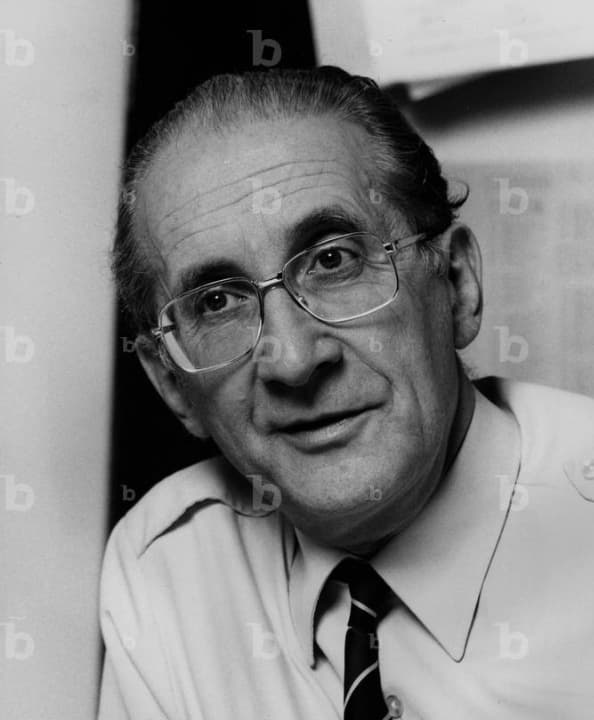
A beautiful photo! I think it is a fairly accurate image of a Jean Paulhan attentive to everything which, in the most ancient thoughts, can still be of use to people of the other...
ITW: Pierre, will you turn it towards the lens? I don't know if that will do anything...
P.O.: Here is the portrait, the medal profile.
ITW: Coming back to the last sentence of this text, "the secret of Jean Paulhan", it also refers a little to the other text that you publish in the same collection.
P.O.: What is the secret?
ITW: In the last sentence of The Attentive.
P.O.: Ah, the secret, yes.
ITW: This refers to another article, this time longer, that you published in the same collection which has just been published by Gallimard, that is to say Pratique de l'école, where you say what you owe and to whom you owe it, including Jean Paulhan. What was this secret that you are trying to get a little closer to in this text, which is called, I recall the title of the text, Here begins my despair as a writer?
P.O.: The secret, look in the little text that I deciphered, which is included in the document that I leave you.
I deciphered this little text, it is called the Koan or the Founder's Apologue. And I believe that Jean Paulhan expresses himself by attributing to a certain Tsang, a Chinese again, decidedly, the Chinese take precedence. It's called Koan of the Founder.
"Tsang cast a bell whose beauty enchanted the people. How did you go about it? the Emperor asked him. When you ordered me to cast a bell, replied Tsang, I collected myself in my heart. After three days, I had forgotten the money and the praise that my work would earn me. After five days, I stopped fearing failure and hoping for success. After ten days, I no longer noticed the difference between yes and no, advantage and disadvantage, exterior and interior, you and me. After seventeen days, having lost even the feeling of my body and my limbs, I felt that the moment to act had come and I set to work, so that the bell was perfect, like a fruit of nature. For a shoe is perfect when the foot does not feel it, a belt is perfect when the waist does not feel it, a heart is perfect. when it has lost the notion of good and evil. A mind is accomplished as soon as it no longer knows how to distinguish truth from falsehood.
I think this is an image of Jean Paulhan that we can dwell on and meditate on. That is to say, it is very obvious that the apologist, Jean Paulhan, is talking about himself, and he is talking above all about a writer superior to all writers who would not worry about the result but who would care about penetrating the secret which allows us to understand that others, and we, are completely one.
I copied it to you.
ITW: It's great, it's a very, very beautiful text.
P.O.: Ah, it’s a beautiful text.
ITW: Does this relate to this concern?...
P.O.: Bernard called me saying I'm discovering the Koan, it's a text that he didn't have, oddly enough, so it's going to take its place somewhere. I copied it to you.
ITW: Thank you Pierre Oster
P.O.: No, because you can decipher it in your turn, because it is in the documents that I gave you, but it is very small.
ITW: Okay. This ties in with what you talk about in this contribution, where you talk about the principle of contradiction, the principle of identity, the principle of non-identity. That was something very dear to Jean Paulhan.
P.O.: So here we are entering shifting ground, and I'm going to tell you everything. It turns out that Jean Paulhan was not a great reader of logic textbooks, because in the texts that I had before my eyes, he went as far as... Well, no, I'm not going to say that. In a way, it was I who forced him, secretly, but with a lot of determination, it was I who forced him to invent the expression counter-identity, principle of counter-identity. Because he didn't know that in French, I don't know how things happen in English, in German, in Spanish and in other languages, principle of contradiction and principle of non-contradiction, it's the same principle. And it is a completely marvelous thing that in the language of logicians, these two apparently contrary expressions actually designate the same principle, which follows from the principle of identity.
So, indeed, in certain texts, and I cannot prove it, because ultimately, we corrected things at the time of the production of the third volume, I saw appear under the pen of Jean Paulhan, because I had little conversations with him which tended to show him that he was making an error in determining the existence of a principle of contradiction.
He thought that to the principle of contradiction, it was necessary to oppose the principle of non-contradiction. However, the two expressions designate the same principle. That's how it is. I quote it moreover, I mark it in a small note. Perhaps other logician friends of his, whom I do not know, said to him: “Indeed, there is a point on which you should try to reflect. You must invent an expression which is not the one you use initially, which is the principle of contradiction. Because the principle of contradiction means the principle of non-contradiction. » That's how it is.
ITW: Is there something you wanted to say about Jean Paulhan, that you wanted to say about Jean Paulhan, that you wanted us to remember about him?
P.O.: What we can say is that he has... “The founder's bell makes a perfect sound. Is the sound made by the big five-volume bell also... such that everyone can hear it? " I don't know. “Principle of counter-identity. It is up to you to express yourself on this subject because the thing is perhaps clearer to you than it is to me.
ITW: This is what you are saying, in short, when you say that Jean Paulhan took up old texts and made old texts resonate. Today, there are perhaps people for whom Jean Paulhan is very relevant and who in turn...
P.O.: Maybe, but we don't know them. I don't see at all that there are either logicians or scientists who appeal to him. Since Lupasco, who was basically his least secret, closest master, himself died in great solitude. “Loneliness”, “suffering” are words that don’t seem to move you…
ITW: Yes, yes, precisely...
P.O.: These were very important elements in Jean Paulhan's psychology. As proof, this sort of despair that inhabited him. You both have the advantage over me of seeing things from a greater distance. I saw things happen like that, while meeting a gentleman who, at least once, had admitted the nature of the suffering he felt. “Here begins my despair as a writer.”
A writer cannot demonstrate that language is [a word].