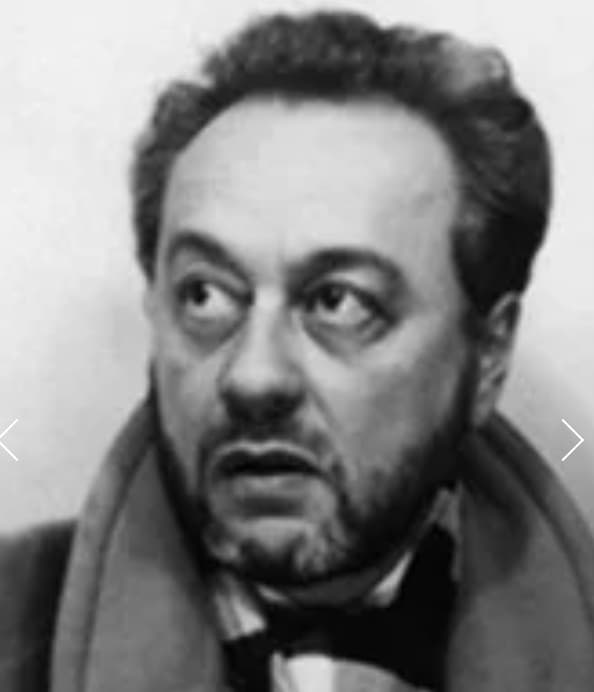
Interview with Jean José Marchand, on Jean Paulhan
Jean José MarchandITW: Jean José Marchand, you were born in 1920, you are an art critic, literary critic, journalist, scholar. We owe you in particular the famous series archives of the 20th century for television. But, if you wish, and since you have accepted the idea, I thank you, we will discuss with you today the personality of Jean Paulhan. We read in the Journal of Jacques Brenner, on the date of February 21, 1945, it is Brenner who speaks: “I enter Paulhan's office. I hesitated at first to enter, Paulhan beckoned me to stay. I went to sit down. I came across a 6 o'clock in Paulhan, where a lot of people come. Astruc, Marchand, Tavernier, Bertelet and others whose names I do not know were going to arrive. »
Was it at this time, Jean José Marchand, that is to say shortly after the Liberation, that you met Paulhan for the first time?
JJM: “Oh no, I had met Paulhan at least two years earlier. That is to say, I met Paulhan, I could tell you in a rather vague way, during the summer of 1942, because that is what happened. At that time I was collaborating on a review called Confluence, which was a review, how should I put it, at the same time, I would even say Pétaino-Gaullist, that is to say latent opposition to Germany, while inflicting a kind of apparent conformism. And in this magazine that René Tavernier directed, I collaborated a lot, I wrote a lot of articles.
And at that time, I needed to go to Paris, because Tavernier had told me: "we could do an anthology of poetry together", basically since 1935, that is to say the five previous years.
ITW: And so you met Paulhan.
JJM: And then it was at that time that, being in Paris, I saw a certain number of people to whom I asked to collaborate at Confluence. Since in short, the two zones were quite separated, you see, by this demarcation line. I must say even very separate. And so, as soon as I arrived in Paris, I telephoned the Nouvelle Revue française and asked to meet Paulhan, citing, in some way, my status as a young apprentice writer from the free zone.
And I must say that I was received immediately and in an extremely cordial manner.
ITW: Is it this famous scene that so many writers have told, that is to say where there was Drieu who had his office next door and Paulhan in another?
JJM: I knew there was Drieu nearby, but Drieu absolutely did not intervene. I myself admired Drieu quite a bit as a writer, but I was not on the same side politically speaking. And so, I preferred not to meet him, because I must say that I feared falling under his charm, because many people had fallen under Drieu's charm, right?
ITW: Let's come back to Paulhan. When you meet him for the first time, he was obviously, as I know you, someone you had already read about before meeting him physically.
JJM: Obviously, yes.
ITW: What had you read about him at that time?
JJM: I had read Les Fleurs de Tarbes, whose title had misled me, because I thought it was a book about, how would I say, almost a travel book in a way. But there, I wasn't very surprised. I had not read, because I had read a lot of La Nouvelle Revue française, because I had been reading the Nouvelle Revue française since the end of 1936. And so, then, I had read a lot of Paulhan, and then in particular the end of La Nouvelle Revue française, where he signed Jean Guérin, with other collaborators, but it was he who was the main author, and who was marked by his very particular spirit.
ITW: Tell me, did you... What did he mean to you, because obviously there was a big generation difference...
JJM: Yes, yes, that's it, I could have been his son.
ITW: You were a young man of 22, what did he mean to you?
JJM: Well, it was essentially La Nouvelle Revue française, for me. More than through his personal work, it was the NRF spirit. And the NRF spirit which was a certain way of considering literature, and at the same time, a certain way of writing too, because there was a very particular style of making notes, wasn't there? That is to say, a bit like not having touched it... It was very particular the way in which the... You just have to reread the collection to be completely struck by the way in which everyone wrote notes in the NRF, in a certain way. And that really struck me.
And what Paulhan also represented was a certain way of being neutral. For example, we knew that he was a municipal councilor of Châtenay-Malabry, and at the same time, we knew that he had defended Maurras, right, when there were attacks coming from the left.
Because for him, you see, literature was something that was a bit of a world apart, and his opinions should not be brought into play when judging a work. That is to say that he could just as easily read a book like books by Maxim Gorky, as well as books by Ernst Jünger, or people like that. For him, it was literature.
ITW: I always come back to that first meeting, because it's something important. What impression did that make on you? Were you disappointed in the man? What was he like physically as well?
JJM: First of all, what struck me, I think what struck everyone, was the fact that he was a giant from whom the fluted voice of a young girl came out, wasn't it? And that was so striking that for a few minutes I was surprised. But what struck me next was the way he treated you.
That is to say, he would start by testing you a little, and then, straight away, he would treat you a bit like a friend. This is how he gave me, the second time we met, which shows that I had passed my final exam, he gave me Beckford's Vathek, first edition, current in 1895, but finally with Mallarmé's preface. And that, I must say, stunned me, because I understood that for him, for example, I was already inducted into this kind of Freemasonry that literature was for him, that's it.
ITW: Did you see each other more often after the Liberation?
JJM: Oh no, we saw each other all the time. For example, I went to... He cared a little about his... because he had his day, a bit like ladies, like Marie-Louise Bousquet, or all the ladies of high society. So I went to his day, and there I met a lot of people, very different people in fact, and that allowed me to have personal contact, very quickly, of course, with people... and to form an idea very different from the idea I had when reading their writings, right.
But to continue on Paulhan himself, what is interesting is that he also offered me a rare first edition of one of his works, and that flattered me a lot, I must say, because I think it was Aytré who loses the habit. I lost the memory of what it was, but I didn't lose the memory of the fact that he gave me this book, right.
ITW: Pascal Pia says somewhere that Paulhan is one of those men who prevented him from writing, from achieving a career as a writer in some way. Did he ask you to write something, to start a work, to write poems, to collaborate with the NRF, or in the Cahiers de la Pléiade previously?
JJM: Oh no, that is to say that, first of all, at that time, he was not advertising, he was not doing real advertising for Drieu's NRF. That is to say, when people said to him "I would like to appear at the NRF", then he immediately intervened and proposed the text, if the text suited him, to give it to Drieu.
But never, never, for example, did he ask me anything for the NRF because he knew very well that I was from the same party as him and even much more partisan at that time than him and so he knew very well that I would not have proposed. No, no, he was always absolutely discreet and above all he said, isn't it... at that time I was full of Valéry's ideas and all that, that is to say ideas that we can do things, that we can do things. He told me, but no, things come like that, you can't undo them, can you, or it's an artifice, that is to say it's a reason that you give yourself by telling yourself that you are going to make something when you already want to do them.
ITW: Since we are precisely on this question, did he read you, did he read your articles, did he hear about your articles, did he talk to you about them and for example did you send him when your book Life on the Borders of the Poem was published, did you send him and what did he think of it? I mean, was he someone who was interested in you from a...
JJM: Yes, yes, that's it, but then, he told me, yes, yes, he told me, so that was much later of course, but then he told me that it had interested him and to show, he mockingly quoted one of my poems, which was a way of... how should I put it, of showing me that he had read me. So he told me, “the best thing I found was the poem dedicated to Picasso.”
ITW: And otherwise, he was someone who didn't ask you, that is to say he didn't say to you, are you writing at the moment, what are you doing?
JJM: No, no, but he knew very well that he had no need to solicit, that on the contrary people flooded him with manuscripts.
ITW: What was the general content of your conversations if you had any quite long or quite important ones with him...
JJM: I can't say that I had long conversations with Paulhan. There I just alluded to the fact that he had somewhat corrected an idea that was dear to me, which was the Valerian idea, you know, that at the beginning there was always a kind of intervention from the god, right, but then everything had to be fabricated. So he was absolutely against that and he thought that things come by themselves, don't they.
Other than that, we haven't had an aesthetic conversation, if that's the meaning of your question. On the other hand...
ITW: He knew that you were also interested in art criticism. You mentioned painting...
JJM: Oh no, never. Never paint. Never, because I was not at all of his... At that time I was very, very doctrinaire and I was entirely on the side of abstract painting, whereas what he liked were people like Dubuffet, Fautrier, whom I also liked but who were not really in my tastes, strictly speaking. I liked a certain Dubuffet period, the period of portraits. The portrait of Paulhan, in my opinion, is very successful by Dubuffet or the portrait of Léautaud, but I didn't like Fautrier so much, I found that it was extremely fabricated at that time.
Where we had... What happened was that in Paulhan's office during the Occupation, I remember conversations in which he gave his opinion on one or the other, but it slipped my mind. I remember, on the other hand, after the Liberation, I remember that he was obviously entirely in favor of indulgence for writers, because he had this idea that, apart from the call for murder and even in one case, even in funny calls for murder like that of Aragon, Fire on Léon Blum, Fire on the observers of democracy, these things made him laugh, so he was for absolute indulgence but he extended this to the writers of the collaboration too, because he was completely against attacking writers, because he thought that there was a distance, that it is the people who say, who write Fire on Léon Blum or even "we must send the Jews to a ghetto" that those themselves, if we told them do it yourselves in general they would faint, because they would be incapable of hitting a Jewish child or shooting Léon Blum and so this action of the writers made him laugh, so he was for indulgence because of that because he said there is an abyss between the fact of saying anything, let's say, let's be lenient, saying anything, and the fact of doing it that's how he was.
So I remember in his office that I had an argument with a man that I really liked and who was Francis Ponge about Brasillac because I said that the fact of shooting Brasillac, while I was a Gaullist to the last degree... I said that shooting Brasillac was shameful, wasn't it, because Brasillac was himself incapable of doing these things, because he could, still following the theory Paulhanesque, writing stupidity that has nothing to do with doing it yourself, and then and at that moment Ponge violently took me to task by telling me "the only one of these guys for whom I have any indulgence is Jouhandeau". I didn't contradict him, obviously on that level, but I said that Brasillac was actually a very good boy, wasn't he, not bad at all, that's it.
ITW: coming back to the personality because I know that you are very interested in beings, what would you say about his personality? Have you ever been invited to his house for example and what was he like?
JJM: invited to his house, no. I know that I was... that is to say, the first time I saw Paulhan was at the end of 1936 because my mother, I was very young, and my mother had accompanied me because I wanted to subscribe to the magazine. There was Madame Paulhan there who was not yet, how shall I put it, in too bad a state since unfortunately afterwards it was no longer at all, and then I know that the two women argued with each other...
ITW: your mother and Germaine Paulhan?
JJM: that's it, and I must say that Paulhan, on the contrary, showed his peaceful and... frightened character! to see that the...
ITW: so in fact your first meeting was when you were a teenager you were over 16 and therefore on Paulhan's personality itself so what would you say about it?
JJM: ah, what you are asking is very serious because first of all I am not a priest, and even if I were a priest I would obviously be extremely lenient. But then what I would say about Paulhan is that I am convinced that despite the appearances, it must be said a little sharp that he could have in his remarks, I believe that he was a good man in reality, and that is quite rare among writers because I never felt, what there is often among writers, that is to say all these hatreds reheated, masked by politeness, it is not true at all, I believe that he was a good man, but it was masked by his... the fact that he did not hesitate from time to time to have a sharp word, for example one day we were talking about Pyrrhus and Cyneas by Simone de Beauvoir which had just been published and I was telling him to what extent, I who at that time was a bit, while at odds with Sartre, but in admiration of Sartre, I was quite devastated to see this book, he said to me: “yes yes these are concierge words” (laughs). Words like that obviously didn't just make us friends...
ITW: And this enigmatic, often mysterious side, the taste for paradox? Léautaud writes in his diary that he was a dancer, for example, were you struck by that?
JJM: Ah, he was a dancer, obviously everyone was struck by that. But I think it was, but this dancing side was the dancing side that certain men could have who are in reality extremely solid, right? I think it was completely... this dancing side was a side that he gave himself... first of all he needed to defend himself against this assault from a multitude of writers because the, how should I say... you know that poets are extremely dangerous people, don't you? and so he clearly felt that it is an environment in which hatred is all the more virulent because it is masked and so I believe that this way of joking was a way of defending oneself. This is what made a man that I like very much, Maurice Nadeau, misunderstand Paulhan because I believe that Nadeau let himself get caught up in this because he saw in Paulhan the man who, while being a member of the socialist party SFIO, did not take these things completely seriously. Which means that Paulhan was never surprised, for example, that, let's say that Roger Vaillant was a communist only to become completely distanced from communism to the point that towards the end of his life we did not suspect that he had been, that he was not surprised by the fact that this or that author took extraordinary positions, that people he had supported at the time of the NRF like André Fraigneau for example went to Weimar etc. All this didn't surprise him because he expected everything from the writers. But precisely because he didn't believe... in other words deep down, I believe that he would have been like Péguy, that is to say that he only believed in witnesses who were killed - which was the case with Péguy. He knew very well, for example, that perhaps Brasillach... someone would have given him a gun, he would have injured his concierge, you know what I mean? (laughs) He knew that.
ITW: If you wish, we will end with what is most important, that is to say the books and the work of Paulhan. What do you prefer in the work? And do you think that these books are something that have accompanied you throughout your life?
JJM: Ah! you see because... notice my reaction I don't say something point blank like for example if you spoke to me about Dostoyevsky I would tell you the character of Svidrigaïlov, if you spoke to me about Baudelaire I would tell you I really like La Fanfarlo, ... There is not that in Paulhan because, it is Paulhan himself who is the important character of his work, more than his work. His work... he knew very well that life... for example you cannot enter the public garden of Tarbes with flowers in your hand, but he knew very well that there were great works like for example that of Gongora which are only flowers on the contrary and he knew that better than me, so deep down I believe that what mattered to him was... in other words, if he entered the SS he wanted to say that we would have to be a little gentle and liberal, If, on the contrary, he joined the SFIO, he wanted to say that he would have to be a little virile all the same... I think.
ITW: Did his election to the Académie Française surprise you?
JJM: Not at all, I think that if there was someone who was deserving in the sense of what Richelieu wanted, that is to say that Richelieu wanted them to be first-rate people, obviously not Madame Simone Weil, I'm not talking about the great one, then that's nonsense, but then Paulhan yes.
ITW: Do you have anything else to say that we remember from Jean Paulhan?
JJM: I would like his work to last, it seems paradoxical after what I have just said. Because I believe that there is always something to discover, because there are works in which there really is nothing to discover and, in other words, I am convinced that he is ultimately a little neglected today, that is to say that his name is better known than his work. But on the contrary, it is obvious that if I want to do a quick review since you asked me, it is obvious that for example the fact that he was interested in both Malagasy poetry and haikai or haiku as you prefer, that he was interested in a number of things, that he drew attention to a number of things, it is always useful. It's very good that there are complete works because we can draw on that, perhaps at random, obviously it's not Tolstoy, but we can draw on things from there, so ultimately yes, I think that it will last with the people who deserve it, that is to say now at a time when French literature is threatened with being replaced by a kind of Anglo-Saxon patois which is not Shakespeare's English, eh well it will always be useful to reread it!
ITW: Thank you Jean José Marchand.