Jean Paulhan
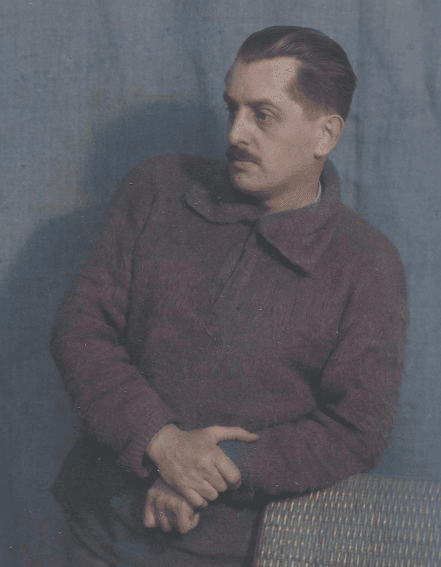
The trace of Jean Paulhan (1884-1968) can be read in the constellation drawn by his thousands of letters, at the crossroads of Surrealism and 'Pataphysics, modernism and the Grand Jeu, the most fully assumed individual stance and the most deliberate collective logic. Already present in the world of little magazines before 1914, secretary to Jacques Rivière from 1920, placed at the head of La NRF from 1925 to 1940, then, with Marcel Arland, from 1953 until his withdrawal from public life, he occupied a central and often decisive place in publishing, especially on the reading committee at Gallimard. From Commerce, Mesures and the Cahiers de la Pléiade, his influence extended to many journals and publishing houses, from Minuit to 84.
The publication, over the past half-century, of many correspondences has made it possible to document his path, dispel doubts, and refute the least well-intentioned accusations. Reading his correspondence with Pierre Drieu la Rochelle shows the clarity of his commitment to the Resistance. Maurice Nadeau, late in life, acknowledged that he had been wrong about Jean Paulhan and had underestimated his merits. That is promising. The memory of his presence now animates a field of research that remains widely open to aesthetic, literary, editorial, and political questions.
Throughout his life, Jean Paulhan showed care, concern, and no doubt also anxiety about language and its condition. He did so in order to question our relationship with it. How are we getting along with language? Do we think language allows us to say what we have, or what we believe we have, to say? Or do we think, on the contrary, that language stands in the way of what we want to say? And that for this reason it must be brutalized, or even, more modestly, renewed?
The essential point is that Jean Paulhan devoted his life to observing this relationship each of us has, and first of all every writer has, with language. Each of us, since his earliest work dealt with the logic of everyday life, of conversation, and for example with the proper naming of new metro stations. His later work dealt with Malagasy, French, and even Auvergnat proverbs, and with the force that the speaker embodies and manifests by speaking. Every writer, since it is to the writer that there falls, not quite a mission, but the responsibility, in his own sphere, of guarding the language. To be the guardian of language and its dreams, to have received it as an inheritance, is an everyday reality. For language is a thing, and a useful thing, and better still.
Jean Paulhan belongs to a generation through which two or three wars passed. He emerged from them not as a pacifist, but as a patriot. He knew Dadaism and modernism; he knew Cubism and informal art. He knew anarchism and Gaullism, those external forces, impulse and the temptation of renunciation, construction and destruction, those inner forces.
Among his comrades, among his friends and among his own, he knew the difficult dialogue between what he called Rhetoric and Terror: on one side, the passion for technique and for named, identified, deciphered figures; on the other, the absolute and probably tyrannical authority of expression. It was tempting to simplify this dialogue and to conclude too quickly in favor of one or the other.
Jean Paulhan saw Roger Martin du Gard, André Gide, François Mauriac, Albert Camus, and Saint-John Perse move toward the Nobel Prize, six years were not enough for Paul Claudel, and he steered Henri Thomas and twenty others toward the Fénéon Prize. He accompanied Antonin Artaud, Joe Bousquet and Roger Gilbert-Lecomte, Marcel Lecomte and Charles-Albert Cingria along the path of their language. He helped Rilke publish his last French poems, imposed Kafka through Alexandre Vialatte, and himself found, during a meeting at Gallimard in 1938, the famous French title Autant en emporte le vent.
If he is to be believed, each author followed his own path, and the most original were also the most significant. Even so, he distrusted genius and its platitudes. But Jean Paulhan, who made authors' names cross paths in journal tables of contents and organized encounters in painters' studios, never entirely gave up the hope of one day glimpsing, in spirit, the rational construction that would organize the whole set of utterances and discourses. He believed no more in literary cliques than in literary or artistic schools, and still less in political parties.
Pushed to their limits, Rhetoric ceased to be a technique and became a vision of the world; Terror ceased to be terrorism and became a reason. Accompanying authors in this necessarily contradictory quest was his ideal and his practice, his compass and his labyrinth. The practice of the journal editor nourished and shaped the reflection of this philosopher of language. Despite the paradoxical relationship between their ambition and their ultimate incompletion, Les Fleurs de Tarbes was not a useless book.
Nor did Jean Paulhan ever renounce belonging to a journal, a community, a society. It was always without exclusion. The journal Le Spectateur, with René Martin-Guelliot, the journal Proverbe, with Paul Éluard, the notebooks of Commerce and Mesures, then the Cahiers de la Pléiade, were the successive forms of these literary societies, which did not pretend to be ephemeral. La N.R.F. was his principal home and passion, and he scarcely thought of the Académie except when the possibility of a comprehensive literary journal receded from his mind.
It is reassuring to see that the figure of Jean Paulhan continues to attract both the arrows of annihilation and the signs of the liveliest and most disinterested interest. "Paulhan begins," Alexandre Vialatte was already writing in 1968, by way of obituary.