
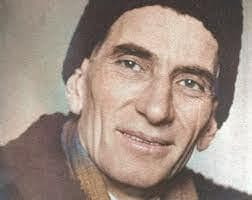
Panaït Istrati
The adventurous and rebellious life of Panaït Istrati has just ended as he had planned. Istrati leaves, at the age of fifty-one, our “apocalyptic” world, before being able to finish saying the most precious and “honest” of what he had to say. He dies bitter, disappointed, not resigned, certainly, but no longer believing in anything except love, passion, joy, fraternity. The man who no longer wanted to teach his brothers to “refuse to die for anyone” was carried away by death, which is not equal for everyone. The “blaze of desires” that he was could not be dispersed: life was too strong and too deep in Istrati for one to think for a moment that he had left her by no longer loving her.
The Balkan Gorky, who had become through patience, genius, and faith in the friendship of Romain Rolland, a French-speaking writer, had not stopped, for twelve years, telling his adventure. From volume to volume, we followed the stages of a painful life, which he tried at least once to remove himself by cutting his throat. But it was a suicide of passion, and not a suicide of renunciation. Once again, Istrati was a rare example of a man committed to life by vocation. Life was his vocation rather than art, he must say that somewhere.
The man was long and thin, with eyes both brilliant and inscrutable: courage and generosity seem to have been his great virtues. We have not forgotten his troubles with the Soviets; we could have predicted them. With Istrati disappears, at the same time as a great storyteller, one of the last representatives of revolutionary romanticism.
Jean Paulhan, 1935.
Resources
1928 Panaït Istrati, Bilili and Nikos Kazantzaki in Ukraine, Odessa, kyiv
Panaït Istrati, Presentation of the Haïdoucs - France Culture
Panaït Istrati, child of the Danube, universal writer
Recurs la Istorie: Panait Istrati, destinul unei vieţi
Panaït Istrati, French writer, Romanian storyteller
Correspondance : Panaït Istrati & Jean Paulhan, 1929-1935
Bibliography of texts published in the NRF
The texts below, published in La Nouvelle Revue Française, are grouped into four main sets: texts by Panaït Istrati, notes and columns by the author, texts about the author, and, when available, translations by the author.
Texts by Panaït Istrati
- Une nuit dans les marais, 1926-03-01
- L'Affaire Roussakov ou L'U. R. S. S. d'aujourd'hui, 1929-10-01
- Le Lac-Salé, 1935-02-01
Texts about Panaït Istrati
These texts may include thematic studies about the author, correspondence, reading notes on works by or about the author, interviews conducted by the author, or works edited by the author.
- L'oncle Anghel, par Panaït Istrati (Rieder), by Joseph Kessel, 1925-03-01, Notes : le roman
- Panaït Istrati, by Jean Guérin, 1935-05-01, articles
Chronological distribution of texts published in the NRF (1908-1968)
This chart shows the chronological distribution of texts across the four categories defined above: Texts, Notes, Translations, and Texts about the author.