André Berne-Joffroy
[Article by Nicole Vulser, published in Le Monde on March 23, 2007]
André Berne-Joffroy was both literary and artistic critic, essayist, contributor to La Nouvelle Revue française. An almost diaphanous silhouette, a mischievous look, a piercing humor and the exquisite elegance of the scholars of the past century: such is the quick portrait that one could paint of him.
Someone “unclassifiable”, the art critic Pierre Restany rightly said about him. André Berne-Joffroy knew a number of writers well: Paul Valéry, Francis Ponge, Jean Paulhan, Yves Bonnefoy. He was one of the few to visit Antonin Artaud when the latter was interned in the Rodez asylum.
He also worked for twenty-five years as a curator at the Museum of Modern Art of the City of Paris and organized a number of exhibitions. Preferring, as he liked to say, "unknown artists to artists in full glory", he endeavored to discover painters or authors, by fighting for example for a Jean Fautrier exhibition to take place, "despite the painter's annoyances with André Malraux", he said.
He also curated the first major Mondrian retrospective in a French museum, at the Orangerie in 1969, and organized the exhibition "Jean Paulhan through his painters" at the Grand Palais in 1974. In turn, André Berne-Joffroy defended Hartung, Bernard Saby, Laubiès, Atlan and, more recently, Miguel Barcelo.
Born in Paris on April 11, 1915, André Berne-Joffroy, orphaned very early by his father and then his mother when he was only 16 years old, continued his studies with the Eudists in Versailles then with the Jesuits in Evreux. Quickly abandoning medical studies, he was enlisted in the health services at the start of the Second World War.
Demobilized, he returned to Paris and began studying philosophy. In 1941, his meeting with Félix Fénéon - the founder of La Revue independent which helped to reveal the works of Rimbaud and Joyce - opened new horizons for him. His frequent attendance of Paul Valéry's classes at the Collège de France also. He joined the literary group of the Ursulines, which brought together ardent defenders of Gide, Valéry and Montherland against the regular attacks of the press critics of the collaboration.
André Berne-Joffroy had signed two books dedicated to Paul Valéry. “It was a delight to write about him,” he said. He also happily signed certain prefaces, the most personal of which remains that of La Vie de Rancé by Chateaubriand.
André Berne-Joffroy's best-known work remains Le Dossier Caravage, published in 1959 by Editions de Minuit. “Caravaggio, whom I admired, gave me the impression of a privileged subject, provoking this very bizarre act which seemed almost inconceivable to me: discourse on painting,” he explained. This Italian artist who died at the beginning of the 17th century, deeply forgotten and little known until the beginning of the 20th century, then became his main subject of study.
Erudite, very free-spirited, very attentive to his friends, and always curious, André Berne-Joffroy also knew how to be "tenacious and intriguing", as he himself said, especially when the institutions, which he could sometimes judge to be too cautious, tried to put obstacles in his way.
Nicole Vulser
Le Monde March 23, 2007
Resources
List of works by André Berne-Joffroy
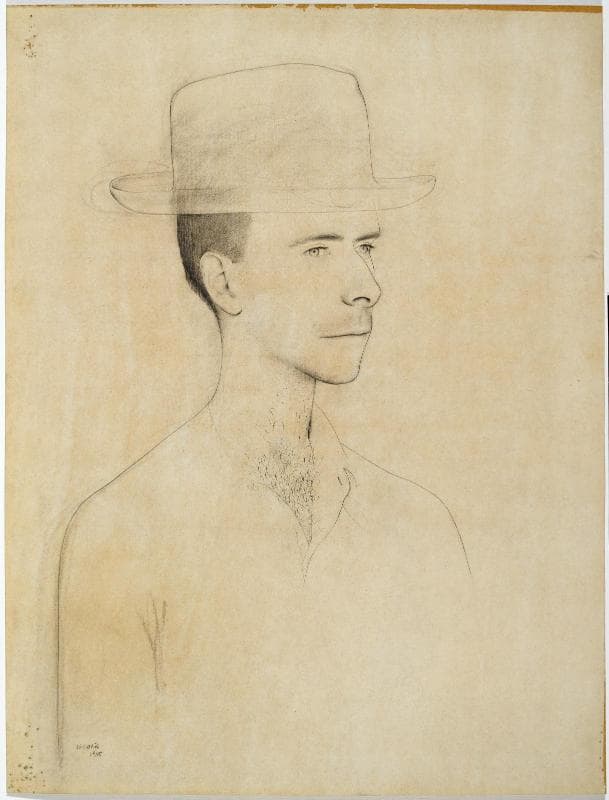
Portrait with hat of Berne-Joffroy by Bigorie, 1945
Valéry, by André Berne-Joffroy - Internet Archive
Correspondance : André Berne-Joffroy & Jean Paulhan, 1950-1958
Texts by André Berne-Joffroy about Jean Paulhan :