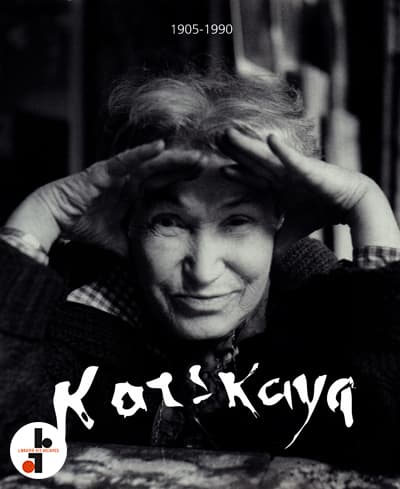
Karskaya
Karskaya leads two different lives: in the first, she takes their bark from innocent trees: birches, oaks, laburnums, and glues it on her canvas. She also sticks dead leaves, leather scraps, plywood splinters. She obviously prefers this little rubbish to paint. So that the amateur — the contemplator — first says to himself: she is generous. She wants to save a whole piece of rubbish that we usually neglect.
But this is immediately belied by the ferocity with which Karskaya tears the skin from still living trees.
In the second life, Karskaya paints brief washes with Indian ink that she calls “unanswered letters” or “daily grays”. These are accents, commas, bone splinters, fights of reflections, points of light and points of shadow. Ah! and above all points of grayness. It would seem that she encountered, between evening and morning, this same twilight which we are not sure whether it heralds day or night.
It creates a kind of net streaked with lightning, a dust of stones, a few glimmers on the side of the abyss. And we look at them with the same feeling of freedom that comes to us from the images that come to us in droves as soon as we close our eyes. However, it also seems to us that these new figures are true, as if Karskaya simply gave free passage to the signs that play in nature, and it is for lack of attention that we do not distinguish them.
There are quite a few people who stupidly complain that life is short. Foolishly, since no man has ever known anything longer than life. Yet there is wisdom in this stupidity: it is that although we reach the age of fifty, or even a hundred, we are not done with surprises and surprises. So we have every right to complain, not that life is short, but that our life is a little too short.
I am not thinking in particular of the latest discoveries of science, which certainly have their charm (it is a charm which no one thinks of rejoicing in). But, taking only painting, we have seen for half a century artists replace their prisons with an abyss, their constructions with lightning, and — to put it quite simply — their volumes with space. It's not that they discovered some new reasons. No. This is because they took advantage of a certain fact – if you like, a certain mystery – which until then had gone unnoticed.
The old painting, with its vanishing points and distance, its horizon line, in short, its perspective, was based on a banal event: that a distant object seems smaller to us than a neighboring object. Trivial, but all in all strange: it could be the opposite. We know that an illustrious character (among others) does not seem less great to us from afar than up close; and the Moon, larger even though it is more distant.
It is no less strange — nor less obvious — that it is enough for us, to make space, to place a black or green point on a white sheet (because the point immediately takes its distance and moves in front of the sheet); What ! without even using a pen or brush, place colored paper, a piece of bark, a dead leaf on white paper. And if the new paper bears some sign of relief (as happens with tapestry braid) the new space is all the more striking: more convincing. Thus begins, with glued paper, modern painting. This is his condition and his remedy.
All I wanted to say is that Karskaya finds herself placed at the very center of this condition. She accepts the exchanges and servitudes better than anyone. She stands as close as possible to the event, from which the painting comes out today. She refreshes herself there and regains her strength not every ten or twenty years (like most painters), but every day, and not for a moment deceives us. Did I say the main thing? This is the great feeling of escape that Karskaya's double life throws us into. And I see the reason very clearly: if it is possible to lead two different lives, why not three? Why not seven or nine?
Jean Paulhan, 1959.
Resources
Exhibitions :