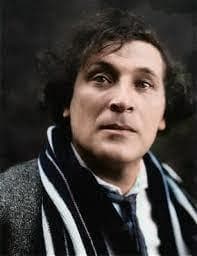
Marc Chagall
Chagall in his true place
That marvelous green fish, those lovers in the night: we would like to give them flowers, to offer them a sacrifice of flowers. Chagall thought of it first. The bouquet even grew and became a whole tree sheltering the lovers. What joy, and one that reaches far! It is as if he were not ashamed to tell us what deep down we all think, what we keep imagining. He himself seems surprised by it: amazed. Yet this is not satisfied joy, not the sensual joy of a Rubens or a Renoir. It carries some melancholy within it (as if Chagall regretted cutting the flowers).
That extraordinary joy - ah, that does not help us speak of him. On the contrary. Some people imagine it is easier to work if there is a pretty landscape outside the window. Well, that is not true. Nothing is more confusing. Better a small room with shadow, lots of shadow.
1
What is a color, what is a form? I do not know. Nobody knows. Like light or humanity, these are words clearer by themselves than anything one might say about them. But at least I can observe their changes. I can ask what the painter means to tell me, what he lets me hear through their variations.
So Chagall is a painter, and a modern painter. He follows (when he does not invent them) all the principles of modern painting as they were fixed between 1900 and 1910 (and it is precisely in 1910 that Chagall, leaving his native Vitebsk, arrives in Paris). Which principles? It is not easy to say what they accept. But we see very clearly what they refuse, what they no longer want to hear of, what they purify us from. It is first evident that painting is deprived of its means. As far back as we can go in the history of European painting, it is characterized by a set of procedures - or illusions, if one prefers: illusion of matter, illusion of volume, linear perspective and color perspective, detailed drawing, anatomical correctness, local color. Not one of these procedures remains today. They disappeared one after another: linear perspective from Daumier and Manet onward; detailed drawing from Gauguin and Van Gogh onward; anatomical correctness from Ingres and Cezanne onward; local color from Monet onward; illusion of volume from Gauguin onward; illusion of matter from Matisse onward; and all these means at once from Braque and Picasso onward.
Yet nature was not thereby better treated - since all those means aimed, after all, at rendering it (what, had we lost it then?). Abstract painting begins the day the painter - around 1907 - calls a canvas a portrait when no one can distinguish a mouth, a forehead, or eyes. What do we see in a non-figurative canvas? Reflections without mirrors, corridors without exits, stalactites without caves. In modern painting, everything strangely happens as if our world had been struck in its course by another world, leaving only fragments behind, sometimes recognizable and sometimes not. So what first strikes us is lack: crack and fault - as if there were no object in the world without a fissure. Also strangeness - as if there were no object fit to unsettle us. And all that follows: new strange objects, autonomous, deriving existence only from themselves and for which the painter is innocent, ambiguous moreover and open to a thousand meanings; or, when they are still natural objects, their order is lacking. They have lost contact, even the most fixed have been shaken and displaced, moved out. After what shock, what collision? They are no longer at their levels: a little higher, a little lower than they should be, showing us less spaces and distances than keeping us at a distance.
Chagall accepts all these conditions, all these rules of modern painting. We see in him neither linear perspective nor color perspective, nor volume, nor of course anatomical correctness or local color. Add that he does not cheat: he is not one to slip into his images some "curious perspective," some realist line, and that somewhat crafty appeal to the viewer.
But everything unfolds as if, at once, he had passed to the other side, into that world that came to break ours, and stood there firmly, perfectly resigned to sacrifices (he even seems to rejoice in them), not disoriented, at home there, as if he had foreseen that crack, had already slipped into that hiatus, had explored those abysses top to bottom.
2
Art has always been linked with religion. The ancient gods and goddesses are succeeded at the right time by the people of Christs and Virgins, saints and angels. This renewal of personnel proceeds regularly, as if arranged in advance. Later come Liberties and Justices, and kings and great captains, always ready to take themselves for gods. But modern painting, at the same time as it breaks with the means that had always been painting's means, breaks with so many sacred evocations; and the least that can be said is that it breaks with the sacred in order to become itself divine. Around 1910 in painting, in short, something equivalent to a religious awakening occurs. As if one were finally about to know what painting is and what art is. And as if around that new knowledge a whole new world had to be reconstituted. All young painters saw themselves at the threshold of an unforeseen era and civilization. From then on, it was less a matter of submitting to reality than of discovering truth.
In short, in the midst of mystical adventure. And Chagall with them, just arrived from Vitebsk, where he had left his fish-merchant father and his grandfather the ritual slaughterer. That is to say he did not feel disoriented or disappointed in the least. Besides, the joy of images was never poisoned for him. At twenty, he was still in childlike drawing. No doubt it is excellent that imitation drawing and the rest are taught in schools. The point is to discourage children - there are some! - who would like to become painters. But Chagall hardly had to defend himself. No one ever explained to him the labor, the discouraging labor of resemblance: false volume, false matter, trompe-l'oeil, false distance, false color. What astonishes him in Cubists would rather be their scruples, their excessive realism.
Yet these Cubists pursue their work. What work? We know well enough that mystical experience is first marked by refusal and negation: refusal of wealth and glory, refusal of fine clothes and beautiful bodies, refusal of pleasant sensations, refusal even of reflection and mind. So many absences at last compose in the mystic's life a landscape made of lacks and faults, like a modern painting. I do not think it has ever been noticed: the three stages that mystics have always distinguished in their path - purgative life, sleep of the faculties, illumination - correspond quite exactly to the three periods of modern painting, or, which is the same, Cubism: analytical Cubism, hermetic Cubism, crystal period.
But it seems Chagall from the first moment sees himself carried to crystal illumination. Not without disturbance, certainly, nor without confusion. Sometimes reality assaults him and troubles him. Or it is the world of yesterday, with its flying peddlers, its snow and barricades, struggling to adapt to a world of blond forests and Eiffel towers: to lodge there without too much confusion.
But from the first instant Chagall is attuned to the divine. Before his blue donkeys, flying clocks, flaming horses, only adoration is possible. He even dares speak without the slightest embarrassment of what has haunted us all since childhood: birth, marriage, death.
3
Mr. Meyer Schapiro remarked strangely last year that Chagall, by agreeing to illustrate the Bible, was going against modern painting, which "prefers spontaneity and immediate thrill to subject matter." But Chagall treating the Bible does so in a wholly spontaneous way too, without much concern for traditional interpretations. And thrill and spontaneity are themselves a subject. What subject? Precisely that one had to pass through thrill and the spontaneous. And why?
Here one cannot avoid thinking of all kinds of old doctrines we had never quite understood (at least I had not). Have they become clear to me? Perhaps not, but they illuminate modern paintings very well. And Chagall's especially. I think of Plato holding that art is a means of knowledge. Of Mengs declaring that the mind is far more delighted by what is absent from the painting than by what is represented there. Of Quatremere de Quincy: "A work of art is beautiful only through what it lacks in order to appear reality." Of Victor Cousin: "Only what is not visible is beautiful." In short, allegorical painting. What then? Had lack and fault already come to reveal another world to us, that world in which Chagall from the first moment is so well installed? And if one tells me that painting of this kind has produced only rather pitiful children, I will not be embarrassed to answer that the beautiful children had to come a bit later and that modern painting would have had less success had it not been secretly called for, wished for, demanded. I would add - as painting today represents the sacred less than it is itself sacred - that modern art no doubt applies less some particular allegory than it figures the very principle of allegory. If that allegory seems to flee subject matter, it is because it addresses the subject of subjects, the reason for painting.
Here one can hardly avoid asking why, to enter the rapture of that world, deprivation and sacrifice were necessary. To which I would like to answer that there may be an original vice of the world, trees, and humans as we see them - and that it may well be precisely that we see them. An essential defect in our procedures and means - and it may be that they are precisely means and procedures, that we have invented them. Therefore they have only fragile truth, tied to our ideas (and could disappear with them), to our imagination (and would vanish if we were suddenly deprived of imagination), to our hands, to our action (and thus narrowly relative to that action); in short, nothing guarantees their truth. I think that is the reason behind reasons.
Yet that is surely not how it presented itself to Chagall, in such abstract form. It must also have had a direct and childlike form, one able to touch us all.
It happens that reality reveals itself to us in flashes. There are waters so clear and running, meadows so green, night mists so blue, fish with eyes so grave, or little cows so moving in their nakedness, that we are first struck by them (as if they had just come to be, as if one moment before they had not been there), and we ask ourselves: "What must we do to deserve them? How can we obtain that they return to us?" More than one child, more than one adult, would be ready to forgo toys for a whole week, to stay a month in a dark room, to fast for five days in order to hear once more, as once heard, a titmouse singing or a mountain springing.
He is familiar with spring and rain. He treats the sun as an equal. He refuses nothing. He has visibly painted everything that occupies him, from flaming horses to the spirit with large eyes. He is equal to himself in joy and sadness. Or rather in that extreme happiness that does not ignore sadness and deprivation. Here one first thinks of the melancholy of a people persecuted above all others. No divinity lacks a dark face. And it was also from the day Paris was tortured that Chagall stopped approaching it timidly - and made it his second Vitebsk.
But perhaps he had to pass through anxieties and sacrifices to be initiated into the joys of fascination. (Sacrifices are no doubt what we call the soul.) And so may it be for all of us, who are only in the first years of the history of gods.
Jean Paulhan, 1957.
Resources
Marc Chagall: Interview with Georges Charbonnier
Marc Chagall, the acrobat angel: A life, a body of work, France Culture
Interview with Marc Chagall in Saint-Paul de Vence in 1967, video
Exhibitions :
See also, by Jean Paulhan :
Bibliography of texts published in the NRF
The texts below, published in La Nouvelle Revue Française, are grouped into four main sets: texts by Marc Chagall, notes and columns by the author, texts about the author, and, when available, translations by the author.
Texts about Marc Chagall
These texts may include thematic studies about the author, correspondence, reading notes on works by or about the author, interviews conducted by the author, or works edited by the author.
- Exposition Chagall (Galerie Hodebert), by André Lhote, 1925-02-01, Notes : les arts
- Exposition Chagall, by André Lhote, 1940-03-01, Notes : les arts
- Chagall (Musée des Arts Décoratifs), by René de Solier, 1961-09-01, Notes : les arts
Chronological distribution of texts published in the NRF (1908-1968)
This chart shows the chronological distribution of texts across the four categories defined above: Texts, Notes, Translations, and Texts about the author.
Textes parus dans les Cahiers de la Pléiade
Les textes qui suivent, publiés dans les Cahiers de la Pléiade, sont regroupés en trois ensembles, les textes de Marc Chagall, les textes traduits par l'auteur et les textes dont il est le sujet.
Textes sur Marc Chagall
Ces textes peuvent être des études thématiques sur l'auteur, des correspondances, des notes de lecture d'ouvrages de l'auteur ou sur l'auteur, ou d'ouvrages traduits par lui.
- Germaine Richier, de Staël, Bazaine, Chagall, par René de Solier, printemps 1950 [208 p.]