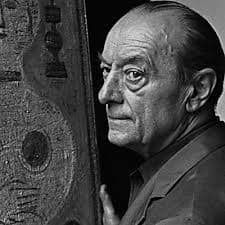
Massimo Campigli
Obviously, the characters who inhabit Campigli's paintings obey rites rather than manias or simple habits. This is what we see in their silence, in their reasonable satisfaction, in their innocence, in their sacred appearance. It seems they are protecting us. From what?
It is not at all one of those hieratic sacred forms which immediately make one think of the Celts or the Redskins, and (at the same time) of sociologists. No, but quite familiar, and even, if I may say so, popular, who tolerates jokes, and even irony, very well.
The bee
Like a bee, Campigli begins by locking his characters in their cells. Sometimes alone; most often two, three or four together. Sometimes neighboring cells are separated by the bars of a banister, the steps of a staircase, the shelves of a cupboard, the grating of a window, the lines of a checkerboard. Sometimes by a simple thickness of air. (It happens - as in the suite of weavers - that the prisoner weaves her prison herself.) How does he go about it? Nothing insulates its creatures better than a wall of air, a row of columns of air. Its characters... as well as its daughters and its women. There are hardly more men in his paintings than bees in a hive.
We think for a moment of those girls of yesteryear who married (as they say) a gate. But in which cloister? To these young women whom Jérôme enclosed in a chain of mail. But Campigli's heroines are rarely naked below the surface of the body: usually, dressed with care, and even with too much care, entangled in their corsets (which make them look like hourglasses), and in their dresses. Not to mention that they are sometimes missing an arm, a leg, a breast: quite incapable of getting out of trouble on their own, if Campigli did not come - like larvae or nymphs - to bring them the honey and water, which they call for, to fan them (as do, in the hive, the wing-beating workers).
Or even manage these mysterious communications, these touches and these complicity, which pass from one to the other with a touch, a smile, a necklace, various games.
No without insistence
He doesn't really want to talk to us. He is not turned towards us. Completely indifferent to the results. On this side too, as on the side of suffering or death, his paintings are closed. It seems, rather than a speech, an old childhood dream, which he constantly reworks, each evening adding to the collection the captives of the day. It must have been at first (I suppose), emotion helping, with great disorder day and night. Then Campigli became a painter, and dreams must have slipped into his paintings, without his knowledge. It was towards cubism.
The cube was not made, no, to embarrass Campigli. He took it as is, simply hollowed it out and transformed it into a sort of cell (where the young women he watches willingly play childish games). Moreover, he treats it quite freely, moving from the regular cell (with a pyramidal base and oblique truncations) to the royal cell in the shape of a thimble. The edge, marked or not, is always present. Stable light would rather resemble a sediment left by the sun, rains, fogs. Even the colors vary little: sienna... — but no, better to say it in Italian: terra di Siena bruciata, ombra naturale, ocra d'oro, terra verde. Campigli's paintings are reminiscent of some marquetry, which would have passed from hand to hand. Or to some mosaic, on which we would have walked for a long time.
Here we will perhaps talk about monotony. If we want. It is simply strange that the exaltation continues, the enthusiasm without ceasing - and on the other hand the dull soul, the drowsiness - show on the outside, more or less, the same face. If it sometimes seems to us that Campigli is repeating himself, we experience, much more surely, that he insists, because he must insist. This is because we, nor he, have not yet completely understood.
What is inspiration? It's having just one thing to say, that you never get tired of saying.
The master of contacts
However, in front of his paintings, stupid, or at least naive, thoughts come to mind. We say to ourselves: it is nevertheless true that it is different to walk - to play, to sit - in pairs, in threes or in fours. (Although we don't usually think about it.) But different in what way? It's difficult to understand. No less difficult than these distant contacts: the water which brings together two bathers, the ball which flies from one girl to the other, the air which both separates and confuses two captives. Or close: the hair that we share, before braiding it, a skein that we unwind, a hat that we try on.
Who thought of calling touch a hobby (or rather the hope of a hobby)? Who noticed that love was the contact of two skins? They said more than they thought they would. All this makes for a strange domain, where we have little more than the embryos of antennas, the outlines of faculties. It would require the same effort of attention, of gathering, which makes doctors distinguish between mediate contact and the immediate, surveyors between first or second order contacts. Otherwise, I don't see how to avoid stupid thoughts.
But Campigli hardly needs reflections: he is a painter. Painter and master of this somewhat troubled country, where events happen in silence, where a nervous thread quivers and a vibration continues. This is the country that certain Cretan or Pompeian girls already inhabited, the two bathing ladies, one of whom (Gabrielle d'Estrées, I believe) pinches the tip of the Duchess of Villars' breast. Better still, the “scene of married life” from San Gimignano where the husband and wife, both absent and present to each other, soak in the same large barrel.
Besides, Campigli doesn't like being called master that much.
That Campigli's paintings in turn touch us (if I dare say) today to this extent, neither their harmony, nor their rigor, nor the extreme delicacy of their nuances would undoubtedly suffice to explain it. But I rather think that we are all caught, against our will, in a reasonable civilization, armed with machines and blocks of concrete, where science means less truth than industry, where the house is nothing more than a machine for living in, and the hand sometimes goes so far as to call itself a device for feeling: in short, deprived almost - I am not just saying, the thing goes without saying - of sacred; but precisely of this particular communion and these contacts which the slightest painting of Campigli provides us with a resolute timidity.
Jean Paulhan, 1950.
Resources
Massimo Campigli at the Center Pompidou
Scrupoli di Massimo Campigli - video, Italian
Massimo Campigli, RAI, Incontri a cura di Gastone Favero - video, Italian
Bibliography of texts published in the NRF
The texts below, published in La Nouvelle Revue Française, are grouped into four main sets: texts by Massimo Campigli, notes and columns by the author, texts about the author, and, when available, translations by the author.
Texts about Massimo Campigli
These texts may include thematic studies about the author, correspondence, reading notes on works by or about the author, interviews conducted by the author, or works edited by the author.
- Campigli (Galerie de France), by René de Solier, 1953-09-01, Notes : les arts
- Les scrupules de Campigli, by Marcel Arland, 1957-06-01, Notes : les arts
- Les Captives de Campigli (Galerie de France), by Marcel Arland, 1961-07-01, Le mois
Chronological distribution of texts published in the NRF (1908-1968)
This chart shows the chronological distribution of texts across the four categories defined above: Texts, Notes, Translations, and Texts about the author.