Interview with Jacqueline Paulhan, on Jean Paulhan
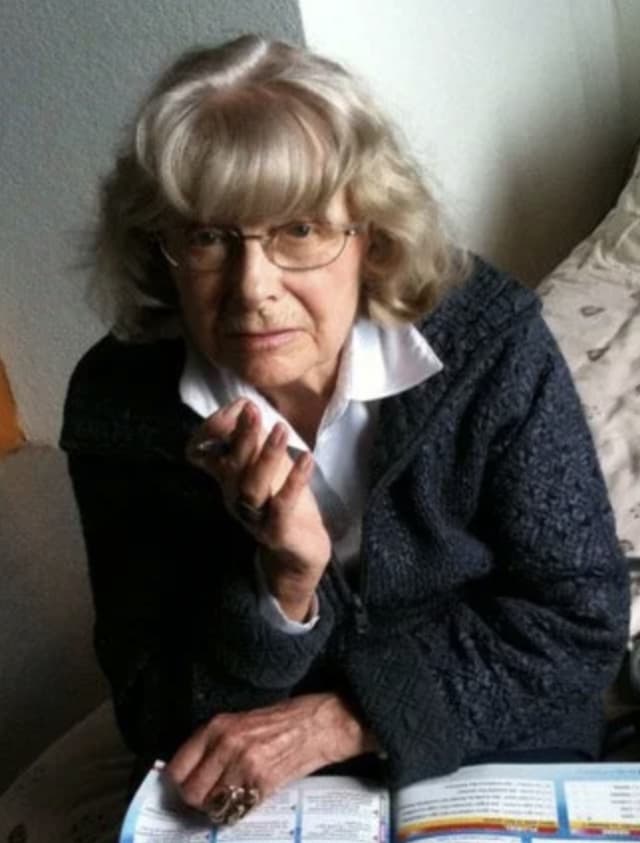
Jacqueline PaulhanITW: Hello, dear Jacqueline Paulhan. Thank you for welcoming us to your apartment, rue des Reculettes, in Paris, to tell us about Jean Paulhan, your father-in-law. But first, and although I know you don't like it very much, I would like you to tell us about yourself. For all those who have not read, for example, your autobiography, Une Petite Fille fragile...
JP: Yes, there are many who haven't read it, because it still hasn't been published.
ITW: So, for all those who are not privileged, who have not read the extracts published by Françoise Champin in her magazine, I would like you to tell us a little about yourself, who were your parents, and where exactly were you born?
JP: I was born where I didn't want to. I was conceived in Canada, carried in America, carried back to sea, and my mother almost gave birth at sea. But she managed to hold back, according to the doctor's advice, and she gave birth in Le Havre where she dropped me off, just like that, by chance. I didn't stay very long in Le Havre. We then went, I think, to Grenoble, and in the meantime I fell ill, so much so that I was sent to [lézin?]. I returned to Grenoble, and began a long career of operations and illnesses, which prevented me from going to school. I only wanted to go, since I couldn't go there. I ended up doing decent, normal studies, but a year late, all the same.
ITW: And who were your parents?
JP: My father was a literature professor, my mother was also a literature professor, and both were from very, very simple, very modest origins. My father's parents were pastry chefs, my mother's parents were minors, well, the parents, the fathers.
ITW: We come to Jean Paulhan, when exactly did you join Jean Paulhan's family?
JP: That’s very curious. We are my sister and I, Colette and myself, we are of Protestant origin, and we received a Protestant education. My sister went to the United States, she was much more religious than me, she worked in a choir at the temple on rue Madame, and I decided to go to this choir to give my sister some news. And then, there was a man there, who sang, who had a very beautiful voice, who sang all wrong (laughs), and I asked him if the tonality was too difficult for him. He told me yes. I told him, I'll put it in C Major, if you want, or G Major. So he said to me: "well, whatever you want", so I made him the transcription in C Major, then I took it to the mailbox on rue des Arènes. This gentleman was called Frédéric Paulhan, and then we met again, and he didn't know a bit of music theory. C Major was no better than D minor or D Major which was in the score, and we hung out, and decided to introduce myself to his father. I remember, I arrived in Jean Paulhan's room, he was completely distraught - distraught because it was perhaps his son's fiancée, because I believe that all women panicked him, and he gave me a book... he gave me a book like that, to hold in my hand, which was of modest size, and he asked me if I had read it, I hadn't read it. He gave me a second one which was much larger, on the small one, and a bigger one and a bigger one, then up to the large format book, you need a whole arm to turn the page, and you can't read anything, because there are 3 words per page. And I could no longer stand up, it was too heavy, I looked for a chair, they were all cluttered with books, I got on the bed, bursting out laughing as I put down all the books, and that was my first meeting with Jean Paulhan.
ITW: And had Paulhan's reputation reached you?
JP: Ah yes, I knew him, it was a time when he had problems with the press, I read all the articles, I knew, yes.
ITW: What era was that? 1950?
JP: I'm confused with the dates, 1949? Maybe? No, I don't know the dates.
ITW: And what effect did the Maison des Arènes have on you? Did you imagine that you could live there one day?
JP: No, I didn't think about it for a second, I was visiting, no no, I didn't think about it for a second.
ITW: Did you like the building and the premises?
JP: I didn't pay much attention, no, I was interested in the books that Jean Paulhan put in my hand, I barely had time to read the titles when he gave me another one, it was mutual panic.
ITW: And then you and Frédéric got engaged?
JP: Yes, a little quickly, because he told me that he was going back to Madagascar and that he would happily wait the three years, but I told him that I wouldn't wait for them, that I would be married after three years, it's true.
ITW: Madagascar, do you remind us what his profession was?
JP: He was a colonial administrator.
ITW: And what were the books in your hands that Jean Paulhan had given you?
JP: Completely forgotten.
ITW: And at that time, did you also see Germaine Paulhan?
JP: I saw Germaine, not that day, a little later, when the engagement was official, because that day, Frédéric announced that I was his fiancée, but there was no question of it. It wasn't an idea I had in my head. And then it was more official. At that time, I knew Germaine and Germaine was very nice. She was very kind to her stepson, Frédéric, who was very grateful to her. She was very kind to me too, but she was very ill.
ITW: And you also knew Frédéric's real mother,
JP: Frédéric's real mother? Oh no, no, no, not at all. Oh no, she had died long before.
ITW: Was Sala dead?
JP: Frédéric's mother? Oh sorry, I was thinking of Jean Paulhan's mother, no, no, no. Frédéric's mother, yes, yes, I knew her very well. She was a Polish Jewish woman, blonde, who had had a lot of misfortune in her life. She had an artificial leg, because she had had a serious accident. And she ran a bookstore. And my goodness, she struggled a lot to live, and it was difficult for her. And she welcomed me very well too, and even once, with a word that almost hurt me a little, she said to me, "finally, an intellectual." Because I suppose that Frédéric must have introduced girls who didn't seem intellectual enough in his eyes, something like that, but it hurt me (laughs).
ITW: So you have arrived in Jean Paulhan's family.
JP: ...hurt for others, not for me. Yes.
ITW: A quick question.
JP: Yes.
ITW: Sala had sisters. Did you know them well?
JP: Ah yes, I knew them very well. Much more than Sala, because Sala died during our stay in Madagascar. When I came back, Lola and Stépha were still alive. Stépha was the wife of Léon Brillouin, a nobleman, and who was also a minister under Pétain, which caused him a lot of harm. But it was his turn to be minister, that's all. C'est un scientifique de très haut niveau. He invented the elements of the transistor. And the second sister was called Lola. She ran a haute couture boutique, and they both had temperaments! But I especially remember Lola, because Stépha and her husband Léon Brillouin lived in the United States. While Lola lived in France, and every Christmas, we had a big evening, the whole family, at Lola's house. And there was caviar, a one kilo can of caviar! and there was a beef tongue. And I didn't like caviar very much, but above all there was too much of it. I was the only skinny one in the family at that time, and I always heard Aunt Lola say: “Jacqueline, are you skinny? Well you finish the caviar." So I finished the caviar and I couldn't take it anymore. And it was the same with the beef tongue. I absolutely came out with general indigestion.
ITW: Do you remember what impression your father-in-law made on you, the first impression with Jean Paulhan?
JP: Ah, someone very kind, very attentive, very kind. The impression was good. She was confused in my head, but she was very good.
ITW: Did he give you any advice?
JP: None, I didn't ask for any.
ITW: And how did your relationship gradually develop with your stepfather?
JP: But when we moved in, rue des Arènes. When I returned from Madagascar, I didn't want to go back to the colony because I had Jean-Kely, my son. You cannot raise a child properly in colonies. They are spoiled, rotten, pampered by the staff.
ITW: Your son was born in 1951?
JP: In 1951, in Madagascar. And I didn't want him to have his childhood, to have his childhood taken in Madagascar. So I stayed, Frédéric, my husband agreed. But we settled on rue des Arènes. And we only had one room, because at the moment, it wasn't for long. And we were hoping to find an apartment. We didn't find it, naturally. At that time, it was nowhere to be found. But we were very good.
Subsequently, we had a little more pieces, we had two pieces. And even a third in the attic, which I discovered. But neither Jean Paulhan nor ourselves were able to get apartments. We crossed each other continuously. But it didn't bother either of us.
My mother was offended. She said to me, how can you live like that? I say, oh but it's going very well...
ITW: Exactly, tell us a little about this life on rue des Arènes. How was domestic life at home on rue des Arènes with Jean Paulhan?
JP: Well there were servants, who were the dragons of the house, who were very difficult to get along with, who took control of everyone. They were very dominant. And then there were the family meals, which were in the dining room. And we all ate together, including a nurse. There was Germaine, who we carefully lowered, who could still walk... You know, I blink, because in fact, the sun dazzles me.
ITW: And you want us to change positions?
JP: No.
ITW: Okay, that will be cut during editing.
JP: Yes, but the lighting is very good.
ITW: We can pull the blind a little, but does that bother you or not?
JP: No, but why is it annoying?
ITW: No, the picture is perfect, so it won't be for you. There we go, let's start again.
ITW: Who were the people around the dining table?
JP: So there was the Choffe family, that is to say Odette and her husband, Frédéric Choffe. There were the four children of Odette and Frédéric. There was my father-in-law obviously, there was Germaine, there was Frédéric, there was me, and there was still the nurse. And then later, when the children were older, at that time, at first they ate at home, finally before the meal, they came to the table too. So it was very large tables, and everyone was very happy like that, it was perfect. And we talked, we talked a lot. And then suddenly there were great silences, but which were not at all awkward silences. It was that something important had been said, and everyone was thinking on their own. And then all of a sudden, the conversation started again, because we had found solutions, one or the other, and it was very curious. And in the morning at breakfast, it was more restricted, the people, the table, it was smaller. But I found in my bowl, in the morning, a little paper that Jean Paulhan had written during the night to give me an answer or a question, or something like that. And I responded with a little note that I put in his bowl the next morning, and we corresponded like that in notes.
ITW: I believe you have a daughter-in-law to father-in-law relationship, or did you have a more intellectual relationship? or more...
JP: Look anyway, it was a very good relationship. He addressed me informally, I addressed him informally. He would have liked me to speak to him informally, but I couldn't do it. He took me everywhere with him. Absolutely everywhere. I said that when there was Frédéric, who was in Madagascar, when he was there he took me with him. He gave us a lot of his invitations. We were among the firsts, etc. I went a lot with my father-in-law, and in particular, I went to see General de Gaulle, which was a big expedition. For my father-in-law as for me, he was like a young man that day. Really, he didn't look his age at all, and neither did I, because I was very young at that time, and I had a very beautiful outfit that my aunt Lola had lent me, and when we arrived at General de Gaulle's house...
ITW: What occasion was that?
JP: We brought together the intellectuals.
ITW: With Malraux perhaps?
JP: Yes, yes, there was Malraux. Jean said to me: “I’m announcing Mr. Paulhan, that makes it easier.” So we announced “Mr & Mme Paulhan”, and obviously there was a big age difference. I was treated to a very big, questioning smile from General de Gaulle, because he thought I was very young for this Jean Paulhan. And then I had some very funny encounters. In particular, I met... well, I met... I was staying next to my father-in-law, and there was an academician who was always with us. And Jean Paulhan was a little angry, and then when he came home, he said, you know, I don't know this academician, but he wouldn't take his eyes off you, didn't you realize that? I say no. Because I usually never see him, he couldn't let go of us. And during the night, this academician died. So, the next morning, Jean Paulhan said to me, “you see, you killed him!” He didn't give up.
ITW: So, I know your father-in-law liked to play,
JP: He played a lot.
ITW: What were these games?
JP: So, the card games, where he cheated a lot, but I saw him doing it (laughter). I planned things. We played heart on hand. It was a game of many degrees, and it was very strong. And me, who looked stupid, there was a way to counteract the effects of the first games. I did it regularly, and no one could believe it. So that pissed him off, because I was winning. There was another game, it was...
ITW: The diamino?
JP: ah the diamino, yes. The diamino was a letter game, which preceded the... what we play now, what is it called, this letter game.
ITW: Scrabble?
JP: Scrabble. It was less interesting than Scrabble, but Jean Paulhan really liked it, because it was words. He prepared very complicated little words in his jacket, and we saw him, during the game, take out words, try to place them... And then he wrote words with bad spellings on purpose, saying, “but it’s also spelled like that.” It was part of his cheating. In boules, he didn't cheat! Boules, for him, was a very serious game. And every Sunday morning, we played bowls in the Arènes de Lutèce, and I went there, not for the love of bowls, because it didn't interest me much, but because we met lots of very interesting people there, and we talked at the same time as we played bowls.
ITW: Did you go to his office, rue des Arènes?
JP: Ah yes, yes, yes.
ITW: Did you ever help him with letters or secretarial work?
JP: No, not really, not really, especially not at the beginning. He had a secretary who had to arrange his books for him in the library, so he installed her in the library. Then after two hours, he went up to see if everything was okay, he found her completely naked. It absolutely annoyed him, he sent her away. He had a secretary, no, another secretary who stole his books. So it also annoyed her when I pointed out to her that it was every day she came that books disappeared. And then, we had others who were more or less serious. It didn't work much. I was very discreet, I didn't worry about it at all. But a few times, I was tidying up his room and there were manuscripts in a pile. Then I found a manuscript that interested me. I put it on top of the pile and then found it at the bottom. So I put it back on. Then the third time, I put a little note “I find this manuscript interesting”. So he read it and he published it, and he got a price. So, I was very happy. And then, a book by Eric Westphal, I don't really remember, La Manifestation, something like that. And he asked me to write articles for the NRF, on cinema. I didn't want to, because I didn't have any cinematic culture. And so, he made me do one on a book, on a very pretty film, I think, Les Nuits de Cabiria. And I told him, I'm going to give you a report that will be lively, that will be good. But I couldn't put it in the cinematic context. I don't know anything about cinema, I have no cinematic culture. And when he read the article, he absolutely agreed with me. And the article did not appear. But he asked me to do book reviews then. He said to me, well listen, I'll give you two, there's one that's really bad. You will give the arguments why it sucks. The other one is good, you tell me why it is good. And I read the two novels, and then I didn't agree with Jean Paulhan. No matter how much I reread them, no, it's not possible, so I said "listen Jean, I'm sorry, but the rubbish one is the one I think is good". And I gave my arguments. “And the good one, I find it useless.” So he kissed me, he said, well done, that's exactly it. I misled you on purpose. But I didn't do any articles, because at that time, I was pregnant with my daughter, I got sick, and everything fell apart.
ITW: In 1953?
JP: Yes, that way. 1954.
ITW: In your private conversations, did Jean Paulhan sometimes talk to you about two women who had counted a lot in his life, Jeanne, his mother, and Suzanne, Aunt Suzanne.
JP: When I talked about his mother, he remained thoughtful, he touched his eye, which was a sign of emotion, and he diverted the conversation. He never spoke to me about his parents, nor his aunt, nor his mother. Nor his father.
ITW: From his father, right?
JP: Never. Never.
ITW: And the grandfather? Grandfather Jean?
JP: Never, either. Neither.
ITW: So, family life was organized like this on rue des Arènes, and I believe that he also had a passion for animals.
JP: Oh, terrible! Terrible, we had animals running all over the house on rue des Arènes, and causing damage, which we then had to take to the Jardin des Plantes or the vivarium, because we could no longer stand them. I remember a little fennec who was very pretty, very cute, but who relieved himself in the paintings, so it wasn't allowed. We had to take him to the Jardin des Plantes... We had a little hamster. This little hamster disappeared for several days. We heard him screaming... We found him stuck against a boiling hot water pipe, he was suffering, poor thing. We had difficulty getting it out of there, in very bad condition, so we also took it to the Jardin des Plantes because it got lost in the house. We had a monkey, a little monkey who smelled bad. What did we get?
ITW: A chameleon, right?
JP: Well, not in my time, no chameleons. We had cats, lots of cats, a little ginger cat, and I remember a rather amusing anecdote. René-Louis Doyon came early one morning, on a Sunday morning, at 7 a.m. to see Jean Paulhan. Obviously, when I opened the door to him all sleepy, I told him I don't think he's awake yet, it's a little early. — Oh well, I didn’t realise, etc. And he was very, very embarrassed. And then out comes the ginger cat, this ginger cat, and he says, oh, how beautiful this cat is! Then you know, it must be a very good ratter because ginger cats smell bad. It's like men. And at that moment, my sparkling red-haired son comes out of the office, he sees him, poor René-Louis Doyon, I thought he was going to faint. He no longer knew how to get out of it.
ITW: Since you are talking about René-Louis Doyon, who were the other people you saw, rue des Arènes, who come to mind?
JP: I've seen a lot of them. Pierre Oster, Alain Robbe-Grillet, Jouhandeau, many, Jouhandeau. Many that don't come to mind...
ITW: The Ponge family, Audiberti?
JP: Yes, yes, Audiberti, of course. But I remember that there was a ritual, it was the fruit juice ritual. At noon, Jean received his friends and I had to go up to make him a fruit juice with a device called Turmix, of which he was very proud. So I made some juice, served everyone and left. But one day, I didn't go because I was detained, he told me, "Jacqueline don't go, André Breton will come." And André Breton knocked on the door, they had lost touch and even been angry for a very long time and I saw Breton enter, I did not see Breton's expression. But I saw the one Jean who lit up with joy to find André Breton. They kissed, hugged, etc. And then Breton turned to me and said, "can I mark our newfound friendship with a kiss on the forehead of this beautiful child?" So I was kissed by the big lips of André Breton.
ITW: And have you seen Francis Ponge as well?
JP: Of course, I saw Francis Ponge.
ITW: Pascal Pia?
JP: No, Pascal Pia I saw it myself.
ITW: After the death of Jean Paulhan.
JP: After Jean Paulhan's death, I did not see him during Jean's lifetime.
ITW: And we hosted writer or painter friends for lunch on rue des Arènes?
JP: Very little, because we lacked dishes. And we couldn't, I remember once, we wanted to invite two people and we made a menu, but it was in the evening, we didn't have enough soup plates, so we left out the soup. We said, we're going to make a salad, but we didn't have a salad bowl, so we left out the salad. And it was like that, step by step. We had to serve rice and ham, because we had nothing at all to cook with. It was extremely painful.
And I remember that when we broke something, for example a teapot, we would go to the cellar and throw the teapot away. We looked for a less broken teapot among all the ones we had thrown away, and we put the teapot or coffee pot back together.
We lived in a certain difficulty.
The curtains were eaten, the windows were broken, etc. We glued them back together with tape, it was very shabby.
And we couldn't do otherwise. Until the day I decided to propose to Jean, telling him, we have a lot of free rooms, since the Choffés left, and instead of leaving them empty, we could rent them to students. My stepfather said, “but what a great idea! That’s what my mother did!”.
So I started repainting, redoing bedspreads, etc., reinstalling rooms. We rented these rooms, we rented them very easily. Firstly because we rented them very cheaply, and secondly because people realized that they were going to Jean Paulhan. So they were happy to go there. And we had very nice, very cooperative students who helped us a lot. I remember there was one called Raoul Gila, who was a Romanian actor and he had a lot of parties, and he always invited me. He even had the sister of the Queen of England at his home, in his room! He came to pick me up quickly, but I wasn't there.
ITW: I think he had a tragic end, this actor...
JP: He got killed. But not rue des Arènes. When he left Rue des Arènes.
ITW: So tell me, since you tell me that you did the work to furnish these rooms, to be able to rent them, tell us what you did for the paintings and sculptures in the dining room, in rue des Arènes. Did you tinker with something to be able to install them, highlight them?
JP: Finally, we had built, I had made a plan for a rack to put the paintings. I didn't build it myself, but it was built by, I think, a carpenter.
ITW: According to your idea?
JP: According to my idea. They were arranged by size, because we couldn't do otherwise. They were stored in the field, and could be taken out very easily. And then they were accumulated everywhere. We couldn't display these paintings, and we didn't have enough space to put the books. Because when I arrived at rue des Arènes, I went to the attic, and in the attic, there was a large entrance room, and we literally rowed among the books to get around. They had to be moved to make their way through the books. So I suggested to Jean that we classify them, sort them, make shelves. I made a bunch of shelves in this attic, and I put books in there and we found them. It was much more convenient, and my father was very happy. With this favor, thanks to this tidying up, I found a small room which I said I was going to make my office. It was all under the slope. There was a skylight that big, and you couldn't stand up everywhere. I said that I would like to take this little room and make an office out of it. Ah, he said, “it was my mother’s.” It had touched him a lot. I had this little room that I sat in, but it was very worrying, because on windy days it would shake. Nobody wanted to believe me, but it was true. Once, I had a witness who said “But yes, she moves!” »
ITW: At the time of preparing the complete works, there was another student, a slightly older student who came to join you, it was Jean-Claude Zylberstein. How was it going?
JP: Jean-Claude Zylberstein was very skillful, he was very intelligent, he knew the work of Jean Paulhan well, and he immediately won over Jean Paulhan and he did the complete works with Pierre Oster and another third character whose name escapes me, who have since died, and they worked a lot. But Pierre Oster, I remember that it was me who initiated the request, because Jean-Claude Zylberstein wanted to find someone else to help him, and I remember, I said to Jean Paulhan “But why not Pierre Oster, but he will never want to?” »And to our great surprise, Pierre Oster accepted straight away.
ITW: We're going to take a look at the people you might have seen or met at... the Arènes, for example Jérôme Lindon.
JP: Yes, I met him at the boules. He was a fierce Gaullist.
ITW: What was his relationship with Jean Paulhan, in your opinion?
JP: Very easy.
ITW: Brotherly relationships between publishers.
JP: Yes, that's it.
ITW: Maurice Toesca?
JP: Maurice Toesca, I saw him a lot too, he was a good bowler, I really annoyed him because I played like that. “You don’t play with your heart, you play with your head”, not the opposite, “you don’t play with your head, you don’t think, you play with your heart”. I said “That works for me!”, Ah he wasn’t happy.
ITW: Were they bowl games that were organized after lunch?
JP: No, in the morning.
ITW: Did you see Blanzat too, when you played boules?
JP: Blanzat came to play bowls, of course, he came to the house too.
ITW: He was a neighbor, I think?
JP: He was a neighbor, he lived on rue de Navarre.
ITW: Yes. There's a famous anecdote... you didn't see it, because you weren't married yet. This is the history of the Arènes mimeograph.
JP: Ah yes, it's not an anecdote, he helped Jean Paulhan in the middle of the night to break the mimeograph into small pieces and carry it, "strong as a Turk" said Jean Paulhan, to carry it, to throw it into the Seine.
ITW: Did you accompany Paulhan to the NRF as well?
JP: Yes, he invited me to his office several times. I met people who were coming and then I came to all the parties that were given before the summer at the NRF, where there were a lot of people. It was very interesting, we really met the elite of literature.
ITW: Do you mean Gallimard cocktails?
JP: Yes.
ITW: Yes because there was still a literary life which no longer exists. There was still a literary life which no longer exists. For example, you were also invited to Florence Gould's house, right?
JP: Yes, I often went to Florence Gould. Yes yes. I remember.
ITW: At the Meurice Hotel?
JP: At the Hôtel Meurice. But I had seen Florence Gould before my marriage, we went with Frédéric, and she had asked us, she had in her dining room, a painting by an old Italian master, a very beautiful painting and she had a lot of things in this room. She told me, Jacqueline, choose what you want as a wedding gift. I chose a small transistor device because I knew we wouldn't have electricity in Madagascar and Jean, my father-in-law, said to me "why didn't you ask for the table? I was so hoping that you would ask for the table", I said to him "but look, I didn't dare!".
ITW: Since we're talking about paintings, do you remember the paintings that he liked to highlight and that he liked to have next to him?
JP: Chirico, Dubuffet, Braque. There were several, he had them within sight.
ITW: And in the dining room, were there any?
JP: In the dining room, there were Fautriers, the dining room was dedicated to Fautrier. There were large paintings by Fautrier, one of which had been torn up by Fautrier himself because he did not find it beautiful, and then there were drawings also by Fautrier.
ITW: There was a weird character at the NRF.
JP: Yes, there were a lot.
ITW: But among them, Roland Purnal. Was he coming to the Arena?
JP: Yes, he was coming. He came to have lunch with us. He was in terrible poverty and had absolutely extraordinary dignity. I don't know where he lived or what he did. I know that he corrected the tests at the NRF, and he corrected them so badly that they had to be redone behind him, and that they gave him an office which according to Elizabeth Porquerolle was a cupboard! But really, it was as cramped as a closet. There was room to put a chair and a board.
ITW: Elizabeth Porquerolle... tell us a little about herself.
JP: She was a neighbor from a geographical point of view, she lived in a very neighboring street parallel to rue des Arènes. She had...
ITW: Writer herself?
JP: She was a writer herself, very original, in all areas in fact, and she couldn't stand Dominique Aury. Because Dominique Aury was not from Nîmes. Whereas she was Nîmoise! So it was she who had to be with Jean Paulhan and not Dominique Aury. That was his reasoning. Not so wrong anyway, because Jean Paulhan had a weakness for the Nîmes. For Yves Bergé, for Marc Bernard, etc.
ITW: Regarding Jean Paulhan's Nîmes origins, did you sense a Protestant culture in the Paulhan family?
JP: Yes, because when it comes to money Protestants are very strict. We don't like little shenanigans, etc. And that was very clear in Jean Paulhan. And then...
ITW: Moral rigor?
JP: Sorry?
ITW: A certain moral rigor?
JP: Moral rigor in all areas. But Jean Paulhan liked to lie, liked to cheat and announce that he was doing it.
ITW: So it wasn't lying anymore?
JP: It was no longer a lie. He said, he even wrote once to his mother, "I could no longer lie, yet it feels so good to lie."
ITW: Did Pierre, Frédéric's brother, live at the Arènes?
JP: No, never. Never.
ITW: We're going to talk about some familiar people from rue des Arènes. Perhaps you have also met the seamstress Florence Jonquières?
JP: Florence Jonquières is not a seamstress. She was a weaver and musician. She was a friend of mine. So there was an editor called Henri Jonquières who edited the correspondence of Goethe and Eckermann and who met Jean Paulhan once but they didn't know each other.
ITW: And Florence Jonquières, so you say she was?
JP: She was my best friend at the time. And my son's godmother. She studied music, she has a degree in music and piano, and she did not break into this profession, which is very difficult. She did hand weaving and now I don't know how she lives, it's very difficult.
ITW: She lived on rue des Arènes?
JP: Never.
ITW: She never lived on rue des Arènes, did she come regularly?
JP: Never. When she came, it was to see me, but there was no connection with Jean Paulhan.
ITW: But there was the Dunant family who frequented the Arena. How did you get to know them?
JP: So there is Pierre, what is his name?
ITW: Frank?
JP: Franck Dunant was studying cello with Pierre Fournier and he had nowhere to rehearse. So I offered him my office and told him I still have to ask my father-in-law if he doesn't mind hearing the cello working. So he did two or three days of rehearsals in my office which was still on the top floor under the attic and we could hear him in the house but only slightly. My father thought it was magnificent. We were very happy so he came to work every day for a year.
ITW: Jean Paulhan thought it was magnificent?
JP: Yes, yes. I think his father played the cello, right? I wonder.
ITW: And we listened to music, rue des Arènes?
JP: Not at all, my father was not a musician at all. But not at all. He loved this composer who makes extremely funny songs... Satie! He loved it for its titles but not for its music. He had received a Satie record and he immediately gave it to me, saying “you tell me if it’s good. I don’t want to listen to it”. That didn't interest him.
ITW: And so, rue des Arènes, at the NRF, you met other writers, other friends of Jean Paulhan?
JP: Yes. I would rather like to name names.
ITW: Jouhandeau for example..
JP: I saw Jouhandeau a lot, a lot.
ITW: He was coming with his wife?
JP: Yes. She had burning eyes, she was extraordinary but she was unbearable.
ITW: Elise...
JP: Yes, Elise... He called her Cariatis. They both came to Florence Gould's house too. There is also Barbara Church who played an important role in the friends of Jean Paulhan. She was also a rich American, who had a beautiful property. I met Mandiargues a lot, whom I liked. I remember Mandiargues once taking me to Barbara Church on a sleet day and in the car, at full speed, and saying to me "you understand Jacqueline, on a sleet day I'm like everyone else. I'm archmyopic, I see nothing, but no one sees anything on a sleet day. So I go for it".
ITW: It was in the Paris suburbs... They had built a villa in the Paris suburbs. You haven't known Henri Church? Barbara's husband.
JP: I don't remember but Barbara Church, very good.
ITW: They were those who more or less financed the journal Mesures.
JP: That’s it.
ITW: Jacques Audiberti was also coming?
JP: Yes. He even took a room.
ITW: Oh yes?
JP: It didn't suit him. Yes, he was loaned. But it didn't suit him. Jacques Auiberti was perpetually dissatisfied. He spent his time moving, looking for rooms that never suited him.
ITW: Did he come with his daughters sometimes or not?
JP: No. I met Marie-Louise Audiberti after the deaths of Jean and Jacques.
ITW: So we're going to talk if you want about a slightly later episode. This is the episode of Histoire d'O. How are you?
JP: The Story of O, it’s funny, it happened. It reached my ears through the press. And I spoke to Jean Paulhan about it. He said yes, yes, it’s a very beautiful book. So I say, but I would like to have it. He says, I don't have many. Anyway, I'll see if I can find any. He was very embarrassed. I started again. He says, but no. I don't think it's for you. He didn't want me to read it. Then I was very obedient so my goodness, I didn't read it. But at that time, I was a young teacher at the Claude Monet high school, in a men's high school where there were only male students and teachers. And as soon as I arrived at the refectory, it was the Story of O. But I didn't read it and it was very irritating for me. So one day I said, lend it to me. And then like that, I'll tell you what I think about it. So they lent it to me and I read it twice that night. I really liked it, because of the slowness, the fantasy, etc. And the next morning, at breakfast, I said to my father-in-law, "guess what I did last night." So he said to me, I don't know. But you, we can think of anything. So I told him “I read the History of O”. Can you guess what he said to me? “finally!”. He got up, went to get me one, and gave it to me. He didn't want to give it to me himself. He feared my reactions. He was very happy that I liked this book. He received abundant correspondence which concerned me, which he transmitted to me. Finally, abundant, quite important, where it was believed that I was the author of Histoire d'O. And I always told him, but I wouldn't hide if I had written this book. I would be beaming with joy.
ITW: Do you remember seeing Dominique Aury at Les Arènes even once?
JP: Very often.
ITW: She was coming there.
JP: She didn't show herself too much because she didn't want to bother Germaine.
ITW: Dominique Aury?
JP: Yes, yes. She didn't want to bother Germaine. But she was coming. She stayed downstairs. She was talking to me. And then, she took Jean in the car, where they had to go.
ITW: So, another episode in the life of Jean Paulhan is his election to the Académie Française in 1963.
JP: Yes. It was very weird. He didn't know if they wanted it or not. He didn't feel recognized by the general public and he is still not recognized, I believe, by the general public, at least in France, because abroad, when I say my name, it makes waves. In France, not at all. It’s even surprising! I believe that the Academy, for him, was a way to be recognized and indeed, it was true. It paid off a bit, if I may say so. But it also killed him.
ITW: Why is this?
JP: Because he took care of General Weygand and he made a speech and he said “born of unknown father”. And we told him, if he... he received threats, threatening letters, if he said these words, they would kill him, I don't know what.
Empty threats, well threats all the same. And he said them, obviously, he was not afraid.
But it disturbed him a lot, because for him, it was even a compliment to be born to an unknown father and to reach so high. He meant he had taken the steps. He was not born with a silver spoon, as they say. And that troubled him a lot.
And then he went to Academy meetings. Each time he came away very disappointed. He said, "we didn't take care of the vocabulary, we didn't take care of the grammar, we only read speeches." But it bothered him immensely.
I drove him to the academy once, because Dominique Aury was not free. I had a very small dauphine, one-eyed, missing a headlight, very small, and when he entered the dauphine, the saber curved at a right angle. He said, "do something to my sword, it will bend." I don't know how we got the sword out of that little car.
But it was very difficult for him, in all his capes, his cocked hat, to get into the car. And when we arrived, all the other academicians arrived in black DS, in magnificent cars, it didn't look good on my little light blue dauphine (laughs).
ITW: Her outfit, how was it prepared? and accessories?
JP: By Florence Gould. She was very beautiful. It suited him very well.
ITW: There was a sword too.
JP: So, the sword is now in Nîmes. The drawing was made by Wogensky. She is in Nîmes. It was given by the family to the city of Nîmes, after the centenary of the birth of Jean Paulhan.
ITW: There was a little critter on it?
JP: A crocodile. Which is the emblem of Nîmes. But I wonder if this is a sword that was made of gold. I wonder if it's really gold... Because she made a big stain on the gold on the box. Gold is unalterable, finally.
ITW: You felt a change in Jean Paulhan's relationships, after his election, did you talk about it?
JP: He hadn't changed.
ITW: No, but the others. The gaze of others.
JP: There were people who were jealous. There were people who thought he had broken his word, because for a long time he had said he would never enter the academy. And then there were some who were delighted for him, and then others who were indifferent.
ITW: I would like to come back to an aspect of Jean Paulhan's personality that you spoke about earlier. It's... his playful side. He also had a passion, I believe, for fairs and fairs.
JP: Yes, for the fairs, the fairs that he tried to take us to, but I never had time to go, but we had a lot of trouble preventing him from entering a cyclotron. I don't know if you know what a cyclotron is, it's a hollow cylinder, but which is 4 or 5 meters in diameter, all the same, and which is 2 or 3 meters high, and which rotates. We sit down, and it spins faster and faster. So thanks to centrifugal force, we are pressed against the walls, we can climb along the wall, we can take any position, feet in the air, fingers in the nose, but it turns very, very quickly. And then all of a sudden, it stops spinning, so we fall heavily back down. We didn't want, at his age, to let him enter the cyclotron, because naturally he had heart problems, it was dangerous, but it was very, very difficult to stop him!
ITW: How do you explain this constant passion of Jean Paulhan, both for the game, and for funfairs, for lunaparks, for young people?
JP: I think he still had a childish side. Toys interested him, and he bought toys for the children. You could tell it was for him, because he played with it for a good while.
ITW: The lure of the forbidden, perhaps, because it was so different from the education he had received.
JP: No, he had toys when he was little, he had a lot fewer.
ITW: No, toys, but not play.
JP: Yes, I don't think he was banned from the game.
ITW: Have you ever been to a fair with him and your kids?
JP: I don't remember anymore.
ITW: At the Saint-Germain Fair, for example?
JP: I don't remember anymore.
ITW: We find this among many writers of the 1920s, the attraction for fairground attractions, for these things.
JP: Yes, undoubtedly. Gide was also interested in it, I believe.
ITW: And he was a player, apart from..., was it relaxation? apart from its...
JP: It was a relaxation, we also played bridge in the evening, and I never had time. I was studying, I had two children, I lived in one room, and life was very, very uncomfortable. And I always managed to be dead. Because when I was dead, I could go and put something away to wash the dishes, or whatever. And I was reminded that that’s it, the game is over! I wasn't playing very well. I learned to play bridge when I was 7 years old with my parents, because someone was missing to play dead and they said "Jacqueline will play dead". And at 7 years old, I played remarkably well for a 7 year old girl. But I don't think I made any progress, I still played like I did at 7 years old, that is to say, still not very well.
ITW: Your children were little when Jean died, but what were their relationships like?
JP: Oh they loved their grandfather.
ITW: And things were going well on your side too, on your grandfather's side?
JP: Oh yes, yes. I think... the children ate before us. So they stayed in the bedroom adjoining the dining room. And Jean-Kely invented extraordinary things to get us to come, because he found himself isolated, I think, so he stuck his toe in the lock and said, "I'm in trouble! I'm in trouble!". So we came, it was an extraordinary gymnastics to get our toe in the lock. Or he did something else of the same kind, he had a lot of imagination. He would fill the sink and then he would remove the siphon under the sink. And naturally, we emptied the sink which emptied onto the floor, he was absolutely delighted. Or he would rub the ointment on the floor to polish it. We could no longer remove this ointment. He had a lot of imagination and he was very funny.
ITW: And the grandfather was patient in the midst of all this?
JP: Very patient! But I even believe once that, when they came to the table and were aware of the honor given to them and that they behaved rather well for children, they found them too well behaved. I remember them saying to Jean, asking, “could I have some yogurt please?” You don't ask for yogurt like that, Jean. We do: “Yoghurt, yogurt, yogurt!” So naturally Jean did that, but then he did it to others too. It was more embarrassing...
ITW: Were you aware of the importance of your father-in-law in the literary world?
JP: Oh yes.
ITW: And you had literary discussions? There were controversies, a lot of controversies?
JP: A lot, we talked a lot. With an open heart, really very easily about everything we felt while reading, he recommended books to me and he asked my opinion all the time. He listened and refuted what I said. He refuted my arguments or he kept them but in the end we talked about it a lot and that's when silences arose. Everyone thought about their arguments before starting the discussion. Silences that weren't at all awkward.
ITW: Very good. Tell us about the countryside trips to Boissise, for example. Was it usually Sunday?
JP: For us it was Sunday or the days when I didn't have classes and Frédéric didn't work it was Saturday and Sunday. But Dominique Aury had us build a small apartment with a large bedroom and a kitchen and a bathroom. Really very kindly. We were very happy to meet again. And we played bowls and we played croquet. Oh yes, I forgot croquet. I forgot the frog too. We threw rings into a frog that had its mouth open. And Jean Paulhan, naturally, sent the rings into the frog's mouth. Us, next door. It was normal.
ITW: And who was cooking?
JP: There was a servant who was a guardian of the house also in the absence of Dominique and Jean. Who did the cooking and then Dominique also did the cooking. Maybe me too, I don't remember anymore.
ITW: This naturally leads us to talk about vacations, did you spend a vacation with Jean Paulhan?
JP: Never. We spent a vacation by proxy, if I may say so, in Port-Cros. Because Jean Paulhan wanted us to go to Port-Cros. He kept such illuminated memories of this island of Port-Cros, of which he had set up the... installed the fort to make it a vacation resort for the NRF. He was enlightened when he spoke of Port-Cros.. He said "Jacqueline, we have to go to Port-Cros, with the children, with Frédéric, etc. and we couldn't afford to go to Port-Cros at all.. He told me, we will go to [Toi Tons], it won't be very expensive... We just couldn't! So I believe that either he paid out of his own pocket, or he asked Madame Henri to receive us for free. Finally, we had free accommodation and food for a month in Port-Cros. It was very pretty. We followed in his footsteps. We were able to experience what he was talking about, we were able to go up to the fort, etc. Finally, it was very interesting. And I understand that he loved this enchanting island very much. Very pretty.
ITW: Did you get the impression that family meant a lot to him?
JP: For Jean Paulhan? Oh yes! Family was important. And he was very happy to get closer to his son Pierre at the end of his life, they were separated. Well, they were a little angry. And, whether it's Dominique Aury or it's thanks to me, I don't know, but finally, he got closer to his son Pierre and his daughter-in-law Raymonde who is very, very nice and who is still alive.
ITW: And how did that manifest itself? Did he ever give you advice on how to live your life?
JP: Oh yes.
ITW: What kind?
JP: Yes, but he was very helpful. There are always times when we slip a little and he brings me back on the right path.
ITW: Was that practical advice?
JP: No, for reflection.
ITW: And for the education of Jean-Kely and Claire's grandchildren, right?
JP: No, I think he thought I was doing well. Finally, I was doing the right thing. I felt afterwards that I had been a little harsh with my children. And I told them, I told them that I had still been a little bit harsh. “Oh but not at all, we are very proud of the education you gave us.” What more could you ask for?
ITW: And who were the other artists in the field of pictorial art? If you want, Fautrier, Mario Torral...
JP: Mario Torral was a friend of mine who met Jean Paulhan, who was Chilean. This is a Mario Torral art painting is here.
ITW: They came to rue des Arènes?
JP: This Mario Torral really liked Claire Paulhan, the little girl. He took care of it a lot. He gave large sheets of paper, brushes and...